Overview
Few animals capture the spirit of the American West quite like the pronghorn (Antilocapra americana). Streaking across open grasslands at breathtaking speeds, this uniquely North American species is a living testament to millions of years of evolution on a continent that once teemed with large predators. Often mistakenly called an "antelope" — a name that still sticks colloquially today — the pronghorn is, in fact, the sole surviving member of the family Antilocapridae, a lineage entirely distinct from the true antelopes of Africa and Asia. It is a creature without a true parallel anywhere else on Earth, and for hunters, wildlife enthusiasts, and conservationists alike, the pronghorn holds a place of special reverence in the tapestry of North American wildlife.
In states like North Dakota — a landscape defined by sweeping prairies, rugged badlands, and wide-open skies — the pronghorn finds a fitting home. For those lucky enough to draw a tag in North Dakota's highly sought-after lottery system, a pronghorn hunt represents one of the most exciting and visually stunning pursuits available to the modern hunter.
Biological Traits
The pronghorn is a marvel of biological engineering. Its scientific name, Antilocapra americana, roughly translates to "American antelope-goat," reflecting early naturalists' attempts to categorize a creature that defied easy classification. Though it superficially resembles African antelopes, the pronghorn belongs to its own exclusive taxonomic family, Antilocapridae, with no close living relatives.
One of the pronghorn's most celebrated characteristics is its extraordinary speed. Widely regarded as the fastest land animal in the Western Hemisphere and the second fastest in the world, the pronghorn can sustain speeds that most predators simply cannot match over distance. Unlike the cheetah, which achieves its top speed in short bursts, the pronghorn is built for endurance — capable of maintaining high speeds across long stretches of open terrain. This remarkable ability is believed to be an evolutionary legacy of the Pleistocene epoch, when North America hosted a diverse array of swift predators including the American cheetah, now long extinct.
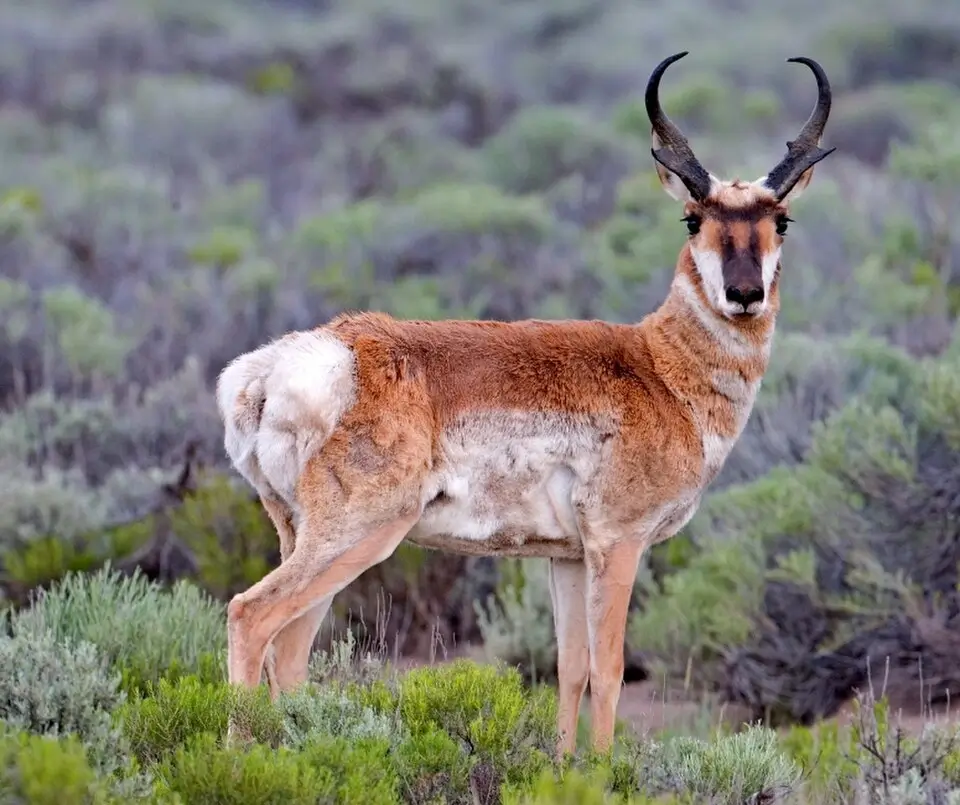
The pronghorn's body is purpose-built for speed and survival. It possesses oversized eyes — among the largest relative to body size of any North American ungulate — providing a panoramic field of vision that allows it to detect threats at remarkable distances. Its hollow, erectile hair serves a dual purpose: providing insulation in cold weather and allowing rapid heat dissipation during exertion. When alarmed, the pronghorn raises the white rosette of hair on its rump, a flash signal visible to other members of the herd from great distances.
Both males and females grow horns, which distinguishes the pronghorn from most other horned ungulates. The horns themselves are another biological curiosity: they feature a bony core covered by a keratinous sheath that is shed and regrown annually — a trait unique among horned animals worldwide. Males typically carry larger, more pronged horns (hence the species' common name), while females often have smaller, spike-like protrusions or none at all. The male's horns frequently exceed the length of his ears and feature a forward-pointing prong that gives the animal its most recognizable profile.
Pronghorns are highly social animals that typically live in herds, with herd size and composition shifting seasonally. During the autumn rut, dominant bucks establish territories and compete vigorously for access to does. Fawns — usually twins — are born in late spring and are remarkably precocious, capable of outrunning a human within just a few days of birth.
The pronghorn's digestive system is that of a ruminant, allowing it to process a wide variety of vegetation including grasses, forbs, sagebrush, and other shrubby plants. This dietary flexibility is essential to survival across the variable landscapes of the American West.
Habitat & Range
The pronghorn is strictly a North American species, found nowhere else on the planet in its wild state. Its range spans much of the interior West, from southern Canada through the Great Plains and intermountain basins of the United States, extending into northern Mexico. The species thrives in open country — grasslands, shrub-steppe, sagebrush flats, and semi-arid plains — where its exceptional vision and speed provide maximum advantage.
In North Dakota, pronghorn occupy the western regions of the state, where the terrain transitions from agricultural flatlands into the rolling prairies, mixed-grass rangeland, and dramatic badlands topography that characterizes the western Dakotas. North Dakota sits squarely within the Great Plains region, a landscape that has historically supported significant pronghorn populations. The combination of open visibility, diverse native vegetation, and relatively low human population density makes North Dakota's western counties well-suited to pronghorn.
Pronghorn are notably averse to tall fences and other physical barriers, as they tend to duck under obstructions rather than jump over them. This behavioral trait means that modern fencing practices can significantly fragment pronghorn habitat and impede the long-distance seasonal migrations that the species undertakes across parts of its range. Efforts to modify or remove fence barriers have become an important part of pronghorn habitat management across the West.
Seasonal movement is a key aspect of pronghorn ecology. In many areas, herds move between summer and winter ranges, sometimes covering considerable distances. These migrations often follow traditional pathways established across generations, underscoring the importance of maintaining connected, open landscapes for the species' long-term viability.
Hunting Information
Pronghorn hunting is widely considered one of the most exhilarating experiences available to the North American hunter. The combination of vast open terrain, the animal's sharp eyesight, and its willingness to cover ground at speed creates a hunting challenge that is both physically demanding and strategically complex. Long-range shooting, careful stalking, and thorough scouting are all essential components of a successful pronghorn hunt.
In North Dakota, pronghorn are classified as a big game species, and licenses are allocated through a lottery system administered by the North Dakota Game and Fish Department. As with other highly prized big game species in the state — including bighorn sheep, elk, moose, and deer — demand for pronghorn tags typically exceeds available allocations, making a drawn tag a genuine prize. Hunters interested in pursuing pronghorn in North Dakota should consult the North Dakota Game and Fish Department's official resources for current licensing procedures, application windows, and applicable regulations, as these details are subject to change and are carefully managed to ensure sustainable harvest.
The open landscapes of western North Dakota that pronghorn call home create a hunting environment unlike any other. Glassing from high vantage points, spotting herds at great distances, and executing careful ground stalks across exposed terrain are the hallmarks of a western pronghorn hunt. Early season hunts often coincide with warm weather, making physical conditioning and heat management important considerations for hunters in the field.
Pronghorn are also prized for their table quality. The meat is lean, finely grained, and mild in flavor when properly field-dressed and handled — qualities that make a successful pronghorn hunt rewarding long after the season closes.
Conservation
The story of pronghorn conservation is one of the great wildlife recovery successes in American history. In the early twentieth century, unregulated hunting and widespread habitat loss had reduced pronghorn populations to alarming lows across much of their range. Concerted conservation efforts — including regulated hunting seasons, habitat protection, and careful population management — helped populations rebound dramatically over the following decades.
Today, the pronghorn is not considered an endangered species, and healthy populations persist across much of the historical range. State wildlife agencies, including North Dakota Game and Fish, play a vital role in monitoring populations, setting sustainable harvest levels, and managing habitat. The lottery-based licensing system used in North Dakota reflects a science-driven approach to ensuring that hunting pressure remains well within sustainable limits.
Ongoing conservation challenges include habitat fragmentation, fence modification, drought cycles, and severe winters — all of which can impact population dynamics in localized areas. Wildlife managers continue to work collaboratively with landowners, conservation organizations, and hunters to address these challenges and maintain robust pronghorn populations for future generations.
The pronghorn stands as a symbol of the American West's wild heritage — an irreplaceable piece of this continent's natural legacy, and a worthy quarry for any hunter fortunate enough to draw a tag.