Overview
Few animals capture the spirit of the American West quite like the Plains bison. Massive, powerful, and deeply woven into the cultural and ecological fabric of North America, the Plains bison (Bison bison bison) is a subspecies of the American bison (Bison bison) and stands as one of the most recognizable large mammals on the continent. For thousands of years, vast herds of these animals thundered across the grasslands of central North America, shaping ecosystems, sustaining Indigenous nations, and defining a landscape that would later become the heartland of the United States.
Today, the Plains bison represents one of conservation's most celebrated comeback stories — a species that once teetered on the brink of extinction and has since been brought back through determined efforts by wildlife managers, tribal nations, and conservation organizations. For hunters and wildlife enthusiasts alike, understanding this remarkable animal means appreciating both its extraordinary biology and the complex history that has shaped its place in modern North America.
Biological Traits
The Plains bison is the larger of the two recognized subspecies of American bison, the other being the Wood bison (Bison bison athabascae). As a member of the family Bovidae and the subfamily Bovinae, the Plains bison is more closely related to domestic cattle than it might initially appear, and the two can even interbreed — a fact that has had significant implications for conservation genetics.
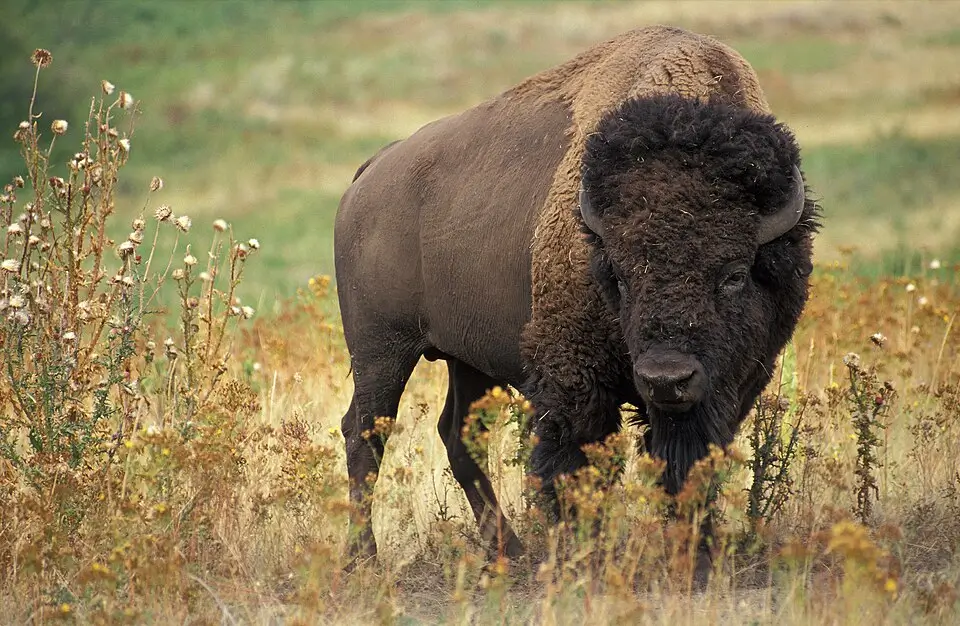
Adult male Plains bison, known as bulls, are among the heaviest land animals in North America. Bulls typically weigh between 1,000 and 2,000 pounds and can stand over six feet tall at the shoulder, with their characteristic massive hump — formed by elongated vertebral spines — giving them a distinctive silhouette that is instantly recognizable on the open prairie. Cows are considerably smaller, typically weighing between 700 and 1,100 pounds, though they share the same general body plan.
Both sexes carry horns, which are short, curved, and sharp. Unlike deer antlers, bison horns are permanent structures made of keratin over a bony core, and they are never shed. The coat of a Plains bison is thick and shaggy, particularly around the head, neck, and forequarters, providing insulation against the brutal winters of the Great Plains. In spring and summer, bison shed much of this heavy coat, giving them a somewhat ragged appearance as patches of old fur hang from their bodies during the molting process.
Plains bison are herbivores, grazing primarily on grasses, sedges, and other low-growing vegetation. Their digestive system, like that of domestic cattle, is designed to process tough plant material through a process of rumination — they chew their cud, allowing their multi-chambered stomachs to break down cellulose efficiently. A mature bull can consume enormous quantities of vegetation each day, making large herds a powerful ecological force capable of significantly altering the structure and composition of grassland ecosystems.
Bison are highly social animals. Cows, calves, and young bulls typically form large mixed herds, while older bulls tend to live in smaller bachelor groups or even as solitary individuals for much of the year. During the rut, which typically occurs in late summer, bulls engage in dramatic displays and intense battles for breeding rights, bellowing loudly and crashing into one another with tremendous force. Calves, often called "red dogs" for their reddish-orange birth coats, are typically born in spring after a gestation period of approximately nine to nine and a half months. Calves are precocial, meaning they can stand and walk within hours of birth.
Habitat & Range
Historically, the Plains bison ranged across a vast swath of central North America, from the boreal forests of Canada in the north to Texas and the Gulf Coast in the south, and from the Rocky Mountains in the west to the eastern deciduous forests. Estimates of pre-European contact population sizes vary widely, but many wildlife biologists and historians suggest that tens of millions of bison once roamed the continent.
The Plains bison's preferred habitat is, as its name suggests, the open plains and prairies of the interior of the continent. It thrives in temperate grasslands, steppes, and savannas — ecosystems characterized by wide-open spaces, diverse grasses, and seasonal extremes of temperature. Bison are remarkably well adapted to the harsh winters and hot summers of this environment, and their grazing behavior plays a crucial role in maintaining the health and diversity of grassland plant communities.
North Dakota sits squarely within the historic core range of the Plains bison. The state's landscape — shaped by glaciation, wind, and the Missouri River — encompasses broad prairies, rolling hills, river valleys, and the dramatic badlands of the western part of the state. This terrain is characteristic Great Plains country, and it once supported enormous bison populations. Today, North Dakota remains an important part of the Plains bison's story, both in terms of conservation efforts and public land management.
Hunting Information
Hunting Plains bison is a profoundly different experience from pursuing whitetail deer or upland game birds. Bison are large, powerful, and can be deceptively fast, capable of reaching speeds of up to 35 miles per hour over short distances. They require appropriate firearms and careful shot placement, and harvesting a mature bull is a physically demanding undertaking given the sheer size and weight of the animal.
In North Dakota, bison hunting is managed as part of the state's big game program, overseen by the North Dakota Game and Fish Department. As with other highly sought-after big game species in the state — including bighorn sheep, elk, moose, and pronghorn — bison hunting opportunities are limited and allocated through a lottery system. Prospective hunters should consult the North Dakota Game and Fish Department directly for current season dates, license availability, application deadlines, and specific regulations, as these details are subject to change from year to year.
The lottery system reflects both the limited number of bison available for harvest and the state's commitment to careful, sustainable wildlife management. Successful applicants for bison tags in North Dakota should consider this a once-in-a-lifetime opportunity and prepare thoroughly — both physically and in terms of understanding the animal's behavior, habitat use, and the logistical demands of recovering and processing such a large animal.
Beyond North Dakota, bison hunting opportunities exist on various tribal lands, national parks and preserves, private ranches, and other public land units across the Great Plains and Rocky Mountain regions. Hunters interested in pursuing Plains bison should research specific opportunities carefully and be prepared for the unique challenges that hunting this iconic species presents.
Conservation
The story of Plains bison conservation is one of the most dramatic wildlife recovery narratives in American history. By the late 19th century, decades of commercial hunting, habitat loss, and deliberate eradication campaigns had reduced the Plains bison population from potentially tens of millions of animals to just a few hundred individuals. The species had been pushed to the very edge of extinction.
The recovery of the Plains bison began with the efforts of a small group of concerned citizens, ranchers, and early conservationists in the late 1800s and early 1900s. Captive herds were established, protective legislation was enacted, and over the following decades, bison numbers slowly began to climb. Today, estimates suggest that approximately 350,000 to 500,000 Plains bison exist in North America, though the majority of these are managed as livestock or in commercial herds, with a smaller number living in conservation herds on public and tribal lands.
One significant ongoing challenge in Plains bison conservation is the issue of genetic integrity. Because bison and domestic cattle can interbreed, many managed bison herds contain at least some cattle genetics — a legacy of early ranching practices. Wildlife managers and conservation organizations work to identify and protect herds with minimal or no cattle gene introgression, recognizing these animals as particularly valuable for long-term conservation goals.
In North Dakota, as throughout the Great Plains, bison hold deep cultural significance for the region's Indigenous nations, particularly the Lakota, Dakota, and other Sioux peoples, as well as the Mandan, Hidatsa, and Arikara nations. Tribal bison management programs have become increasingly important components of the broader conservation picture, with many tribes working to restore free-ranging bison herds on tribal lands as both a cultural and ecological priority.
The continued recovery and expansion of Plains bison populations represents a genuine conservation success, and the presence of these magnificent animals on the North American landscape is a testament to what thoughtful wildlife management and sustained effort can achieve. For hunters, wildlife watchers, and outdoor enthusiasts of all kinds, encountering a Plains bison in its native habitat remains one of the most awe-inspiring experiences that North America's wild places have to offer.