Overview
Few animals embody the spirit of North America's wetlands quite like the muskrat (Ondatra zibethicus). This semi-aquatic rodent has carved out a fascinating ecological niche across the continent's marshes, ponds, rivers, and lakes, becoming one of the most recognizable and ecologically important furbearing animals in North America. From the vast prairie potholes of North Dakota to the coastal marshes of the Atlantic seaboard, the muskrat is a constant, industrious presence — building, foraging, and shaping aquatic ecosystems in ways that benefit countless other species.
Despite its somewhat unglamorous reputation as a common marsh rodent, the muskrat is a creature of remarkable adaptability, behavioral sophistication, and historical significance. Its dense, warm fur drove the early North American fur trade and sustained generations of trappers and indigenous peoples. Today, it remains a valued furbearer for hunters and trappers across the continent, while also serving as a keystone species in many wetland environments. For outdoor enthusiasts, wildlife watchers, and hunters in states like North Dakota — where wetlands and prairie potholes are abundant — the muskrat represents both a sporting opportunity and a living symbol of healthy, functioning wetland ecosystems.
Biological Traits
The muskrat (Ondatra zibethicus) is the sole member of the genus Ondatra and belongs to the family Cricetidae, which it shares with voles, hamsters, and lemmings. Despite its superficial resemblance to beavers and rats, the muskrat occupies its own unique taxonomic branch within the rodent world.
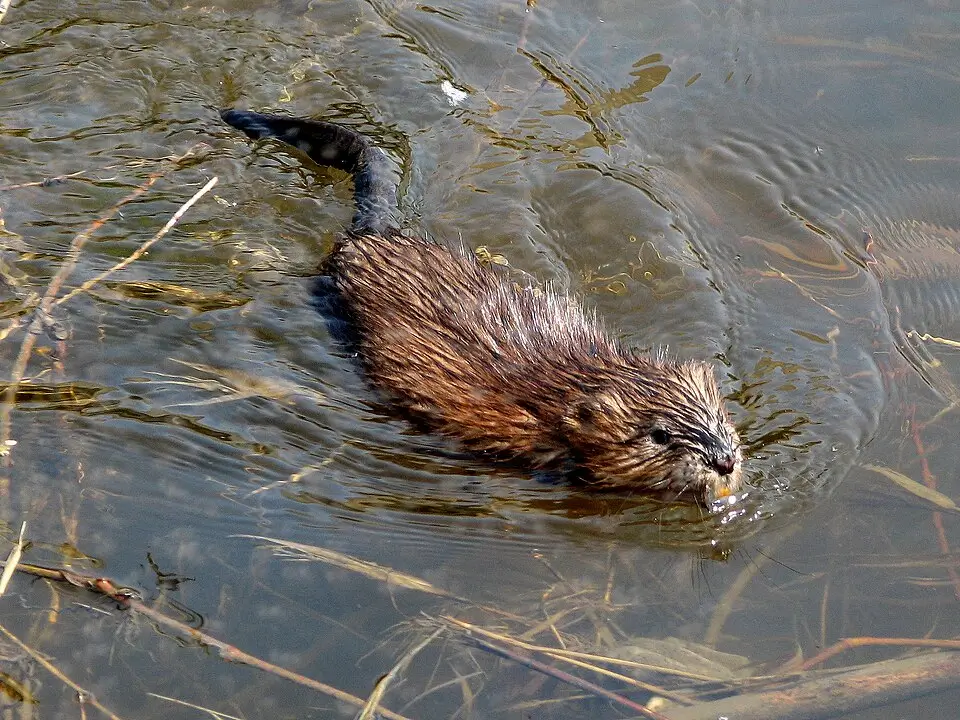
In terms of size, the muskrat is a medium-sized rodent. Adults typically measure between 16 and 25 inches in total length, with roughly half of that length accounted for by the tail. Body weight generally ranges from about 1.5 to 4 pounds, though larger individuals can occasionally exceed this range. The tail is one of the muskrat's most distinctive features: it is laterally flattened — compressed side-to-side rather than top-to-bottom — which makes it an effective rudder when swimming. This characteristic immediately distinguishes the muskrat from beavers, whose tails are wide and paddle-shaped, and from common rats, whose tails are round and slender.
The muskrat's coat is dense, soft, and waterproof — an essential adaptation for an animal that spends so much of its life in and around water. The outer guard hairs are dark brown, often with a reddish tint, while the undercoat is thick, fine, and much paler in color. This combination of coarse outer fur and soft underfur made muskrat pelts highly prized in the fur industry. The animal's feet are partially webbed, enhancing its swimming ability, and it is capable of remaining submerged for up to 15 to 17 minutes at a time.
The name "muskrat" derives from a pair of musk glands located near the base of the tail. These glands produce a musky-scented secretion that the animal uses for communication, territory marking, and attracting mates during the breeding season. This scent plays an important social role in muskrat communities, helping individuals identify one another and establish territorial boundaries.
Muskrats are prolific breeders. Females typically produce multiple litters per year, with each litter containing anywhere from four to eight young. In warmer climates, breeding can occur throughout much of the year, though in northern regions like North Dakota, the breeding season is concentrated in the warmer months. Young muskrats are born blind and helpless but develop quickly, reaching sexual maturity within their first year of life. This rapid reproductive rate is a key factor in the muskrat's ability to sustain healthy population levels even in the face of heavy predation and harvesting pressure.
As herbivores, muskrats feed primarily on aquatic and semi-aquatic vegetation. Cattails, bulrushes, sedges, pondweed, and water lilies form the backbone of their diet. They will also consume agricultural crops near wetlands and occasionally eat aquatic invertebrates, mussels, crayfish, and small fish, making them opportunistic omnivores to a degree. Their feeding habits have a notable impact on wetland vegetation structure, often creating open-water areas known as "eat-outs" — patches where dense vegetation has been consumed — which can actually benefit waterfowl and other wetland-dependent species by diversifying habitat structure.
Habitat & Range
The muskrat has one of the broadest distributions of any North American mammal. Its native range spans virtually the entire continent, from Alaska and northern Canada south through the contiguous United States and into the northern reaches of Mexico. It has also been introduced to Europe and Asia, where it has established populations in countries ranging from France and Germany to Russia and China.
The muskrat's preferred habitat is permanent or semi-permanent wetlands — marshes, ponds, lakes, rivers, streams, and drainage ditches — that offer shallow water, abundant emergent vegetation, and stable water levels. They are highly adaptable, however, and can thrive in a wide variety of wetland types, from pristine natural marshes to heavily modified agricultural drainage systems.
In North Dakota, muskrats find ideal conditions across much of the state's landscape. North Dakota sits within the heart of the Prairie Pothole Region, one of the most productive and ecologically rich wetland systems in North America. The thousands of shallow glacially formed wetlands — known as prairie potholes — that dot the North Dakota landscape provide exactly the kind of vegetated, shallow-water habitat that muskrats require. These potholes are also critical breeding grounds for migratory waterfowl, and the relationship between muskrats and waterfowl is mutually beneficial: muskrats maintain open-water channels and diverse vegetation structure that ducks and geese depend upon, while the broader wetland ecosystem supports the abundance of aquatic plants that muskrats need to thrive.
Muskrats are quintessential engineers of their aquatic environments. They construct two main types of structures: burrows dug into the banks of waterways, and dome-shaped lodges built from cattails, reeds, mud, and other vegetation in open water. These lodges, which can stand several feet above the waterline, provide insulation, protection from predators, and safe nursery space for raising young. The construction and maintenance of these structures is a near-constant activity for muskrats, particularly in autumn as they prepare for winter.
Natural predators of the muskrat include mink, otters, red foxes, coyotes, great horned owls, bald eagles, and large snapping turtles. In North Dakota, all of these predators are present to varying degrees, and population dynamics between muskrats and mink in particular are closely intertwined — so much so that ecologists and trappers often observe predictable fluctuations in mink numbers that follow shifts in muskrat abundance.
Hunting and Trapping Information
The muskrat holds a proud place in the traditions of North American hunting and trapping culture. Long before European settlers arrived on the continent, indigenous peoples harvested muskrats for food and fur. The animal's pelage was woven into garments, its meat served as a nutritious food source, and its musk glands were used for medicinal and ceremonial purposes.
During the height of the North American fur trade, muskrat pelts were among the most commercially significant furbearing commodities on the continent. Even today, trapping and hunting muskrats remains a popular and legitimate outdoor pursuit, particularly in wetland-rich states like North Dakota.
In North Dakota, the muskrat is classified as a furbearer and is subject to the regulations administered by the North Dakota Game and Fish Department. Hunters and trappers interested in pursuing muskrats in North Dakota should consult the official North Dakota Game and Fish website and the current furbearer regulations for the most up-to-date information regarding season dates, licensing requirements, legal methods of take, and any applicable bag limits or restrictions. As regulations can change from year to year, it is always advisable to review the current year's regulations directly from official state sources before heading afield.
Traditional methods for harvesting muskrats include body-grip traps (such as the classic Conibear-style traps), foothold traps, and cage-style live traps set at the entrances to burrows, along well-used travel routes, or near active lodges. In some states, muskrats may also be taken by shooting during specified seasons, and where legal, this can be an exciting and challenging pursuit using rimfire rifles or shotguns along marsh edges at dawn or dusk.
For those new to muskrat trapping, North Dakota's wetland-rich environment provides abundant opportunity. Scouting for active lodges, well-worn bank runs, and fresh feeding sign such as cut vegetation and discarded plant stems are all effective ways to locate productive trapping sites.
Conservation
The muskrat is currently listed as a species of Least Concern by the International Union for Conservation of Nature (IUCN), reflecting its wide range and robust population levels across most of its native habitat. While localized declines can occur in response to habitat loss, drought, disease, or extreme population cycles, the muskrat as a species is not considered threatened at a continental scale.
In North Dakota, the health of muskrat populations is closely tied to the condition of the Prairie Pothole Region. Wetland conservation efforts — including those supported by programs like the North American Waterfowl Management Plan and various USDA conservation programs — benefit muskrats indirectly by preserving and restoring the shallow wetland habitats the species depends on.
Regulated hunting and trapping actually play a meaningful conservation role by helping to maintain balanced predator-prey dynamics and preventing population cycles from becoming so dramatic that they lead to large-scale habitat degradation. The "eat-out" phenomenon, in which overpopulated muskrat colonies consume wetland vegetation down to the waterline and mud, can temporarily devastate the productive capacity of a prairie pothole. Responsible regulated harvest helps moderate these boom-bust cycles.
Wildlife managers in North Dakota and across the broader Great Plains region continue to monitor muskrat populations as an indicator species for overall wetland ecosystem health. In many respects, the muskrat serves as a barometer for the vitality of the Prairie Pothole Region — when muskrats are thriving, so too are the marshes, the waterfowl, and the rich biodiversity that defines one of North America's most extraordinary landscapes.