Overview
Few wildlife encounters stir the heart of an outdoorsman quite like spotting a mature mule deer buck standing motionless against a backdrop of golden badlands or pine-studded ridgelines. The mule deer (Odocoileus hemionus) is one of North America's most recognizable and celebrated big game animals, a symbol of the rugged western landscape that has captured the imagination of hunters, wildlife photographers, and nature enthusiasts for generations. With their distinctively large, mule-like ears, bold stotting gait, and impressive forked antlers, mule deer occupy a unique and beloved place in the culture of American hunting and wildlife conservation.
In North Dakota, mule deer are a prized and carefully managed big game species. Found primarily in the western portions of the state — across the dramatic terrain of the Badlands and the rolling prairies of the Missouri River breaks — these deer represent one of the premier hunting opportunities in the Upper Midwest. Understanding their biology, behavior, and habitat requirements not only makes for a more successful hunt, but also deepens appreciation for one of the most fascinating ungulates on the continent.
Biological Traits
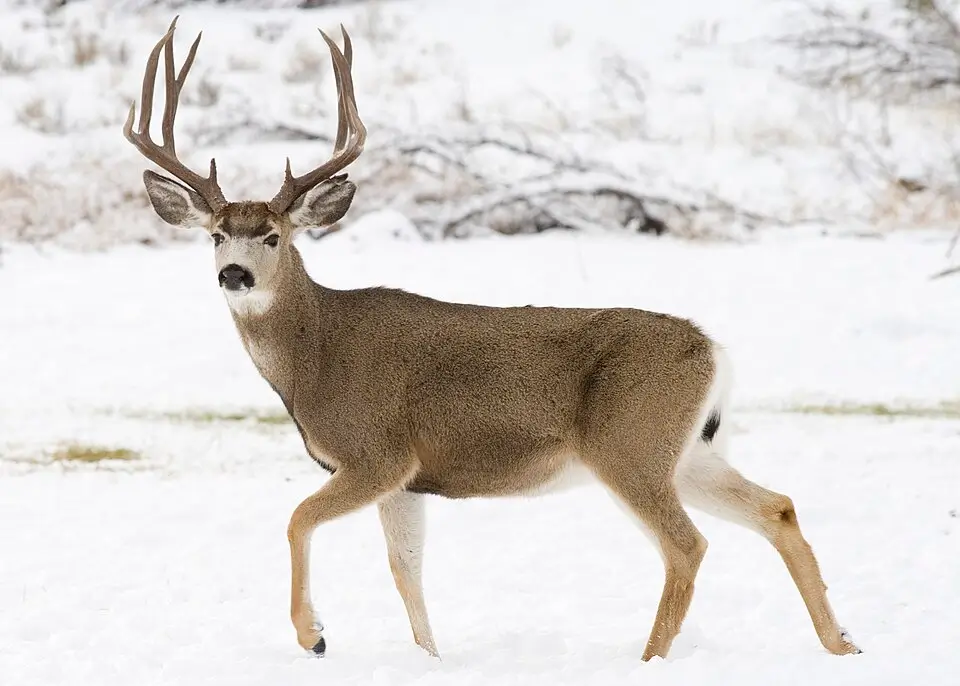
The mule deer's scientific name, Odocoileus hemionus, translates roughly to "half-mule hollow-tooth," a nod to the animal's most visually striking feature: those large, prominent ears that can measure nearly a foot in length. These oversized ears are not merely decorative — they provide mule deer with exceptional hearing capabilities, allowing them to detect predators and approaching threats at remarkable distances.
Mule deer are notably distinct from their close relative, the white-tailed deer (Odocoileus virginianus). One of the clearest distinguishing features is their tail: a mule deer's tail is narrow, rope-like, and tipped with black, in sharp contrast to the white-tailed deer's broad, flag-like tail. Their antlers are another defining characteristic. Unlike white-tailed bucks, whose antlers grow from a single main beam with tines projecting upward, mule deer bucks sport a unique bifurcated or "forked" antler structure where each beam forks into two roughly equal tines, creating a symmetrical, distinctive rack that hunters prize above almost all others in the West.
Adult mule deer bucks typically weigh between 150 and 300 pounds, with some exceptional individuals exceeding that range, while does are considerably lighter, generally ranging from 95 to 200 pounds. Their coat transitions with the seasons: a reddish-brown in summer gives way to a thicker, grayer winter coat as temperatures drop. This seasonal change in coloration also serves as effective camouflage in their varied environments.
Perhaps the most iconic behavioral trait of the mule deer is its stotting gait — sometimes called "pronking" — in which the animal bounds away from danger using all four feet simultaneously, springing stiff-legged across the landscape. This bouncing escape strategy may seem inefficient compared to the flat-out sprint of a white-tailed deer, but it is remarkably effective in rugged, broken terrain, allowing mule deer to change direction quickly and navigate steep hillsides with surprising agility.
Mule deer are also crepuscular animals, meaning they are most active during the low-light hours of dawn and dusk. During the heat of the day, they typically bed down in shaded or sheltered areas, using their natural coloring to blend into their surroundings. Their diet consists primarily of browse — shrubs, forbs, and woody vegetation — though they will also consume grasses and agricultural crops when available.
The mule deer rut typically occurs in late fall, generally from November into December across much of their range. During this period, bucks become highly active, traveling extensively in search of receptive does, engaging in sparring matches with rival bucks, and temporarily abandoning their characteristic wariness. This behavioral change makes the rut one of the most exciting and productive times for hunters.
Habitat & Range
Mule deer are quintessentially western animals. Their range spans much of western North America, from the coastal forests of Alaska and British Columbia in the north, south through the American West, and into the highlands of Mexico. They inhabit an extraordinarily diverse array of environments, from desert scrublands and sagebrush flats to high-altitude mountain meadows, from dense conifer forests to open prairie breaks and badlands.
In North Dakota, mule deer are concentrated in the western third of the state, where the landscape transitions from the flat agricultural plains of the east to the dramatically eroded badlands, coulees, and buttes characteristic of the Little Missouri River and Missouri River drainages. This rugged terrain, with its steep draws, brushy hillsides, and scattered juniper groves, closely mirrors the classic mule deer country found throughout the Rocky Mountain region and provides ideal year-round habitat.
The badlands of North Dakota — made famous by Theodore Roosevelt during his ranching years in the late 19th century — offer mule deer a complex landscape of shelter, food, and water. Deer use the steep terrain for escape cover and thermal regulation, moving between south-facing slopes to catch winter sun and north-facing draws where cooler temperatures and denser vegetation persist into summer. Sagebrush, greasewood, snowberry, and various native forbs make up a significant portion of their diet in this region.
Mule deer are also well-adapted to coexist with agriculture and rural land uses. In North Dakota's western counties, it is not uncommon to find mule deer utilizing crop fields, hay meadows, and shelter belts alongside native rangeland, particularly during late summer and early fall when agricultural crops provide a high-calorie food source ahead of winter.
Hunting Information
Mule deer hunting holds a special place in North Dakota's outdoor heritage. The state's Game and Fish Department manages mule deer as a highly valued big game resource, and licenses for deer — including mule deer — are allocated through a lottery system. This controlled approach to licensing ensures that deer populations remain healthy and that hunting pressure is distributed responsibly across available habitat.
Prospective hunters should consult the North Dakota Game and Fish Department's official resources for current season dates, license application periods, unit boundaries, and specific regulations, as these details are updated annually and may vary by management unit. The lottery-based system means that applying early and understanding the preference point or bonus point structure (where applicable) can improve a hunter's chances of drawing a coveted mule deer tag in a productive unit.
For those fortunate enough to draw a tag, the experience of hunting mule deer in North Dakota's badlands is truly world-class. Many seasoned hunters employ a spot-and-stalk approach, using binoculars and spotting scopes to glass open hillsides and drainages from elevated vantage points before carefully planning a stalk. The open nature of much of western North Dakota's terrain rewards patience and glassing effort. Early mornings and evenings, when deer are most active, offer the best opportunities for locating animals.
The rut, typically occurring in November across the state, offers hunters a particularly exciting window when bucks are on the move and less cautious than at other times. Still-hunting through brushy draws and coulee bottoms can also be productive, particularly after fresh snow makes tracking possible. Hunters should always scout thoroughly before the season, learning travel corridors, bedding areas, and preferred feeding zones.
Rifle hunting is the most common method for pursuing mule deer in North Dakota, though archery and muzzleloader seasons may also be available depending on current regulations. Always verify legal requirements, including licensing, blaze orange regulations, and tagging procedures, directly with the North Dakota Game and Fish Department before your hunt.
Conservation
The conservation of mule deer is a shared responsibility embraced by wildlife agencies, landowners, hunters, and conservation organizations across western North America. Hunters play a particularly vital role: license fees and excise taxes on hunting equipment — generated through the Federal Aid in Wildlife Restoration Act (commonly known as the Pittman-Robertson Act) — fund a significant portion of state wildlife management programs, including habitat improvement projects and population monitoring for mule deer.
In North Dakota, the Game and Fish Department monitors mule deer populations through annual surveys and works collaboratively with landowners to maintain and enhance habitat. Chronic Wasting Disease (CWD), a neurological disease affecting deer and other cervids, is an ongoing management concern across the region. Hunters are encouraged to follow all CWD-related regulations, including guidelines on carcass transportation and voluntary testing programs, to help slow the spread of this disease.
Healthy mule deer populations depend on the preservation of intact sagebrush and grassland ecosystems, maintenance of water sources, and the management of predator-prey dynamics. Conservation easements, public land stewardship, and responsible grazing practices all contribute to maintaining the high-quality habitat that mule deer require across their range.
For those who love wild places and the animals that inhabit them, every mule deer season represents not just a hunting opportunity, but a chance to participate actively in the conservation legacy that has kept this magnificent species thriving across the American West.