Overview
Few animals in North America enjoy the cultural fame of the groundhog. Known scientifically as Marmota monax, the groundhog is perhaps best recognized for its starring role in the beloved tradition of Groundhog Day, celebrated each February 2nd, when legend holds that the animal's shadow — or lack thereof — predicts the remaining length of winter. Yet beyond the folklore and festivities, the groundhog is a fascinating, ecologically important mammal that deserves recognition for far more than its meteorological mythology.
The groundhog, also commonly called the woodchuck, whistle-pig, or land beaver, is a member of the squirrel family Sciuridae and belongs to the group of large ground squirrels known as marmots. It is one of the most widely distributed marmot species in North America, found across a broad swath of the continent from the southeastern United States all the way into Canada and Alaska. Across its range, the groundhog plays a meaningful ecological role and provides an accessible, year-round small game hunting opportunity for sportsmen and sportswomen of all experience levels.
In states like North Dakota — a region defined by sweeping prairies, fertile farmland, and wide-open badland vistas — the groundhog fits naturally into both the landscape and the hunting culture. Whether you're a seasoned hunter fine-tuning your long-range rifle skills or a beginner looking for an approachable introduction to small game hunting, the groundhog offers a uniquely rewarding experience.
Biological Traits
The groundhog (Marmota monax) is the largest member of the squirrel family found in most of its range. As a true marmot, it shares its genus with other well-known species like the yellow-bellied marmot of the American West, but Marmota monax stands apart for its remarkable adaptability to a wide variety of environments, including human-modified landscapes such as farms, roadsides, and suburban parks.
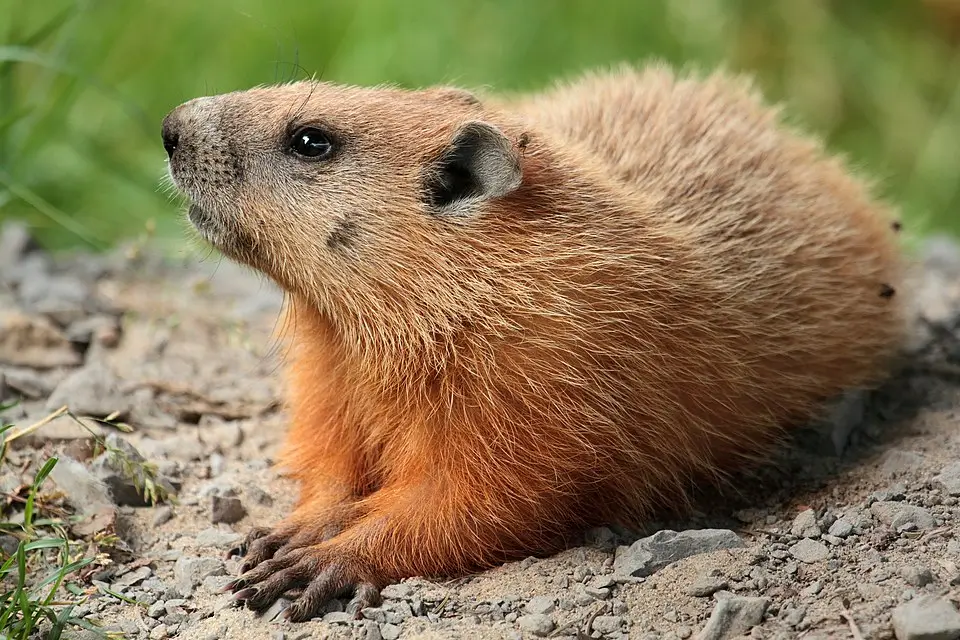
Groundhogs are stocky, heavily built rodents with short but powerful limbs, a broad flattened head, small rounded ears, and a moderately bushy tail. Their fur is typically a grizzled brownish-gray, providing natural camouflage against the earth and grass of their preferred habitats. Adults generally weigh between five and fourteen pounds and measure roughly sixteen to twenty-six inches in length, though individuals can become noticeably heavier in late summer and early fall as they accumulate fat reserves for winter.
One of the groundhog's most remarkable biological features is its capacity for true hibernation — one of the deepest and most physiologically dramatic of any North American mammal. Unlike many animals that merely enter a state of torpor, groundhogs dramatically reduce their heart rate, body temperature, and metabolic activity during winter hibernation. An active groundhog's heart may beat around 80 times per minute; during deep hibernation, that rate can drop to as few as 5 beats per minute. Body temperature falls correspondingly, dropping to near ambient soil temperature. This extraordinary physiological state typically lasts from late October or November through February or March, depending on geographic location and individual variation.
Groundhogs are primarily herbivores with broad dietary preferences. They feed heavily on grasses, clovers, alfalfa, dandelions, and a wide variety of other plants, fruits, and agricultural crops. This dietary flexibility makes them highly adaptable but also occasionally puts them at odds with farmers and gardeners, whose crops and pastures can suffer from heavy groundhog feeding and burrowing activity.
The burrow systems that groundhogs excavate are impressive engineering feats. A typical burrow may extend five feet underground and stretch twenty-five feet or more in length, featuring multiple entrance and exit tunnels, a nesting chamber, and even a dedicated latrine area. These burrows are not only vital to the groundhog's own survival — providing shelter from predators, weather, and temperature extremes — but also serve as important habitat for many other species. Foxes, raccoons, opossums, skunks, cottontail rabbits, and various reptiles and amphibians frequently take up residence in abandoned groundhog burrows, making the groundhog a keystone habitat provider in its ecosystem.
Groundhogs are largely solitary animals outside of the breeding season. Mating occurs shortly after emergence from hibernation in late winter or early spring. Females give birth to litters typically ranging from two to six young after a gestation period of approximately 31 to 32 days. The young are born blind, hairless, and helpless but develop quickly, emerging from the burrow for the first time at around six weeks of age and dispersing to establish their own territories by mid-summer.
The animal's common name "whistle-pig" comes from its habit of emitting a sharp, high-pitched whistle when alarmed — a warning call that alerts other groundhogs in the vicinity to potential danger. This vocal behavior, combined with the groundhog's natural wariness and tendency to retreat quickly to its burrow when threatened, makes it a challenging and rewarding quarry for hunters.
Habitat & Range
The groundhog has one of the broadest ranges of any North American marmot. Its distribution extends from the Atlantic coast of the eastern United States westward through the Midwest and into the northern Great Plains, and northward through much of Canada including the boreal forests of Ontario, Quebec, and the Prairie Provinces, all the way into parts of Alaska.
The species thrives in transitional habitat — areas where open ground and forest or shrub cover meet. Forest edges, meadows, open fields, pastures, roadsides, and agricultural land all provide ideal groundhog habitat, offering both abundant food resources and nearby cover for escape and denning. In more open prairie environments, such as those found across much of North Dakota, groundhogs tend to concentrate along field margins, fence lines, ditches, shelterbelts, and creek corridors where woody vegetation provides some degree of cover.
North Dakota's landscape, characterized by the broad rolling prairies of the Great Plains, patches of badlands terrain, and extensive farmland, offers suitable groundhog habitat across much of the state. The agricultural regions of eastern and central North Dakota in particular, with their mix of cropland, pasture, and shelterbelts, can support healthy groundhog populations. The species' affinity for disturbed and edge habitat means that farmsteads, rural roadsides, and cultivated fields often harbor some of the densest populations.
Hunting Information
The groundhog is a popular small game animal across much of its range, prized both for the hunting challenge it presents and for the practical benefits of population management in agricultural areas where burrows and feeding activity can damage crops, machinery, and livestock infrastructure.
Groundhog hunting is particularly popular in the eastern and midwestern United States, where it serves as an excellent warm-weather activity during the summer months between spring turkey season and fall big game season. For many hunters, groundhog hunting doubles as an opportunity to practice long-range shooting skills, scout properties for fall deer and turkey seasons, and simply enjoy extended time outdoors.
In North Dakota, the groundhog falls under the category of small game and other game species managed by the North Dakota Game and Fish Department. Hunters interested in pursuing groundhogs in North Dakota should consult the current North Dakota Game and Fish regulations for the most up-to-date licensing requirements, season structures, and any applicable rules. The North Dakota Game and Fish Department provides comprehensive hunting information organized by species on their official website, and it is always advisable to review current regulations before heading into the field.
Popular methods for hunting groundhogs include rifle hunting — often with flat-shooting, accurate calibers suitable for the open prairie environments of the Great Plains — as well as archery and pistol hunting at closer ranges. Spot-and-stalk hunting and hunting from fixed positions near active burrows are both effective strategies. Because groundhogs are most active during the warmest parts of the day in spring and early summer, midmorning through mid-afternoon hunts are often the most productive.
Landowner relationships are particularly important for groundhog hunters in agricultural states like North Dakota. Many farmers view groundhogs as a genuine nuisance and welcome hunters who can help manage local populations on their properties. Approaching landowners respectfully and requesting permission early in the season can open doors to excellent hunting access across private farmland.
Conservation
Despite being a species that is sometimes managed as a nuisance animal in agricultural settings, the groundhog is not a species of conservation concern. Its populations are considered stable and healthy across most of its range, and its adaptability to human-modified landscapes has allowed it to persist and even thrive as land use patterns have changed over the centuries.
The groundhog's role as a burrowing species provides tangible ecological benefits. Its burrows aerate and turn over soil, contributing to local soil health and providing essential den habitat for dozens of other species. Responsible, regulated hunting helps maintain balanced groundhog populations in areas where they are numerous, benefiting both agricultural producers and the broader ecosystem.
Conservation-minded hunters in North Dakota and beyond can contribute positively by practicing ethical, respectful hunting, obtaining proper licensing, obtaining landowner permission, and embracing the tradition of fair chase. The groundhog may not carry the prestige of a whitetail buck or a bull elk, but it is a worthy quarry that connects hunters to the land and to the rich tradition of North American wildlife management.