A Comprehensive Guide to Puma concolor
Few animals capture the imagination of wildlife enthusiasts, hunters, and outdoor adventurers quite like the cougar. Known by more common names than almost any other animal in North America — mountain lion, puma, panther, catamount, and painter among them — this magnificent predator has roamed the Western Hemisphere for millions of years. The cougar (Puma concolor) is the largest wild cat native to North America and one of the most adaptable predators on the planet. From the icy peaks of the Canadian Rockies to the steamy swamps of Florida, and from the arid deserts of the American Southwest to the dense forests of South America, the cougar has established itself as a supreme survivor.
In the context of North Dakota and the broader Great Plains region, the cougar occupies a fascinating and somewhat mysterious role. Once considered extirpated from much of the Midwest, the species has demonstrated a remarkable capacity for range expansion, with individual animals — particularly young males dispersing from established western populations — occasionally making appearances in states where they were long absent. Understanding this animal in depth, from its biology and behavior to its ecological significance and relationship with hunters and wildlife managers, offers a rewarding window into one of North America's most iconic wild creatures.
Biological Traits
The cougar, Puma concolor, belongs to the family Felidae and is classified within the subfamily Felinae, making it more closely related to domestic cats and cheetahs than to the "big cats" of the genus Panthera such as lions and leopards. Despite its impressive size, the cougar cannot roar — a trait that distinguishes it from true big cats — but it is capable of producing a startling array of vocalizations, including chirps, whistles, hisses, growls, and the legendary blood-curdling screech that has unnerved many a backcountry traveler.
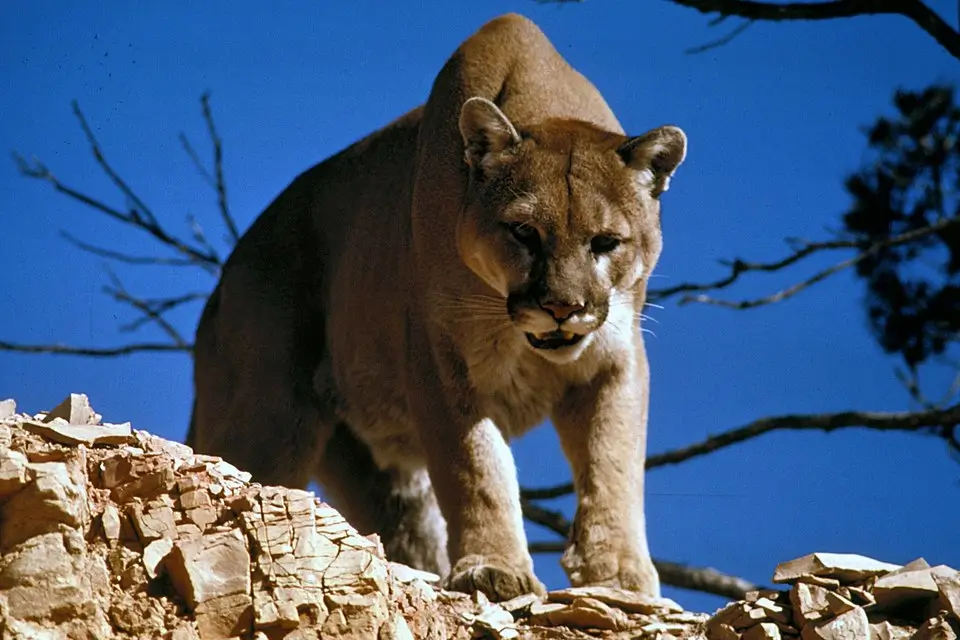
Adult male cougars are substantially larger than females, a characteristic known as sexual dimorphism. Males can weigh anywhere from roughly 115 to over 220 pounds in some regions, with long, powerful bodies built for explosive bursts of speed and athletic leaping. Females are noticeably smaller and lighter. The species has a uniform tawny to grayish-brown coat, with lighter undersides and distinctive dark markings on the muzzle, behind the ears, and at the tip of the long, heavy tail. Cubs, by contrast, are born with spotted coats and ringed tails — a camouflage adaptation that fades as they mature.
Cougars are obligate carnivores, meaning they rely entirely on meat for their nutritional needs. Deer — including white-tailed deer and mule deer — form the backbone of the cougar's diet across much of North America, though they are highly opportunistic hunters and will take elk, bighorn sheep, pronghorn, smaller mammals, and even porcupines and raccoons when the opportunity arises. They are classic ambush predators, relying on stealth, patience, and explosive acceleration rather than endurance to bring down prey. A cougar will often stalk its quarry to within a very short distance before launching a rapid, powerful strike, typically targeting the neck or back of the skull.
These cats are largely solitary and territorial. Adult males maintain large home ranges that can span dozens to hundreds of square miles depending on habitat quality and prey availability. Female home ranges are generally smaller and may overlap with those of males. Communication between individuals is largely accomplished through scent marking — scrapes in the soil, urine sprays, and scat deposits left at conspicuous locations throughout their territory.
Reproduction in cougars is not tied to a specific season. Females can come into estrus at any time of year, and after a gestation period of approximately 90 days, typically give birth to litters of one to six cubs, with two to three being most common. Cubs remain with their mother for up to two years, learning the complex skills of hunting and territorial behavior before dispersing to establish ranges of their own. It is this dispersal behavior — especially among young males — that accounts for the occasional verified sightings of cougars far outside their core western range, including reports in Great Plains states like North Dakota.
Habitat & Range
The cougar holds the distinction of having the widest natural range of any wild land mammal in the Western Hemisphere. Historically, Puma concolor was distributed from coast to coast across North America, from southern Canada all the way down through Central and South America to the southern tip of Patagonia. European settlement and subsequent persecution drastically reduced this range across much of the eastern and central United States, but the cougar has maintained strong populations in the mountainous West and is showing signs of eastward range recovery in some areas.
Cougars are habitat generalists in the truest sense. They are equally at home in dense coniferous forests, open scrubland, rocky desert terrain, tropical rainforests, and high alpine environments. The common thread among all cougar habitats is the availability of adequate prey and sufficient cover for stalking and denning. Rocky outcroppings, dense brush, and forested draws all provide ideal conditions.
In North Dakota specifically, the cougar is not considered a resident breeding population, but the state's rugged Badlands region in the southwestern part of the state — with its dramatic buttes, steep coulees, and river breaks — does provide terrain that could theoretically support transient cougars moving eastward from established populations in the Black Hills of South Dakota or the Rocky Mountain foothills of Montana and Wyoming. The Great Plains landscape that characterizes much of North Dakota presents challenges for a species that prefers cover and rocky terrain, but dispersing young males in particular have demonstrated a willingness to traverse open country in search of new territory.
Hunting Information
The cougar occupies a unique and carefully managed position in North American hunting culture. In states and provinces with established resident populations — primarily in the western United States and Canada — cougar hunting is a regulated activity that serves as an important wildlife management tool, helping to balance cougar populations with available prey and minimize conflicts with livestock and human communities. Cougar hunting is a demanding and rewarding pursuit, traditionally conducted with the aid of trained hounds that track and tree the cat, allowing the hunter to make a careful, ethical shot.
In North Dakota, the cougar does not currently have a designated hunting season, and the North Dakota Game and Fish Department — which oversees hunting regulations for the state — does not list cougar among the species with established season dates or licensing frameworks in the same manner as deer, elk, pronghorn, or bighorn sheep. The department manages a wide variety of big game species through its licensing and lottery systems, but the cougar's status as a rare transient visitor rather than a resident population means it occupies a different regulatory category.
Hunters and outdoor enthusiasts in North Dakota who encounter a cougar while pursuing other game should familiarize themselves with the most current regulations from the North Dakota Game and Fish Department, as rules regarding the handling of rare or protected species can change as populations and management priorities evolve. The department's official website and regulation booklets are the authoritative source for up-to-date information.
Conservation
The conservation story of the cougar is ultimately one of resilience. Despite centuries of persecution — including historical government-sponsored bounty programs that encouraged the killing of cougars across much of their range — the species has survived and, in many regions, is actively expanding. Today, western states maintain healthy, well-managed cougar populations, and the animal is not considered threatened or endangered across its overall range, though specific regional populations, such as the critically endangered Florida panther (Puma concolor couguar), face significant conservation challenges.
Scientific understanding of cougar ecology has grown enormously in recent decades, aided by advances in GPS telemetry and camera trap technology. Researchers have documented remarkable long-distance dispersal events, with individual male cougars traveling hundreds or even thousands of miles from their birthplaces. These movements are critical for the long-term genetic health of cougar populations and represent nature's own mechanism for range recovery.
For wildlife watchers and hunters alike, the cougar represents one of North America's most compelling conservation success stories — a testament to what thoughtful wildlife management, legal protection, and a reduction in indiscriminate persecution can achieve. In states like North Dakota, where verified sightings remain uncommon, each confirmed cougar observation is a reminder of the dynamic and ever-changing nature of wild ecosystems.
Organizations such as state wildlife agencies, university research programs, and national conservation groups continue to monitor cougar populations and movements across the continent, ensuring that this magnificent predator remains a vital and celebrated part of North America's wildlife heritage.