Overview
Few birds in North America carry as much cultural mystique as the common snipe. Long the subject of folklore, practical jokes, and the origin of the term "sniper," this remarkable shorebird is far more than a punchline — it is a legitimate and challenging quarry for hunters and a fascinating subject for birders and wildlife enthusiasts alike. Known scientifically as Gallinago gallinago, the common snipe occupies a unique niche in the world of migratory game birds. It is elusive by nature, masterfully camouflaged, and capable of explosive, erratic flight that has earned it a reputation as one of the most difficult birds in the world to hunt. In North Dakota and across the broader Great Plains region, the common snipe is a bird of particular interest, passing through or breeding in wetland habitats that define much of the state's remarkable natural landscape.
Understanding the common snipe — its biology, behavior, habitat preferences, and role in North American hunting tradition — offers a richer appreciation for the complex ecosystems that support it and the conservation efforts required to ensure it thrives for future generations.
Biological Traits
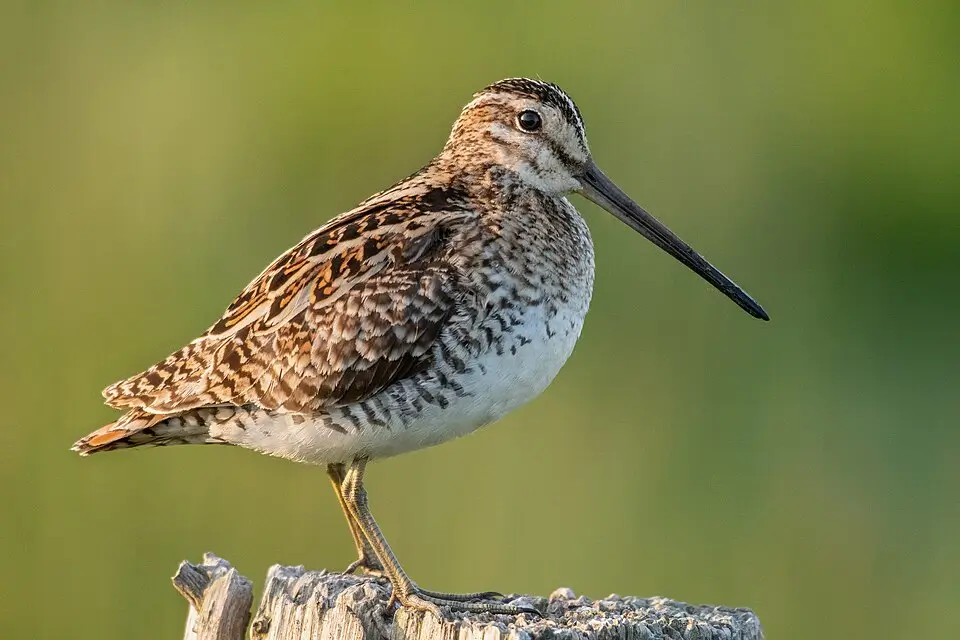
The common snipe (Gallinago gallinago) belongs to the family Scolopacidae, a large family of wading birds that includes sandpipers, woodcocks, and curlews. It is a medium-sized shorebird, compact in build, with a remarkably long, straight bill that is perfectly adapted for probing soft mud and wet soils in search of invertebrates. The bill tip contains sensitive nerve endings, allowing the snipe to detect prey entirely by touch — a fascinating sensory adaptation known as "rhynchokinesis," which enables the bird to flex the tip of its bill independently while it is inserted in the ground.
The plumage of the common snipe is a masterwork of natural camouflage. Browns, blacks, and creams weave together in complex streaked and barred patterns across the bird's back, wings, and crown, allowing it to vanish almost entirely against a background of dead grass, reeds, and muddy marsh edges. The underparts are lighter, with a streaked breast fading to a pale belly. A bold striped pattern runs along the crown and above the eye, adding to the bird's distinctive facial appearance. This cryptic coloration makes snipe notoriously difficult to spot until they are nearly underfoot, at which point they burst upward in a rapid, twisting, zigzagging flight accompanied by a distinctive harsh "scaipe" call.
That erratic escape flight — a high-speed, jinking burst that makes the bird nearly impossible to track — is the defining characteristic that has shaped both the bird's legendary status among hunters and the very word "sniper" itself. Marksmen skilled enough to successfully shoot a snipe in flight were considered to possess exceptional accuracy, and military sharpshooters adopted the term as a badge of skill.
Common snipe are also known for a remarkable aerial display during the breeding season called "drumming" or "winnowing." During this display, males — and sometimes females — fly high into the air and then dive steeply, spreading their outer tail feathers. As air rushes over these specialized feathers, a resonant, haunting sound is produced that carries far across open wetlands. This sound, often described as a trembling or bleating hum, is a signature of spring and early summer in northern wetland habitats.
In terms of diet, the common snipe feeds primarily on invertebrates found in soft, wet soils — earthworms, insect larvae, beetles, crustaceans, and small mollusks are all consumed. The bird forages by probing repeatedly into the substrate, its sensitive bill detecting movement and texture underground. It may also consume seeds and plant material on occasion.
Habitat & Range
The common snipe has a vast global range, breeding across much of the Palearctic — from Iceland and the British Isles eastward through Europe and Asia — as well as in North America, where it breeds across Canada, Alaska, and the northern United States. In the context of North America, the subspecies Gallinago gallinago delicata (sometimes treated as a separate species, the Wilson's snipe) is the form most commonly encountered, though the broader species complex shares similar ecology and behavior.
Snipe are deeply tied to wetland habitats throughout their range. They favor freshwater marshes, wet meadows, bogs, fens, river floodplains, and the edges of lakes and ponds where soft, muddy soils are available for probing. Dense, low vegetation — sedges, rushes, grasses, and low shrubs — provides essential cover for nesting, roosting, and daytime loafing. Open water edges and mudflats are frequented for feeding.
North Dakota, with its iconic Prairie Pothole Region, represents prime snipe habitat. The Prairie Pothole Region is one of the most important wetland complexes in North America, a mosaic of glacially formed wetlands, shallow lakes, and seasonally flooded grasslands that stretches across the Dakotas, Minnesota, Iowa, and into Canada. This landscape produces an extraordinary abundance of invertebrates and supports enormous populations of migratory birds. For the common snipe, the potholes of North Dakota serve as both breeding grounds in the northern part of the state and as critical migratory stopover habitat during the spring and fall movements. Snipe are often found in areas with standing water just a few inches deep, interspersed with sedge meadows and cattail margins.
During migration, snipe may turn up in a wide variety of wet habitats, including flooded agricultural fields, drainage ditches, and sewage treatment ponds — anywhere that soft, saturated ground provides foraging opportunities. In winter, they retreat to the southern United States, Central America, and northern South America.
Hunting Information
The common snipe holds a storied place in hunting tradition on both sides of the Atlantic. In Europe, snipe shooting has been practiced for centuries and is considered one of the ultimate tests of a wingshooter's skill. In North America, the tradition is equally deep-rooted, though snipe hunting has declined in popularity compared to more high-profile species like ducks and pheasants. That relative obscurity is, in many ways, the snipe hunter's reward — opportunities are often plentiful where other hunters don't venture.
In North Dakota, the common snipe falls under the category of migratory game birds and is managed at the federal level by the U.S. Fish and Wildlife Service in coordination with state wildlife agencies. The North Dakota Game and Fish Department provides comprehensive hunting information for migratory game birds, including snipe, as part of its broader regulatory framework for the state. Hunters interested in pursuing snipe in North Dakota should consult the North Dakota Game and Fish Department's current regulations, as season dates, bag limits, and licensing requirements are subject to annual review and federal frameworks.
As with all migratory bird hunting in the United States, snipe hunters are required to comply with federal regulations, including possession of a valid state hunting license and compliance with the Harvest Information Program (HIP), a federal data collection initiative that tracks migratory bird harvest across the country. North Dakota's Game and Fish Department lists snipe under its "Other Migratory Game Birds" category alongside species such as woodcock, moorhen, and rails.
Hunting snipe is widely regarded as one of the most challenging and rewarding forms of upland and wetland wingshooting. Dogs — particularly spaniels and pointing breeds — are invaluable partners, as they can locate and flush birds from dense vegetation that would otherwise conceal them almost indefinitely. Once flushed, the snipe's spiraling, darting escape flight demands quick reflexes, good footwork, and genuine shooting skill. Hunters who master snipe shooting often find that their performance on other wingshooting species improves dramatically as a result.
The typical approach to snipe hunting involves walking slowly through suitable habitat — wet meadows, marsh edges, and flooded fields — either with a dog or by pushing through cover on foot, watching for the characteristic flush and calling the shot quickly before the bird changes direction. Shotguns choked improved cylinder or skeet are generally preferred, as the close-range flushes and rapid crossing shots favor open patterns.
Conservation
The common snipe is currently listed as a species of Least Concern by the International Union for Conservation of Nature (IUCN), reflecting its wide range and large global population. However, like many wetland-dependent species, snipe populations are sensitive to habitat loss, drainage of wetland areas, and changes in land use that reduce the availability of soft, wet foraging and nesting habitat.
In North Dakota, the preservation and restoration of Prairie Pothole wetlands is critical not only for snipe but for the extraordinary diversity of migratory birds that depend on this landscape. Organizations such as Ducks Unlimited, the U.S. Fish and Wildlife Service through the National Wildlife Refuge System, and private landowner incentive programs have worked to protect and restore wetland habitats across the state. Programs like PLOTS (Private Land Open To Sportsmen), administered by North Dakota Game and Fish, provide hunters with legal access to private lands that include wetland and grassland habitats beneficial to snipe and other migratory species.
The common snipe is a beneficiary of broad wetland conservation efforts, even when those efforts are directed primarily at waterfowl. Healthy, diverse wetland systems support the full spectrum of marsh life — from nesting ducks to feeding herons to the probing bills of snipe searching for worms in the margins. Supporting conservation organizations, participating in wetland easement programs, and advocating for sound water management policy are all meaningful ways that hunters and wildlife enthusiasts can help ensure that snipe habitat in North Dakota and beyond remains intact and productive.