Overview
Few birds ignite the spirit of upland hunting quite like the common pheasant. With its brilliant plumage, explosive flush, and challenging flight pattern, Phasianus colchicus — commonly known as the ring-necked pheasant — stands as one of the most iconic and beloved game birds in North America. Whether you are a seasoned wingshooter with decades of field experience or a newcomer stepping into the tall grass for the very first time, the sight of a rooster pheasant rocketing skyward is an experience that leaves a lasting impression.
Originally native to Asia, the common pheasant has been successfully introduced to virtually every corner of the globe where suitable habitat exists. In the United States, it has become a cornerstone of upland game hunting culture, and in states like North Dakota — with its sweeping prairies, vast grain fields, and mixed grasslands — the bird has found a particularly welcoming home. For hunters and wildlife enthusiasts alike, the common pheasant represents a perfect intersection of natural beauty and sporting tradition.
This article explores the biology, habitat preferences, hunting culture, and conservation status of this remarkable bird, with a special focus on what makes North Dakota such a compelling destination for pheasant hunters.
Biological Traits
The common pheasant, Phasianus colchicus, belongs to the family Phasianidae — the same family that includes turkeys, quail, grouse, and peacocks. It is a large, ground-dwelling bird, and one of the most visually striking members of its family.
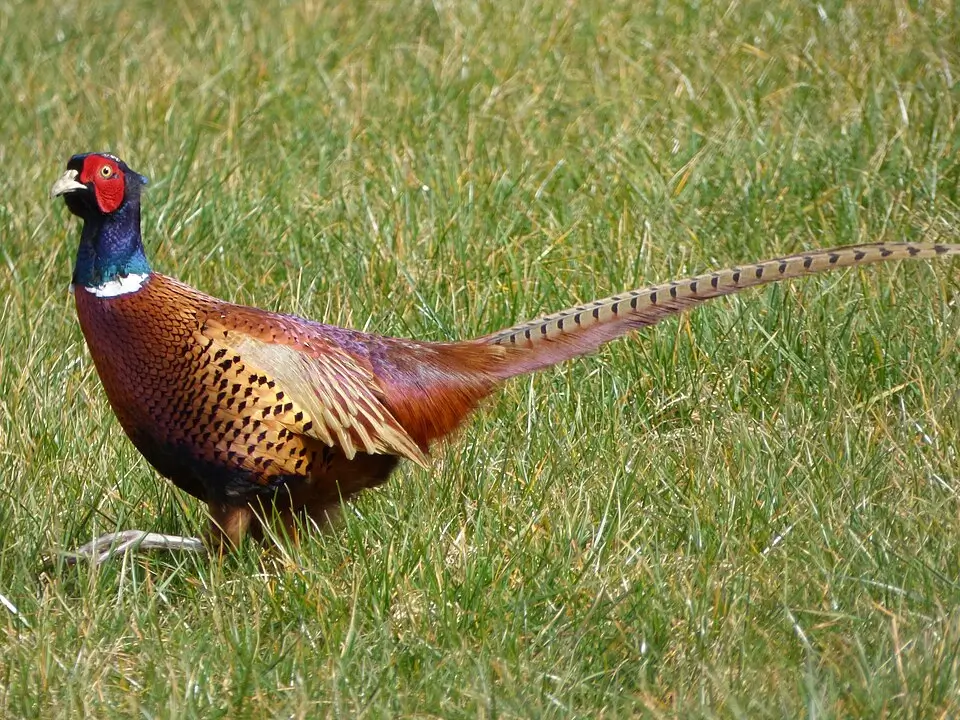
Sexual dimorphism in this species is dramatic and unmistakable. Male pheasants, known as roosters or cocks, are renowned for their spectacular coloration. They typically display a rich, iridescent combination of copper, gold, brown, and green feathers across the body, with a deep, bottle-green head, vivid red facial wattles, and the distinctive white ring around the neck that gives the bird its popular name — the ring-necked pheasant. The rooster's tail is long, pointed, and elegantly barred, often accounting for a significant portion of the bird's total length. In contrast, female pheasants — called hens — are far more subtly patterned, wearing a mottled brown and buff plumage that provides excellent camouflage against their natural surroundings. This difference in appearance between the sexes is an evolutionary adaptation: the rooster's bright colors attract mates during the breeding season, while the hen's cryptic coloring helps protect her and her nest from predators.
Pheasants are polygynous birds, meaning a single rooster will typically mate with multiple hens during the breeding season. After mating, hens seek out concealed nesting sites in dense vegetation — often near agricultural fields or grassland edges — where they lay clutches of olive-brown eggs. The hen alone incubates the eggs and raises the chicks, which are precocial, meaning they are born with open eyes and are capable of moving and feeding themselves within hours of hatching.
In terms of diet, the common pheasant is an opportunistic omnivore. It feeds heavily on seeds, grains, berries, and insects, making agricultural landscapes particularly attractive. During colder months, waste grain left in harvested fields becomes a critical food source, allowing pheasants to survive harsh winters where food availability would otherwise be limited.
Pheasants are primarily ground-dwellers, using their strong legs to walk and run through vegetation. When threatened, their first instinct is often to run rather than fly. However, when flushed — particularly by hunters and their dogs — they burst into flight with a startling, cacophonous wingbeat, climbing steeply before leveling off and gliding. This explosive flush, accompanied by the rooster's distinctive cackle, is one of the most thrilling moments in upland bird hunting.
Habitat & Range
Originally native to the Caucasus region and across a broad swath of Asia — from the Black Sea coast through China and into Korea and Japan — the common pheasant has been introduced throughout Europe, North America, Australia, New Zealand, and numerous other regions over several centuries. In North America, introductions began in the late 19th century, and the species quickly established itself across the agricultural Midwest and Great Plains.
Today, North Dakota sits squarely within some of the finest pheasant habitat in the entire United States. The state's geography plays a major role in this distinction. As part of the Great Plains region, North Dakota is characterized by broad prairies, farmland, rolling grasslands, and a mosaic of wetlands and shelterbelts — all of which provide ideal conditions for pheasant populations. The state is bordered by Canada to the north, Minnesota to the east, South Dakota to the south, and Montana to the west, placing it at the heart of the northern Great Plains pheasant range.
Pheasants thrive in areas where agricultural land is interspersed with natural cover. Grain crops such as corn, wheat, sunflowers, and soybeans provide essential food resources, while native grasses, shrubby draws, cattail marshes, and planted shelterbelts offer the protective cover that pheasants need for nesting, roosting, and escape from predators. North Dakota's agricultural landscape, combined with its extensive network of public lands managed under programs such as Wildlife Management Areas (WMAs) and PLOTS (Private Land Open To Sportsmen), creates a patchwork of accessible habitat that supports both healthy bird populations and outstanding hunting opportunities.
Winter weather is a critical factor for pheasant survival in the northern Great Plains. Deep snow, ice, and prolonged cold can significantly reduce pheasant numbers, particularly when birds cannot access food or find adequate thermal cover. Shelterbelts — rows of trees and shrubs planted to reduce wind erosion — play an outsized role in pheasant survival during winter, providing windbreaks and roosting sites that allow birds to conserve energy during the most extreme conditions.
Hunting Information
The common pheasant is one of the most widely hunted upland game birds in North America, and North Dakota has long been recognized as a premier destination for pheasant hunters. The North Dakota Game and Fish Department oversees hunting regulations and licensing within the state, offering detailed guidance on upland game hunting opportunities for resident and non-resident hunters alike.
Hunters pursuing pheasants in North Dakota have access to an impressive array of public hunting lands, including Wildlife Management Areas (WMAs) and acres enrolled in the PLOTS program, which opens private land to public hunting. This combination of public and accessible private land gives hunters a wide range of options when scouting for birds.
Pheasant hunting in North Dakota traditionally takes place during the fall and early winter months, when birds have completed their breeding cycle and are concentrated in agricultural and grassland habitats. Hunters typically work through standing cover — tall grasses, cattail sloughs, shelterbelt edges, and unharvested crop fields — often with the assistance of flushing or pointing dogs. Well-trained bird dogs, including Labrador retrievers, springer spaniels, German shorthaired pointers, and Vizslas, are invaluable partners in the upland field, helping hunters locate and flush birds, and retrieving downed roosters from dense cover.
It is important to note that specific season dates, bag limits, and licensing requirements for pheasant hunting in North Dakota are established annually by the North Dakota Game and Fish Department. Hunters are encouraged to consult the official North Dakota Game and Fish website for the most current and accurate regulatory information before heading afield. Licensing requirements and any applicable lottery systems are administered through official state channels.
The sport itself rewards patience, preparation, and fieldcraft. Early morning and late afternoon tend to be the most productive times to hunt, as pheasants are most active feeding during these hours. Reading the landscape — identifying travel corridors between food sources and cover — is a skill that separates consistently successful hunters from those who simply walk fields at random.
Conservation
The common pheasant's status as a beloved game bird has made it a focal point of conservation efforts across North America. While pheasants are not a species of conservation concern on a global scale — their native range in Asia remains extensive — North American populations are subject to the ebbs and flows of agricultural practices, land use changes, and weather patterns.
In North Dakota, as across the broader Great Plains, habitat quality is the single greatest driver of pheasant population health. The loss of native grasslands to row crop agriculture, drainage of wetlands, and removal of shelterbelts can reduce the carrying capacity of the landscape for pheasants and other upland birds. Conversely, conservation programs that encourage landowners to maintain or restore grassland cover, wetland buffers, and woody edge habitat have demonstrated measurable benefits for pheasant populations.
Organizations and agencies dedicated to upland bird conservation work alongside state game and fish departments to promote land stewardship practices that benefit pheasants and the full suite of grassland wildlife that shares their habitat. Programs like the Conservation Reserve Program (CRP) have historically provided significant acreage of enrolled grassland that serves as critical nesting and winter cover for pheasants.
Hunters themselves are among the most passionate advocates for pheasant habitat conservation. License revenues and excise taxes on firearms and ammunition — collected through the Federal Aid in Wildlife Restoration Act (Pittman-Robertson Act) — fund much of the habitat work and population monitoring conducted by state wildlife agencies across the country.