Overview
Few birds in North America inspire as much fascination among wildlife enthusiasts, birders, and hunters alike as the American woodcock (Scolopax minor). Known by a delightful array of colorful nicknames — timberdoodle, bogsucker, Labrador twister, and mudbat among them — this remarkable shorebird has carved out a unique ecological niche that sets it apart from nearly every other game bird on the continent. Despite technically belonging to the shorebird family, the American woodcock has largely abandoned the shores and shorelines of its relatives, choosing instead the moist, thicket-laden woodlands and alder-choked bottomlands of eastern and central North America.
The American woodcock is a bird of contradictions. It is simultaneously subtle and spectacular, secretive and theatrical. During most of the year, a woodcock can stand motionless in the leaf litter of a hardwood forest floor and remain virtually invisible to all but the most observant eye. Yet each spring, the male woodcock transforms into one of nature's most enthusiastic performers, launching himself into the twilight sky in a spiraling, chirping display flight that has mesmerized naturalists for generations. It is this combination of mystery and spectacle, of camouflage and courtship, that has earned the American woodcock a devoted following across its entire range.
For hunters, the American woodcock represents a truly special upland game bird experience. Flushing suddenly and silently from dense tangles of cover, often twisting erratically between branches and saplings, the woodcock tests the reflexes and wing-shooting skills of even experienced bird hunters. And for states like North Dakota, which sits along the western edge of the woodcock's range and migration corridor, encounters with this bird during the fall season can be genuinely memorable.
Biological Traits
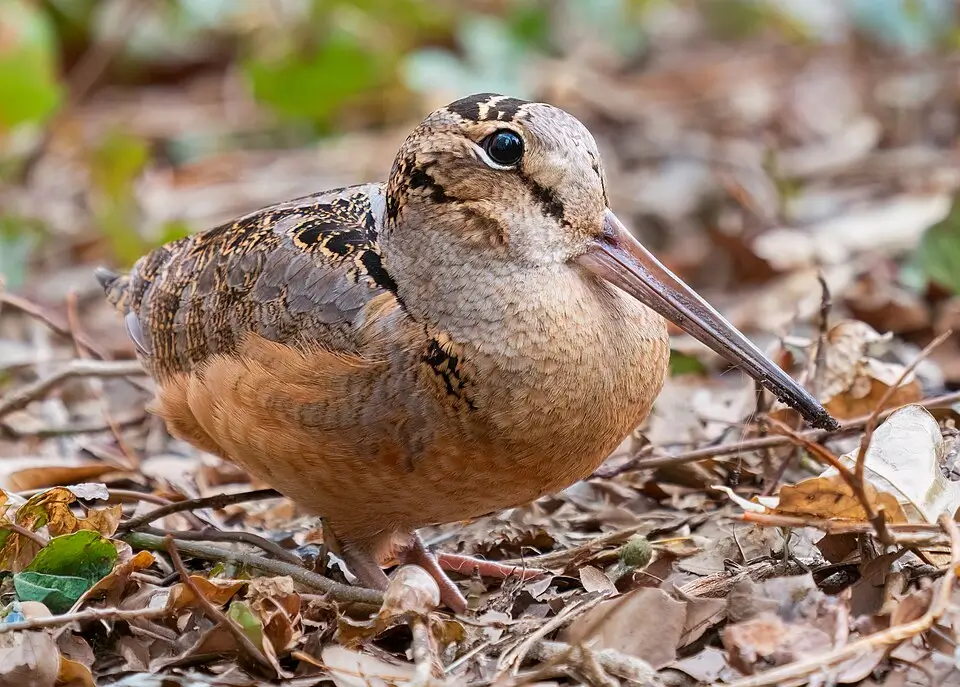
The American woodcock is a compact, rotund bird with a distinctive silhouette that once seen is never forgotten. Its most immediately recognizable feature is its extraordinarily long, flexible bill — a specialized feeding tool perfectly adapted for probing deep into soft, moist soil in search of earthworms, which form the foundation of the bird's diet. The bill's upper mandible is uniquely flexible near the tip, allowing the woodcock to grasp prey underground without fully opening its mouth — a remarkable anatomical adaptation known as rhynchokinesis.
The woodcock's eyes are large and set far back on the sides of its rounded head, providing an almost 360-degree field of vision — a critical adaptation for a bird that spends much of its time with its bill buried in the ground. This unusual eye placement also gives the woodcock a somewhat comical yet endearing expression that has contributed to its popularity among wildlife enthusiasts.
In terms of plumage, the American woodcock is a masterwork of cryptic coloration. Rich browns, russets, tans, and blacks blend together in an intricate pattern that mimics the dead leaves and forest debris of the woodland floor with stunning fidelity. When a woodcock holds still — which it will do until nearly stepped upon — it can be almost impossible to detect, even at close range. Both sexes share this camouflage patterning, though females tend to be larger than males, making the American woodcock an example of reverse sexual size dimorphism — a trait more common in raptors than in shorebirds.
The woodcock's famous courtship display, known as the "sky dance," is performed by males primarily at dawn and dusk during the spring breeding season. The displaying male produces a nasal, buzzy peent call repeatedly from the ground before launching himself into an ascending spiral flight that can carry him hundreds of feet into the air. During this flight, the woodcock's specially modified outer wing feathers produce a distinctive twittering sound. At the peak of his ascent, the male delivers a series of liquid, musical chirping notes before tumbling back earthward in a swooping descent to resume his ground-based calling. This display is repeated night after night throughout the breeding season and is one of the most anticipated natural spectacles of early spring in the eastern woodlands.
Habitat & Range
The American woodcock occupies a broad range across the eastern half of North America. Breeding populations are found across much of the northeastern United States and southeastern Canada, with the species extending westward through the Great Lakes region and into the upper Midwest. The woodcock requires a specific combination of habitat types: young, dense forest or shrubby cover for nesting and roosting, adjacent open fields or forest clearings for the male's courtship display flights, and nearby areas of moist, rich soil — particularly bottomlands, alder runs, and stream corridors — for feeding.
The species is strongly associated with early successional habitats: young forests, regenerating clear-cuts, brushy old fields, and alder thickets. As forests mature and canopy cover closes in, woodcock tend to abandon them in favor of younger, more open cover. This preference for early successional habitat means that the woodcock's fortunes are closely tied to forest management practices across its range.
During fall migration, American woodcock move southward along broad migratory corridors, with birds from across the northern portion of the range funneling through the central and eastern United States on their way to wintering grounds in the Gulf Coast states. North Dakota, situated at the northwestern edge of the woodcock's regular range, can see migrant woodcock moving through the state during the fall, particularly in areas with appropriate habitat along river corridors, wooded coulees, and moist lowland thickets.
Hunting Information
The American woodcock has a long and storied history as an upland game bird. Traditionally hunted with pointing dogs or flushing spaniels in the thick alder runs and birch coverts of the northeastern United States, woodcock hunting is considered by many sporting writers to be one of the most elegant and challenging forms of wing shooting available in North America. The birds' habit of holding tightly for a pointing dog, combined with their explosive, twisting flush through dense cover, creates an experience that is demanding, exciting, and deeply connected to the rhythms of the autumn landscape.
In North Dakota, the American woodcock is classified under the state's "Other Migratory Game Birds" category, as managed by the North Dakota Game and Fish Department. As a migratory bird, the American woodcock is regulated under the framework of the federal Migratory Bird Treaty Act, with seasons and bag limits set in coordination between the U.S. Fish and Wildlife Service and individual states. Hunters in North Dakota who wish to pursue woodcock should consult the North Dakota Game and Fish Department's current regulations for the most accurate and up-to-date season dates, bag limits, and licensing requirements.
It is important to note that hunting migratory birds, including woodcock, requires hunters to be enrolled in the Harvest Information Program (HIP), which is referenced in the North Dakota Game and Fish Department's regulations index. HIP is a federal program designed to improve population estimates for migratory game birds, and certification is required of all migratory bird hunters.
Woodcock hunting in North Dakota tends to occur during the fall migration window, when birds moving south from breeding grounds to the north pass through suitable habitat within the state. Hunters searching for migrant woodcock in North Dakota should focus on moist, wooded bottomlands along river systems, shelterbelt edges adjacent to wet ground, and any areas featuring the dense low cover that woodcock favor for daytime resting. Early morning and late evening are typically the most productive times to hunt, as woodcock tend to be most active during low-light periods.
Traditional woodcock hunting employs a pointing or flushing dog to locate and move birds from dense cover. The woodcock's cryptic plumage makes it almost impossible to spot without a dog's nose, and even when flushed, the bird's twisting, unpredictable flight through woody cover demands quick reflexes and accurate shooting. Lighter gauge shotguns and open choke patterns are generally favored by experienced woodcock hunters to deal with the close-range, fast-moving nature of the shots typically presented.
Conservation
The American woodcock is a species that has attracted significant conservation attention in recent decades. As a species closely tied to early successional forest habitats, the woodcock has faced challenges associated with large-scale changes in land use and forest management across its range. Conservation organizations and wildlife agencies at both the state and federal levels have worked to understand and address the factors influencing woodcock population trends.
Habitat management for American woodcock often involves active forest management practices — including timber harvesting, prescribed burning, and shrubland restoration — that create and maintain the young, brushy cover the species depends upon. Many wildlife management areas, including those managed by the North Dakota Game and Fish Department, incorporate habitat work beneficial to a range of early successional species, which can in turn support migrant woodcock moving through the state.
The American woodcock's status as a migratory species that breeds in Canada and the northern United States and winters along the Gulf Coast means that its conservation requires a truly continental approach, with cooperation among federal and state agencies, Canadian wildlife authorities, private landowners, and conservation organizations across its entire annual range.