The Mourning Dove: An In-Depth Guide to North America's Most Abundant Game Bird
Introduction
The soft, melancholic cooing of the Mourning dove is one of the most recognizable and widespread sounds across the North American continent. Often mistaken for a gentle call of sadness, this vocalization is actually a territorial and mating call, echoing from rural farmlands to suburban backyard feeders. Known scientifically as Zenaida macroura, the Mourning dove is a member of the dove family, Columbidae, and is celebrated for its elegant form, swift flight, and remarkable adaptability. This species holds a unique position in both the natural ecosystem and human culture, being one of the most abundant and popular game birds in the United States. Its presence spans a vast geographical range, from the southern reaches of Canada to deep into Mexico, making it a familiar avian neighbor to millions. This article explores the biological characteristics, widespread habitat, cultural significance, and the principles of its conservation, offering a comprehensive look at this quintessential bird of field and sky.
Biological Traits
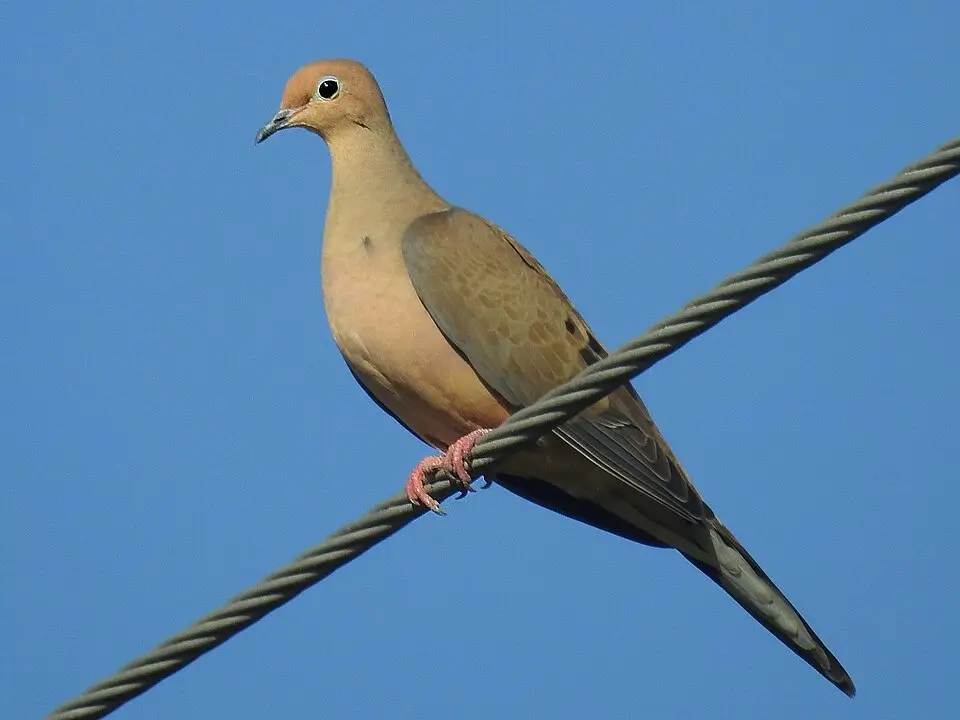
The Mourning dove is a medium-sized, streamlined bird, perfectly built for its characteristic swift and direct flight. Adults typically measure between 9 to 13 inches in length with a wingspan of approximately 17.5 inches, a design that facilitates impressive speeds often exceeding 40 miles per hour. Their plumage is a masterpiece of subtle, camouflaging colors. The upperparts are a warm, dusty brown, while the underparts are a lighter, buffy pink. The most distinctive features are the long, pointed tail bordered by white edges, visible when the bird takes flight, and a small, rounded head. A notable iridescent patch of feathers on the neck, often shimmering with pink and purple hues, catches the light, particularly in males. Their eyes are a striking dark color, encircled by a thin ring of pale blue skin.
One of the most remarkable biological traits of the Mourning dove is its adaptation to granivory, a diet consisting almost exclusively of seeds. Their uniquely structured esophagus allows them to store food in a crop before digestion, enabling them to consume large quantities quickly and digest them later in safety. This is particularly advantageous during feeding. Unlike many birds, Mourning doves drink water using a pumping action, sucking it up without tilting their heads back, a skill necessary as they rarely feed near water sources. Their diet includes seeds from a wide variety of plants, such as sunflower, wheat, corn, and various native weeds and grasses, making them important agents in seed dispersal.
Reproductively, Mourning doves are prolific breeders, which is a key factor in their abundant populations. A pair may raise up to six broods in a single year in warmer southern climates. Their nests are simple, flimsy platforms of twigs, often so loosely constructed that eggs or nestlings can be seen from below. The female typically lays two small, white eggs, which both parents incubate for about two weeks. The hatchlings, known as squabs, are fed a nutrient-rich substance called "crop milk" or "pigeon milk," a secretion from the lining of the parents' crops, which provides essential nutrients for rapid growth. The young fledge in about two weeks, allowing the parents to begin another nesting cycle swiftly.
Habitat & Range
The Mourning dove boasts one of the largest and most diverse ranges of any North American bird. Its breeding territory extends from southern Canada, across the entire continental United States, and down through Mexico into Central America. This incredible range is a testament to its adaptability. While it is fundamentally a bird of open and semi-open habitats, it is not a specialist. It thrives in agricultural fields, grasslands, scattered woodlands, and prairies. Equally, it has adapted remarkably well to human-altered landscapes. Suburban parks, gardens with bird feeders, and even urban areas with sufficient green space can support healthy populations of Mourning doves. Their habitat preferences are strongly tied to the availability of two key resources: food and water. They favor areas where seeds are plentiful on the ground, such as harvested grain fields or areas with abundant weeds. They also require daily access to water for drinking and bathing.
A significant portion of the Mourning dove population is migratory. Those that breed in the northern parts of the United States and southern Canada typically migrate south to the southern United States, Mexico, and Central America for the winter. This migration is a massive annual event, with birds traveling in flocks that can number in the hundreds or thousands. They navigate using a combination of the sun, Earth's magnetic field, and visual landmarks. In contrast, populations in the southern United States and Mexico are often permanent residents, remaining year-round where conditions are favorable. This mix of migratory and resident populations across different latitudes contributes to the species' resilience and constant presence throughout much of its range.
Hunting Information
The Mourning dove is arguably the most popular and widely hunted migratory game bird in North America. Its popularity among hunters stems from several factors: its incredible abundance, the challenging speed and agility of its flight, and its cultural significance as a traditional game species. Mourning dove hunting is a social and sporting event in many communities, often marking the symbolic end of summer and the beginning of the autumn hunting season.
As a migratory bird, the Mourning dove is protected under the federal Migratory Bird Treaty Act. Hunting seasons, bag limits, and other regulations are established through a cooperative framework involving the U.S. Fish and Wildlife Service, individual state wildlife agencies, and the four flyway councils. This ensures harvest is managed sustainably across the bird's range. State wildlife agencies, such as the Arizona Game and Fish Department, set specific season dates, daily bag limits, and possession limits that are tailored to their regional populations and hunting traditions. For hunters in states like Arizona, participating in Mourning dove season requires possessing a valid state hunting license, a federal migratory bird stamp (for hunters aged 16 and older), and completion of a hunter education course. Hunting methods typically involve pass shooting over flight paths, field shooting over harvested grain fields, or hunting near water sources during dry periods.
Conservation
The conservation story of the Mourning dove is a notable success in wildlife management. Despite being one of the most harvested birds on the continent—with tens of millions taken by hunters annually—the population has remained remarkably stable and abundant, estimated to be in the hundreds of millions across North America. This stability is a direct result of rigorous, science-based management practices. Annual breeding population surveys, harvest data analysis, and banding programs provide wildlife managers with the critical data needed to set sustainable hunting regulations.
The Mourning dove's incredible reproductive capacity is the engine of its resilience. The ability to raise multiple broods each season quickly replenishes the population. Furthermore, conservation efforts often focus on habitat preservation and creation. Programs that maintain open grasslands, filter strips along agricultural fields, and provide winter food plots benefit not only Mourning doves but a host of other grassland-dependent species. Hunter-supported conservation groups, such as the National Wild Turkey Federation and Ducks Unlimited, often undertake habitat projects that incidentally benefit doves as well. While not currently a species of conservation concern, ongoing threats such as habitat loss due to intensive agriculture and urban sprawl, and environmental contaminants, are monitored. The continued success of Mourning dove populations depends on the sustained commitment to adaptive management and habitat conservation that has characterized their stewardship for over a century.
Frequently Asked Questions
What is the scientific name of the Mourning dove?
The scientific name of the Mourning dove is Zenaida macroura.
Where do Mourning doves live?
Mourning doves have a vast range across North America, from southern Canada through the entire United States to Mexico and Central America. They thrive in open habitats like fields and prairies and are highly adaptable to suburban and urban environments.
Can you hunt Mourning doves in Arizona?
Yes, Mourning doves are a popular game bird in Arizona. As a migratory species, hunting is regulated under both federal and state laws. Hunters in Arizona must have the appropriate state license, a federal migratory bird stamp, and adhere to the specific season dates and bag limits set by the Arizona Game and Fish Department.
Why is the Mourning dove so abundant despite heavy hunting?
The Mourning dove's abundance is sustained by its high reproductive rate, capable of raising multiple broods per year, combined with rigorous, science-based wildlife management that uses population and harvest data to set sustainable hunting regulations.
What do Mourning doves eat?
Mourning doves are primarily granivores, feeding almost exclusively on seeds. Their diet includes seeds from grains like wheat and corn, as well as from various native weeds and grasses.