The Common Snipe: A Master of Camouflage and a Challenge for Hunters
The world of wetland birds is filled with fascinating species, but few combine cryptic beauty, unique behaviors, and a storied history quite like the Common snipe (Gallinago gallinago). This modest-sized wader, often overlooked due to its superb camouflage, has captured the attention of birdwatchers and hunters alike for centuries. Known for its dramatic aerial displays and challenging nature to flush from cover, the Common snipe is a true specialist of marshy environments across a vast global range. This article delves into the biology, habitat, and cultural significance of this remarkable bird, with a particular look at its context within the diverse landscapes of places like Arizona.
Introduction
The Common snipe is a member of the sandpiper family, Scolopacidae, a group that includes many familiar shorebirds. Its scientific name, Gallinago gallinago, is derived from the Latin word for a chicken or hen, gallina, with a diminutive suffix, likely a reference to its plump body shape and somewhat chicken-like behavior when foraging on the ground. For many observers, the snipe is more often heard than seen. Its presence is frequently announced by a distinctive, rasping "scape" call as it bursts from dense vegetation in a zigzagging, rapid flight.
Historically, the snipe has been an important game bird in Europe and North America. The term "sniper" actually originates from the 18th-century British Empire in India, where hunting the elusive common snipe was considered a supreme test of a marksman's skill. The bird's erratic flight pattern and the difficulty in spotting it in its wetland habitat required exceptional precision and stealth, qualities that came to define a "sniper." This legacy connects the bird directly to a term now universally recognized, underscoring its enduring place in both natural history and human culture.
Biological Traits
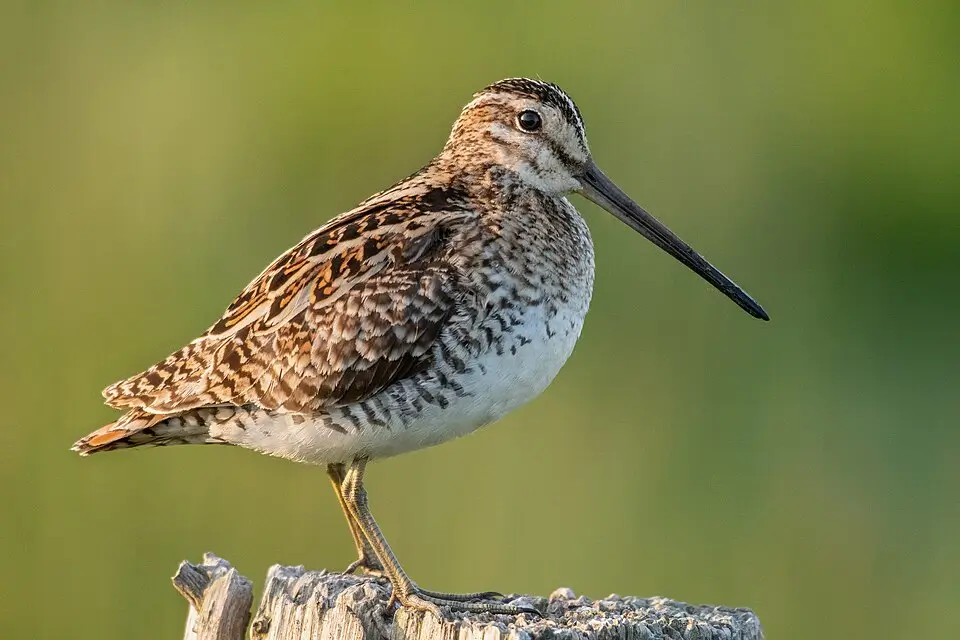
The Common snipe is a compact, stocky bird, typically measuring between 25 to 27 centimeters (10 to 11 inches) in length, with a wingspan of about 44 to 50 centimeters (17 to 20 inches). Its most striking feature is its extraordinarily long, straight bill, which can be over 6 centimeters (2.5 inches) long. This bill is not just for show; it is a highly sensitive tool, equipped with tactile receptors at the tip. These receptors allow the snipe to probe deep into soft mud and feel for worms, insect larvae, and other invertebrates, effectively "seeing" with its bill in the murky substrate where its prey lives.
The bird's plumage is a masterpiece of camouflage. Its upperparts are a complex mix of buff, brown, black, and white stripes, designed to perfectly blend with the dappled light and shadows of a marsh or wet meadow. Its underparts are generally lighter, with a white belly and buff-colored breast and flanks marked with dark bars. Two prominent pale stripes run along the crown of its head, a key identification feature. When standing still, a snipe can be nearly invisible against a backdrop of reeds and grass.
One of the most celebrated behaviors of the Common snipe is its aerial display during the breeding season. Males perform a "drumming" or "winnowing" display. They fly high in a wide circle before diving rapidly towards the ground. As they pull up at the last moment, their stiff, outer tail feathers vibrate in the wind, producing a haunting, bleating sound often compared to a distant sheep or a hollow, throbbing note. This sound is used to attract females and declare territory.
Like many birds, the Common snipe is migratory. Populations that breed in the northern parts of Eurasia and North America migrate south to spend the winter in milder regions. This migratory pattern brings them through a variety of habitats and makes them a seasonal visitor in many areas.
Habitat & Range
The Common snipe is a bird of wetlands. Its preferred breeding habitat consists of marshes, bogs, wet meadows, and the margins of slow-moving streams and ponds across the Palearctic and Nearctic realms—essentially, northern Europe, Asia, and North America. It requires areas with saturated soil for feeding and dense, low vegetation for nesting and concealment.
During migration and in winter, its habitat broadens slightly, but it remains tied to water. It can be found in coastal marshes, flooded agricultural fields, sewage ponds, and the muddy edges of lakes and rivers. In North America, its wintering range extends across the southern United States, Mexico, and into Central America. The bird is a year-round resident in some milder western European coastal areas.
When considering a state like Arizona, which is primarily characterized by arid and semi-arid landscapes, the presence of the Common snipe is entirely dependent on the availability of suitable wetland habitats. Arizona is not typically considered a core stronghold for the species. However, the state does contain critical oases and riparian corridors that serve as vital stopover points for migratory birds traveling along the Pacific and Central flyways. Areas like the San Pedro River, the Colorado River corridor, and various high-elevation marshy meadows and reservoir margins can provide the necessary conditions for snipe to rest and refuel during migration. Therefore, while not a common breeding ground, Arizona can host Common snipe as seasonal visitors, particularly in the cooler months when birds move southward from their northern breeding grounds. Sightings are most likely in the southeastern and central parts of the state where water is more reliably present.
Hunting Information
The Common snipe has a long and respected history as a game bird. Hunting it is considered a challenging and rewarding pursuit, often attracting dedicated enthusiasts. The skill required stems from the bird's behavior: snipe hold tight in cover, exploding into flight at the hunter's feet with a distinctive, sharp "scaipe!" call. Their rapid, twisting, and irregular flight path makes hitting them consistently a true test of wing-shooting ability.
It is crucial for any potential hunter to understand that hunting regulations, including season dates, bag limits, and licensing requirements, are strictly defined and enforced by state wildlife agencies. These regulations are based on scientific population data and are designed to ensure sustainable harvest. The provided source data does not contain specific official hunting information for Arizona or any other state. Therefore, anyone interested in hunting Common snipe must consult the authoritative and current regulations published by the relevant state's wildlife management agency.
In the United States, the Common snipe is managed as a migratory bird under frameworks established by the U.S. Fish and Wildlife Service in coordination with state agencies. This typically means a federal migratory bird stamp (duck stamp) may be required in addition to a state hunting license and any state-specific game bird validations. Seasons generally occur in the fall and winter, aligning with the birds' migration and presence in the state.
For a state like Arizona, where snipe are primarily migrants, the hunting opportunity would be seasonal and localized. Hunters would need to identify areas with appropriate wetland habitat during the times snipe are present. The Arizona Game and Fish Department would be the definitive source for whether a season is established, its dates, and any zone-specific rules. Responsible hunting involves not only abiding by the law but also practicing ethical shot selection, retrieving all downed birds, and respecting the wetland habitats that support the species.
Conservation
The global population of the Common snipe is estimated to be large, and the species is currently classified as "Least Concern" by the International Union for Conservation of Nature (IUCN). This positive status reflects its wide distribution and presumably stable population trend in many areas.
However, like all wetland-dependent species, the Common snipe is vulnerable to the loss and degradation of its habitat. Wetlands are among the most threatened ecosystems worldwide, drained for agriculture, development, or altered by water diversion and pollution. Climate change also poses a significant long-term threat by altering precipitation patterns and the hydrology of breeding and wintering grounds.
Conservation efforts for the Common snipe are inherently linked to the broader protection of wetland ecosystems. International agreements like the Ramsar Convention on Wetlands, along with national laws and local conservation initiatives, play a vital role in preserving the marshes, bogs, and meadows that snipe and countless other species depend upon. In regions like the American Southwest, preserving riparian corridors and managing water resources are essential for maintaining these critical migratory stopovers. The continued health of the Common snipe population is, therefore, a good indicator of the health of the wetland environments across its range, reminding us of the interconnectedness of all species within an ecosystem.
In conclusion, the Common snipe is far more than just a game bird. It is a symbol of wild, watery places, an evolutionary marvel with its sensitive bill and cryptic plumage, and a performer of one of nature's most unique aerial displays. Whether observed during a quiet walk in a marsh or pursued as a challenging quarry, it commands respect and admiration, embodying the intricate beauty of the natural world.
Frequently Asked Questions
What is the scientific name of the Common snipe?
The scientific name of the Common snipe is Gallinago gallinago.
Why is the Common snipe considered a difficult bird to hunt?
The Common snipe is considered difficult to hunt because of its superb camouflage in wetland vegetation, its tendency to flush suddenly at close range, and its fast, erratic, zigzagging flight pattern, which makes it a challenging target for wing-shooters.
What kind of habitat does the Common snipe live in?
The Common snipe lives in wetland habitats such as marshes, bogs, wet meadows, and the muddy edges of ponds, rivers, and lakes. It requires soft, wet soil for feeding and dense, low vegetation for cover.
Can you hunt Common snipe in Arizona?
While the Common snipe may occur in Arizona as a migrant in suitable wetland areas, specific hunting regulations, including season dates and licensing, are not provided in the source data. Anyone interested must consult the official regulations from the Arizona Game and Fish Department for current and authoritative information.
What is the conservation status of the Common snipe?
The Common snipe is currently listed as 'Least Concern' by the IUCN, indicating a large global population. However, its survival is tied to the conservation of wetland habitats, which are under threat from drainage, pollution, and climate change.