The Chukar: A Comprehensive Guide to the Mountain Partridge
The Chukar (Alectoris chukar) is a striking and resilient bird that has captured the fascination of birdwatchers, hunters, and naturalists alike. Known for its distinctive call and remarkable adaptability to harsh environments, this partridge species represents a remarkable success story in avian evolution. From the rocky slopes of the Himalayas to the arid landscapes of the western United States, the Chukar has established itself as a true mountain specialist, embodying the rugged beauty and tenacity of the high-altitude ecosystems it calls home.
As a member of the Phasianidae family, which includes pheasants, quail, and other partridges, the Chukar shares many characteristics with its ground-dwelling relatives while maintaining unique traits that set it apart. Its introduction to North America in the early 20th century has created new opportunities for observation and hunting, while also presenting interesting ecological questions about species adaptation and management. This article explores the fascinating world of the Chukar, examining its biological characteristics, natural history, habitat requirements, and the various ways humans interact with this remarkable bird.
Biological Traits
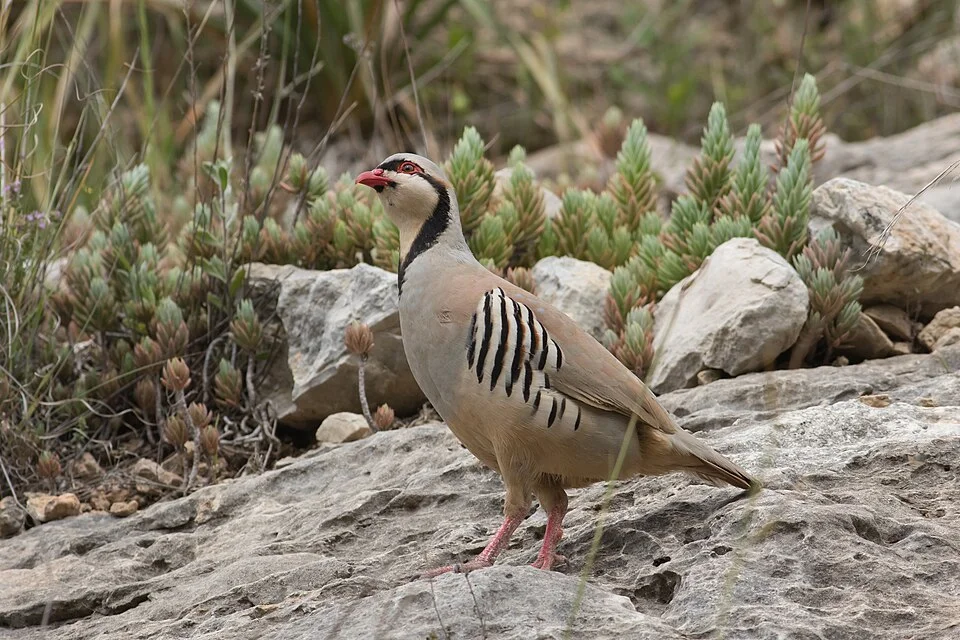
The Chukar presents a beautiful example of natural camouflage and functional design. Adults typically measure between 32 to 35 centimeters (13 to 14 inches) in length, with a weight ranging from 450 to 700 grams (approximately 1 to 1.5 pounds). Their plumage is predominantly grayish-brown on the upperparts, transitioning to a warmer buff color on the underparts. The most distinctive marking is the bold black band that runs across the forehead and through the eyes, creating a striking "mask" effect. This is complemented by a white throat and a black collar that encircles the lower neck.
The bird's flanks display beautiful barring patterns, with alternating bands of black, white, and chestnut-brown that provide excellent visual disruption in their rocky habitats. The bill is a vibrant red-orange, matching the bird's strong legs and feet, which are perfectly adapted for life on steep, uneven terrain. Sexual dimorphism is subtle in Chukars, with males typically being slightly larger and possessing leg spurs, though females may occasionally develop small spurs as well.
In terms of behavior, Chukars are highly social birds, often found in coveys of 10 to 40 individuals, particularly during the non-breeding season. Their vocalizations are iconic, with the namesake "chuk-ar" call serving various purposes, including territorial proclamation, communication between mates, and alerting the covey to potential threats. During the breeding season, pairs form, and males perform courtship displays that include strutting, tail fanning, and offering food items to females.
Reproduction follows a seasonal pattern tied to environmental conditions. Females typically lay between 8 to 20 eggs in a shallow scrape on the ground, often well-concealed among rocks or vegetation. The nest is a simple depression lined with grass and leaves. After an incubation period of approximately 23 to 25 days, the precocial chicks hatch fully feathered and mobile. They can feed themselves almost immediately, though they remain under the protection of both parents for several weeks. The young birds grow rapidly and are capable of short flights within 10 to 14 days of hatching.
The Chukar's diet is primarily herbivorous, consisting of seeds, leaves, grasses, and other plant materials. They also consume insects and other small invertebrates, particularly during the breeding season when protein demands increase for egg production and chick growth. Their feeding behavior involves scratching at the ground with their strong feet to uncover food items, a characteristic trait of many gallinaceous birds.
Habitat & Range
The native range of the Chukar spans a vast area across Eurasia, from the eastern Mediterranean region through the Middle East and Central Asia to the Himalayas and western China. This extensive distribution encompasses a variety of habitats, but the species shows a strong preference for rocky, mountainous terrain between 1,500 to 4,500 meters (approximately 4,900 to 14,800 feet) in elevation. They are particularly associated with arid and semi-arid environments, including rocky slopes, cliffs, canyons, and sparse scrublands.
Within these habitats, Chukars demonstrate remarkable adaptations to water scarcity. They can survive for extended periods without direct water sources, obtaining much of their moisture from dew, succulent plants, and the insects they consume. When water is available, they drink regularly, often visiting the same water sources at dawn and dusk. Their ability to thrive in dry conditions has been crucial to their success across their native range.
The species' introduction to North America began in the late 19th and early 20th centuries, with multiple release attempts across the western United States and Canada. The most successful introductions occurred in the 1930s, particularly in the Great Basin region, which includes parts of Nevada, Utah, Idaho, Oregon, and California. The landscape and climate of this region closely resemble the Chukar's native Central Asian habitats, providing ideal conditions for establishment.
Today, self-sustaining populations exist throughout much of the Intermountain West, from southern British Columbia through Washington, Oregon, Idaho, Nevada, Utah, California, Arizona, and into Montana and Wyoming. These introduced populations have adapted remarkably well to their new environments, often occupying niches similar to those in their native range—steep, rocky hillsides with sparse vegetation, particularly areas with cheatgrass and other annual plants that provide both food and cover.
The birds' habitat preferences are closely tied to their survival strategies. Rocky areas provide protection from predators, thermal regulation opportunities (using sun-warmed rocks in cooler temperatures and shade during heat), and nesting sites. The vegetation in these areas, while often sparse, provides the seeds and plant materials that form the bulk of their diet. Seasonal movements may occur in some populations, with birds moving to lower elevations during harsh winter conditions when snow cover reduces food availability.
Hunting Information
The Chukar has become a prized game bird across much of its introduced range, particularly in the western United States where healthy populations support recreational hunting. Pursuing Chukar is often described as both challenging and rewarding, requiring physical endurance, sharp shooting skills, and strategic thinking. The birds' preference for steep, rugged terrain means hunters must be prepared for demanding hikes in often remote areas.
Hunting strategies for Chukar typically involve walking up birds with the assistance of pointing dogs. English setters, German shorthaired pointers, and various other breeds are commonly used to locate and hold coveys. The moment a dog locks on point, hunters must prepare for explosive flushes, often with multiple birds taking flight simultaneously in different directions. Shotguns in 12, 16, or 20 gauge with improved cylinder or modified chokes are commonly used, with shot sizes typically ranging from 6 to 7½.
The hunting season for Chukar generally aligns with other upland game bird seasons, typically beginning in the fall and extending through winter months. Specific dates, bag limits, and regulations vary by state and are established by wildlife management agencies based on population surveys and ecological considerations. Hunters must always consult the current regulations for their specific state and hunting area before participating.
Beyond the sporting challenge, Chukar hunting provides an opportunity to experience some of the most beautiful and dramatic landscapes in the western United States. The pursuit often takes hunters through remote canyons, across high desert plateaus, and along rocky ridgelines with spectacular vistas. Many hunters consider the experience of being in these environments, regardless of harvest success, to be a primary reward of Chukar hunting.
For those new to Chukar hunting, several practical considerations are important. The physical demands of the terrain cannot be overstated—proper hiking boots with good ankle support are essential, as is carrying adequate water, even in cooler temperatures. The birds' alert nature and preference for broken terrain mean that shots are often challenging, with quick presentations at varying angles and distances. Practice with clay targets simulating crossing and incoming shots can help prepare hunters for these field conditions.
Conservation
The conservation status of the Chukar is generally stable and secure across most of its range. According to the International Union for Conservation of Nature (IUCN), the species is classified as "Least Concern," indicating that it does not currently face significant threats of extinction at a global level. This positive status reflects the species' wide distribution, large population size, and adaptability to various habitats within its native range.
In their native Eurasian habitats, Chukar populations face some localized pressures, including habitat degradation from overgrazing, hunting pressure in certain areas, and predation by various raptors and mammals. However, these factors have not significantly impacted overall population stability. The species' reproductive rate—producing relatively large clutches—helps maintain healthy populations despite these natural and anthropogenic challenges.
In North America, where Chukar populations exist as introduced species, conservation and management focus primarily on maintaining sustainable harvest levels through regulated hunting. State wildlife agencies conduct annual population surveys to monitor trends and adjust hunting regulations accordingly. These management practices aim to balance recreational opportunities with long-term population health.
Habitat conservation plays a crucial role in maintaining healthy Chukar populations. In the western United States, threats to habitat include wildfire, invasive plant species, development, and changes in land use. Conservation efforts often focus on maintaining intact landscapes with the rocky terrain and native vegetation that Chukars require. Partnerships between government agencies, conservation organizations, and private landowners work to protect these areas through various mechanisms, including conservation easements and habitat restoration projects.
Research continues to improve our understanding of Chukar ecology and population dynamics. Studies examine factors affecting survival, reproduction, habitat use, and responses to environmental changes. This scientific information helps inform management decisions and conservation strategies. Citizen science projects, including bird counts and hunter harvest surveys, provide valuable data that contribute to these efforts.
The future of Chukar conservation appears promising, with stable populations across most of their range and effective management practices in place. Continued monitoring, habitat protection, and adaptive management will be essential to ensuring that this remarkable bird continues to thrive in both its native and introduced ranges. The Chukar serves as an excellent example of how thoughtful wildlife management can support both ecological health and recreational opportunities.
Frequently Asked Questions
What does a Chukar bird look like?
The Chukar is a rotund, grayish-brown bird with a distinctive black mask across its eyes, a white throat, and a black collar around its lower neck. Its sides display striking black, white, and chestnut barring, and it has a bright red-orange bill and legs.
Where can Chukar birds be found?
Chukars are native to rocky, mountainous regions from the Mediterranean through Central Asia to the Himalayas. They have been successfully introduced to the western United States, particularly in the Great Basin region, where they inhabit similar dry, steep, and rocky terrain.
What is the Chukar known for?
The Chukar is known for its loud 'chuk-ar' call, its remarkable ability to thrive in arid, rugged environments, and as a challenging and popular upland game bird among hunters.
What do Chukar birds eat?
Chukars are primarily herbivorous, feeding on seeds, leaves, grasses, and other plant materials. They also consume insects and small invertebrates, especially when breeding.
Are Chukar populations stable?
Yes, globally the Chukar is classified as a species of 'Least Concern' by the IUCN, with stable populations across its extensive native range and well-managed introduced populations in North America.