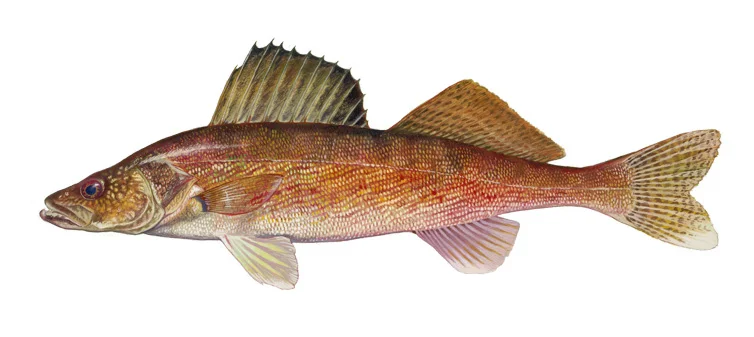
Description: Walleye are recognized by their large, silvery eye, sharp teeth, and a spiny anterior dorsal fin. They can be told apart from sauger by the absence of spots on the dorsal fin and a black membrane between the last two or three spines. They also have a white tip on the lower tail lobe. Introduced to Wyoming in the early 20th century, walleye did not fully establish in Wyoming waters until the 1960s.
Habitat: Though occasionally found in rivers (especially during spring spawning), walleye prefer large lakes and reservoirs. Key waters include Glendo, Alcova, Pathfinder, Seminoe, Boysen, Keyhole, and Grayrocks reservoirs, plus Lake DeSmet.
Diet: Walleye are one of the top carnivores in Wyoming waters. They are most active at night, dusk, and early morning, when they feed in shallower inshore waters.
Size: Reproductively mature walleye measure roughly 15–17 inches. They can reach lengths over 34 inches. Typical weight is under 5 pounds.
Lifespan: Typically about 10 years in the wild, though they can survive 20–25 years.
Habitat & Range
Walleye prefer large lakes and reservoirs. Though occasionally found in rivers during spring spawning, key Wyoming waters include Glendo, Alcova, Pathfinder, Seminoe, Boysen, Keyhole, and Grayrocks reservoirs, plus Lake DeSmet and Ocean Lake.
Life History
Walleye are most active at night, dusk, and early morning. Spawning occurs primarily in April on rocky shorelines of lakes and reservoirs, though some migrate into rivers to spawn in gravel beds. Their eyes feature a tapetum lucidum that enhances vision at night and in turbid water. Lifespan: about 10 years typically, up to 20–25 years.
Status, Trends & Threats
Most Wyoming walleye populations are sustained through natural reproduction. The Game and Fish Department stocks some waters where natural reproduction cannot sustain quality angling. The department does not stock walleye in waters containing native sauger to reduce hybridization risk.
License & Regulations
A valid Wyoming fishing license is required for anglers age 14 and older. Licenses are available for residents, non-residents, and short-term durations (1-day and annual). Purchase online through the Wyoming Game and Fish Department website or at authorized license retailers throughout the state.
Frequently Asked Questions
Description
Walleye are recognized by their large, silvery eye, sharp teeth, and a spiny anterior dorsal fin. They have a white tip on the lower tail lobe and no spots on the dorsal fin.
Habitat
Walleye prefer large lakes and reservoirs. Key Wyoming waters include Glendo, Alcova, Pathfinder, Seminoe, Boysen, Keyhole, and Grayrocks reservoirs, plus Lake DeSmet.
Diet
Walleye are one of the top carnivores in Wyoming waters, most active at night, dusk, and early morning when they feed in shallower inshore waters.
Size
15–17 inches at maturity, up to 34+ inches. Typical weight under 5 pounds. State record: 17.42 pounds at 34 inches.
State Record
17.42 pounds, 34 inches
Life Cycle
Spawning occurs in April on rocky shorelines or gravel beds. Walleye have a tapetum lucidum for enhanced night vision. Lifespan: about 10 years, up to 20–25 years.
Regulations
Walleye is classified as a game fish in Wyoming. A valid Wyoming fishing license is required. Anglers must distinguish walleye from sauger where both exist, as creel limits differ. Check Wyoming Game and Fish Department regulations for current rules.
References
| State | Category | Directory | Subcategory | Content | Source |
|---|---|---|---|---|---|
| Wyoming | Fishing | License | License & Fees | A valid Wyoming fishing license is required for anglers age 14 and older. Licenses are available for residents, non-resi | Link |