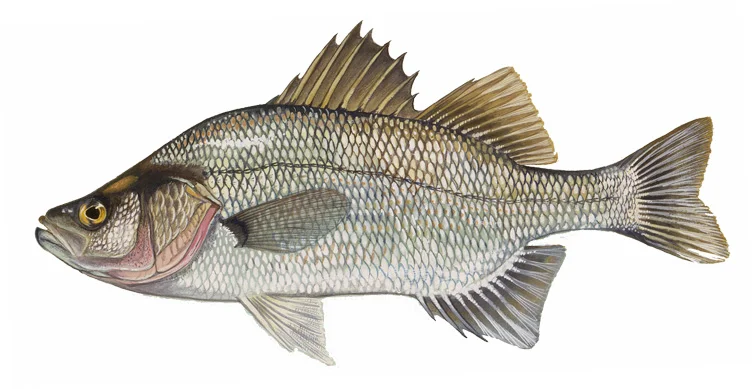
Fisheries biologists are concerned about white perch because its prolific reproductive capabilities give it a competitive advantage over some more desirable species. Although scorned by some fishermen as a pest (small size), the white flaky flesh of the white perch is among the best.
Range: All reservoirs except Keowee and Jocassee
Commonly Mistaken Species: Some species of fish that are commonly mistaken for this species: Hybrid bass Striped bass White bass
Identifying The Temperate Bass of South Carolina
Habitat & Range
White perch were primarily found in estuarine and marine habitats throughout the Atlantic coast southward to areas near Charleston, SC. It is now common that they also inhabit the Piedmont in the Pee Dee, Santee, Cooper, Broad, Saluda and Savannah rivers and many of the inland reservoirs such as lakes Murray, Greenwood, Thurmond and Wateree.
Life History
Spawning: - White perch are a schooling species that are semi-anadromous, meaning they move between estuarine and fresh waters to spawn.
- From April to June, when water temperatures average 50-60°F, white perch migrate from estuarine waters into large rivers where females release up to 150,000 adhesive eggs.
- Populations that are locked within reservoirs do not follow this pattern, but instead migrate within the reservoir.
- Immediately following the laying of the eggs, males release millions of sperm cells. In spite of this haphazard spawning ritual, the ratio of hatched eggs is enormous when compared to other fish.
- Eggs can hatch in as little as 30 hours or take as long as six days depending on water temperature.
Diet: - They have a diverse diet including worms, shrimp, crabs, insects and small fishes.
Frequently Asked Questions
Size
6-9 inches Less than 1 pound, most landlocked specimens less than 1/3 pound
Lifespan
Approximately 17 years
State Record
: 1-15.2 pounds (2007)