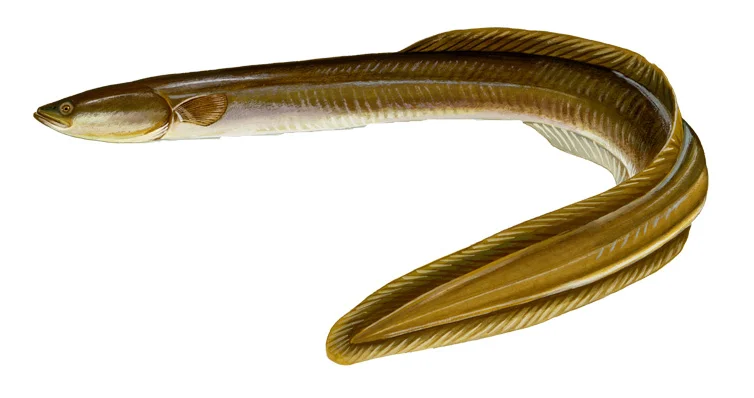
Eels are highly esteemed food fish, particularly in Europe and Japan where they are served smoked, pickled and fried. Eels can be caught by angling but they are generally caught by trapping.
Range: Primarily in the Coastal Plain, rare in Piedmont
Commonly Mistaken Species: One species of fish that is commonly mistaken for this species:
Lamprey
Habitat & Range
In freshwater, female American eels prefer coastal rivers and reservoirs where the males locate close to tidal areas.
Life History
Spawning: - American eels are diadromous fishes, migrating between fresh and salt waters. Spawning begins when adults leave freshwater and brackish habitats and migrate to an area in the Atlantic Ocean east of the Bahamas and southwest of Bermuda in the region referred to as the Sargasso Sea.
- Very little is known of the actual act of spawning as it has never been observed. The eels begin their life as planktonic larva called a leptocephalus. The leptocephalus is transparent and ribbonlike as it floats in the currents of the ocean for up to a year before it metamorphoses into the next stage as a glass eel.
- Glass eels can be found in coastal rivers and streams during late winter and spring. The glass eels then metamorphose into the elver stage.
- Elvers appear by the thousands at the mouth of creeks and rivers as they migrate upstream to grow.
- Before sexual maturation, the eels, both sexes, appear yellow in color. Once sexually mature, both sexes of eels appear silver and head to the ocean to reproduce once more.
Diet: - Fish, insects, worms, snails, clams and crabs.
Frequently Asked Questions
Size
2 ½ feet ½ to 3 pounds
Lifespan
Approximately 25 years (southern populations: females, 9 years and males, 5 years)