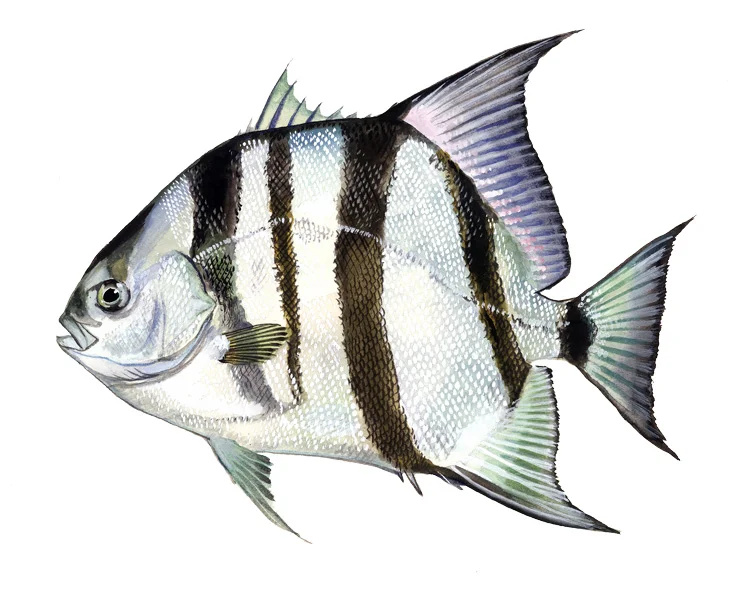
Silver-gray to yellowish; disc shaped, nearly as deep as long; sides with 4 – 6 black vertical bars that may fade with age. First rays of anal and second dorsal fins elongate, forming a point. First dorsal fin spiny. Mouth small.
Habitat & Range
Adults: Inhabit nearshore and offshore waters, typically over rocky or live bottom habitat and in association with wrecks, artificial reefs, and piers.
Juveniles:Tolerate wide salinity ranges; utilize estuaries , harbors, rivers, and tidal creeks , often in association with hard bottom, or sub tidal oyster reefs .
Life History
Reproductive Cycle: - Both sexes mature by 1 year of age. Approx. size at maturity: males – 3 ¾ inches, females – 4 ¾ inches.
- Spawning occurs at the surface in offshore waters during May – September (peak May-June).
- Larvae inhabit warm, higher salinity nearshore coastal surface waters. Juveniles often utilize estuaries as nursery grounds.
Foraging Habits: - Generalist feeders during daylight on a wide variety of invertebrate prey. Foraging occurs throughout the water column, along bottom, and on, around, or within manmade structure.
- Prey includes sponges, polychaete and sabellid worms, tunicates, hydrozoans, soft corals, amphipods, anemones, algae, and crustacean larvae.
Status, Trends & Threats
- Distribution is primarily temperature dependent. Present in nearshore waters April – November. Juveniles leave estuaries during fall and join adults in shallow offshore waters; younger fish may remain near offshore artificial reefs almost year-round. Older fish probably overwinter in deep water offshore; some may also move southward as nearshore waters cool during fall.
- Form schools of a few to several hundred fish. Strong schooling behavior in vicinity of manmade structure could increase vulnerability to fishing pressure.
- No commercial fishery exists in South Carolina.
- Conservation concerns: degradation or loss of nearshore larval habitat and estuarine nursery grounds; degradation or loss of limited nearshore live and hard bottom habitats; potential for overfishing; lack of knowledge regarding basic biology of spadefish in South Carolina waters.
Frequently Asked Questions
Size & Record
12 - 18 inches, 6 pounds; South Carolina State Record: 14 pounds, 2 ounces (2005); maximum age: at least 8 years