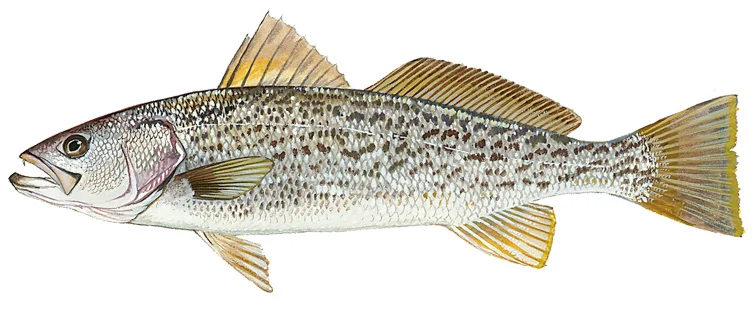
Greenish above, silver below. Sides and back with numerous black spots forming wavy lines. Fins yellowish. Mouth large and superior with two canine-like teeth at tip of upper jaw. No chin barbels.
Habitat & Range
Adults: Inhabit estuaries as well as bays, sounds, and nearshore coastal waters. Prefer sandy bottoms and at the edges of grass beds where their prey are concentrated.
Juveniles: Tolerate wide salinity ranges. Utilize estuaries as nursery grounds, especially over sandy or sand-grass bottoms in moderate salinity water. Move to deeper channels, rivers, bays and sounds with age.
Life History
Reproductive Cycle: - Both sexes mature by 1 – 2 years; approx. length at maturity: males – 7 inches, females – 9 inches.
- Spawning occurs in deeper reaches of estuaries and nearshore bays and sounds from March – October (peak April – June). Males form spawning aggregations and attract females by using muscle contractions to vibrate the swimbladder.
- Larvae become demersal (occupying the sea floor) shortly after hatching and utilize tidal currents to reach low salinity nursery habitats in upper reaches of estuaries. Juveniles leave estuaries and migrate to coastal waters during fall.
Foraging Habits: - Adults: Visual predators with generalized diet; typically feed at periphery of estuarine grass beds. Primarily consume menhaden, herring, anchovies, croaker, spot, penaeid shrimp, and crabs.
- Juveniles: Primary prey species include mysid shrimp and clupeid fishes (anchovies). Larvae feed on zooplankton.
Status, Trends & Threats
- Distribution is primarily temperature regulated. Present year-round in South Carolina though not as numerous as in Chesapeake Bay and northward; most abundant April – November. Overwinter in continental shelf waters; migration is offshore and southward in fall, inshore and north in spring. Large schools may form as water temperatures decrease during fall and excessive cold my result in mortality.
- Weakfish stocks are characterized by heavy interannual variability, most likely due to inconsistent recruitment of larvae and juveniles. Stocks are also currently enduring long-term declines, though apparently not due to fishing pressure.
- No commercial fishery currently exists for weakfish in South Carolina.
- Conservation concerns: degradation and loss of estuarine habitat; potential for significant larval and juvenile mortality; potential for significant recreational harvest; lack of biological data for weakfish in South Carolina waters.
Frequently Asked Questions
Size & Record
13 inches, 1 pound; South Carolina State Record: 11 pounds, 13 ounces (1981); maximum age: approx. 11 – 12 years, older individuals reported from northern portion of geographic range.