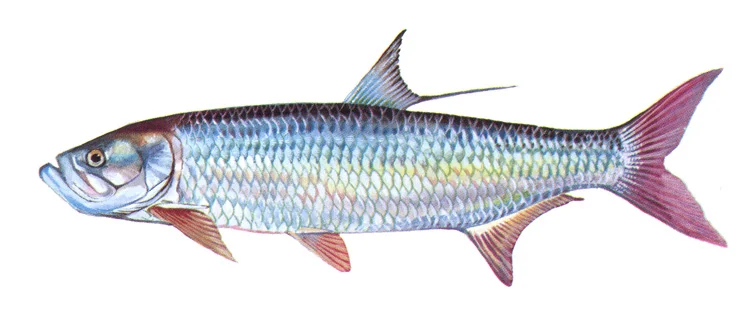
Silvery, scales large, eyes large; lower jaw projects forward of fish. Dorsal fin originates near mid-point of body; last ray on dorsal fin filamentous and very long.
Habitat & Range
Juveniles and adults inhabit temperate and tropical waters and are capable of tolerating wide salinity ranges. Larger fish are primarily marine but may enter brackish estuaries and fresh water rivers.
Adults: Typically inhabit nearshore waters including bays, sounds, or estuaries ; also enter rivers.
Juveniles: Prefer salt marsh and estuarine habitats; may move into fresh water impoundments and upper reaches of coastal rivers; older juveniles move to deeper canals, bays, and coastal waters.
Life History
Reproductive Cycle: - Both sexes mature by approximately 10 years of age; approx. size at maturity: males – 35 inches, females – 49 inches.
- Spawning most likely occurs offshore after migration from inshore aggregation areas. In South Carolina, spawning occurs May – August.
- Larvae proceed through a leptocephalus larva stage lasting 2 – 3 months. These transparent, leaf-like larvae require high-salinity, oceanic water and metamorphose offshore prior to moving to inshore nursery habitats.
Foraging Habits: - Adults and older juveniles are mostly piscivorous (fish-eating) and consume mid-water prey. Prey species include: striped mullet, silversides, salt water catfishes, pinfish, menhaden, and ribbonfish. May also consume blue crab and penaeid shrimp.
- Young juveniles consume small fishes, crabs, grass shrimp, and zooplankton; may also capture insects.
Status, Trends & Threats
- In South Carolina from April to peak in July/August. Distribution is temperature regulated. Tarpon inhabit temperate to tropical waters and may be cold stunned and die in water less than 50degF. Probably overwinter in Florida waters, migrating north in spring, south in fall.
- Tarpon may form schools of a few to more than a hundred fish, especially in preparation for spawning.
- Adults and older juveniles tolerate low-quality habitats such as shallow, muddy, and anoxic water due to their ability to breathe air through a modified swimbladder.
- Conservation concerns: Degradation of estuarine nursery grounds; inshore and nearshore water quality; location of spawning areas unknown; lack of biological data for this species in South Carolina waters.
Frequently Asked Questions
Size & Record
40 – 60 inches, 40 – 60 pounds; South Carolina State Record: 154 pounds 10 ounces (1987); maximum age: approx. 50 years – possibly up to 70 years.