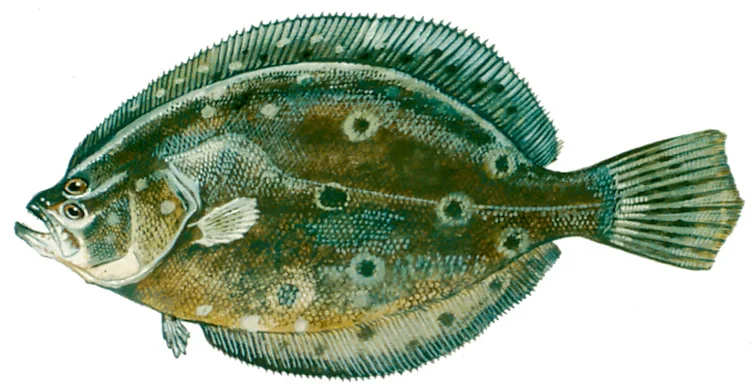
Dorsoventrally flattened body with both eyes on left side of body; color varies with upper side assuming coloration of surrounding habitat. Five prominent ocellated spots on posterior portion of body forming two triangles. Dorsal fin originates at anterior portion of eye.
Habitat & Range
Adults: Inhabit lower to middle reaches of estuaries , coastal bays, and shallow nearshore shelf waters; typically burrow into sandy to slightly muddy bottoms; occupy a variety of estuarine habitats including tidal creeks and areas with submerged vegetation; also around inlets, jetties, beaches and nearshore reefs.
Juveniles: Utilize bays, estuaries , tidal creeks , submerged vegetation and oyster reefs as nursery habitats. Larvae enter lower salinity waters in upper reaches of estuary whereas juveniles typically reside in moderate salinity waters.
Life History
Reproductive Cycle: - Both sexes mature by 2 years of age; approx. size at maturity: males – 9 inches, females – 11 inches.
- Spawn along continental shelf during seasonal migrations to offshore overwintering grounds; exact spawning locations unknown. In the South Atlantic Bight, spawning occurs November – February. Fish return to inshore habitats during spring.
- Young larvae develop offshore as plankton; older larvae utilize tidal currents and vertical migrations in water column to enter estuaries during winter and spring. Postlarvae complete metamorphosis to bottom dwelling fish after settlement in the estuary.
Foraging Habits: - Predatory using camouflage to blend into surrounding habitats; foraging occurs during daylight; prey ambushed or stalked along the bottom.
- Adults: Consume anchovy, menhaden, bluefish, weakfish, mummichog, penaeid shrimp, crabs, squid, bivalve mollusks, and worms.
- Juveniles: Young flounder consume mostly invertebrates (mysids, polychaete worms, grass shrimp); fish constitute greater portion of diet with age. Larvae eat zooplankton.
Status, Trends & Threats
- Less abundant in South Carolina waters than P. lethostigma, but dominates flounder abundance from North Carolina northwards. Seasonal distribution is primarily temperature regulated. In South Carolina, may overwinter in estuaries or deeper nearshore waters, elsewhere offshore migrations are made as water cools during fall and overwinter on continental shelf.
- Tolerate a wide salinity range; however, typical habitat is higher salinity than that of the southern flounder and growth is apparently optimal at intermediate (≥ 10 ppt) salinities. Adults generally prefer salinities ≥ 28 ppt.
- Conservation concerns: lack of knowledge regarding summer flounder biology and movements in South Carolina waters; degradation or loss of estuarine nursery habitat. .
Frequently Asked Questions
Size & Record
14.7 inches, 1.5 pounds; South Carolina State Record: 3 pounds, 8 ounces (1982) maximum age: approx. males – 7 years, females 12 – 20 years; due to fishing pressure max. age probably not reached (realized max. age is approx. 3 – 4 years in South Atlantic Bight).