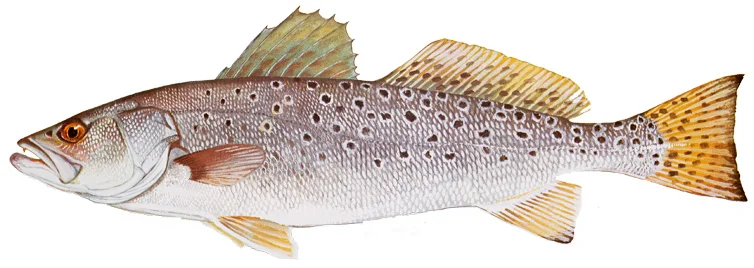
Dark gray above with bluish reflections. Numerous round black spots irregularly scattered on back and sides, extend to soft parts of dorsal and caudal fins. Two large canine-like teeth at tip of upper jaw, all remaining teeth small, gradually increasing in size posteriorly on lower jaw. First dorsal fin with 9 – 10 spines, second dorsal fin with one spine and 25 – 28 rays. Soft portion of dorsal fin without scales.
Habitat & Range
All ages utilize inshore live bottom habitats: primarily estuaries and rivers, but also shallow coastal bays and sounds and possibly along front beaches of barrier islands.
Adults: Common near salt marsh edges and over grass beds, in the vicinity of tidal creek mouths and channels, and over oyster reefs .
Juveniles: Utilize shallow tidal creeks and salt marsh as nursery habitats, often over submerged vegetation. Subadults inhabit larger tidal creeks and main portions of estuaries .
Life History
Reproductive Cycle: - Adults mature at 1 year of age. Approximate size at maturity: males – 9 inches, females – 10 inches. Spawn April – September in moderate salinity in deeper portions of estuaries.
- Spawning aggregations occur at night, often in habitat associated with piers, pilings, bridges, points of land, and holes. To attract females to aggregation sites, males generate sounds by contracting muscles to vibrate the swimbladder.
- Larvae utilize shallow tidal creeks as nurseries from June – November. Older juveniles progress to larger creeks and deeper reaches of estuaries in fall, often forming schools of similar sized fish.
Foraging Habits: - Prey on organisms located near shallow tidal creeks and marsh grass edges. Fishes constitute a greater portion of the diet as size increases.
- Adults: Large adults eat menhaden, spot, mullet, croaker, mud minnows, and occasionally grass and penaeid. Smaller adults consume larger amounts of crustaceans but also consume fishes.
- Juveniles: Feed on opossum shrimp, grass shrimp, mysid shrimps, copepods, amphipods, spot, and mud minnows. Larvae consume zooplankton (primarily copepods).
Status, Trends & Threats
- Temperature and salinity influence distribution and abundance. In South Carolina, seatrout typically inhabit estuaries year-round, but may congregate to overwinter in deeper channels and rivers or in main estuary, possibly increasing fishing pressure. Excessive cold can result in mass mortalities. All life stages prefer moderate salinities; larvae are apparently susceptible to low salinities caused by periods of significant freshwater influx.
- Conservation concerns: degradation and loss estuarine habitat vital to all life stages; compromised water quality; influence of altered freshwater runoff on larval development; potential for significant harvest in recreational fishery.
Frequently Asked Questions
Size & Record
14 inches, 1.3 pounds; South Carolina State Record: 11 pounds, 13 ounces (1976); maximum age: approx. 8 – 10 years.