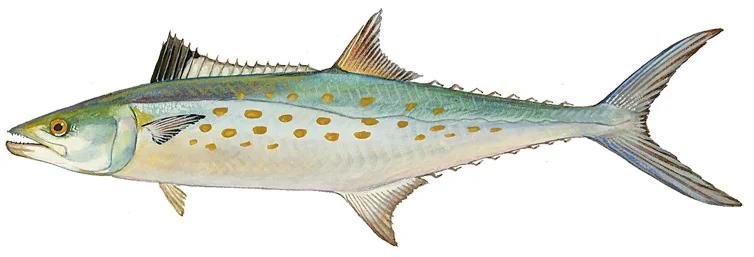
Bluish-green on back, sides silver with numerous yellow to bronze spots and no lines or streaks, anterior portion of first dorsal fin is black, lateral line gradually curves down toward caudal fin, dorsal fins scarcely separated, first dorsal fin has 17 – 19 spines.
Habitat & Range
Adults: Inhabit primarily offshore coastal waters out to continental shelf edge; sometimes over rocky bottoms and artificial reefs, or along beaches and in shallow estuaries , bays, and sounds.
Juveniles: Primarily utilize high salinity nearshore coastal and beachfront waters ; some individuals may also enter estuaries.
Life History
Reproductive Cycle: - Both sexes mature by 2 years of age; approx. size at maturity: males – 8 inches; females – 11 inches.
- Spawning occurs over inner and mid-continental shelf, apparently at night. In South Carolina, spawning occurs May – September.
- Larvae remain in high salinity habitats throughout development and are most abundant over inner and middle continental shelf waters.
Foraging Habits: - Adults and juveniles are predatory, surface feeding fish, consuming small schooling fishes, including: menhaden, anchovies, herring, shad, small jacks, and pompano, also some squid and penaeid shrimp.
- Larvae and young juveniles feed on larvae of other pelagic (open-water) schooling fishes.
Status, Trends & Threats
- Spanish mackerel form large and fast moving schools and migrate long distances. As a result, significant numbers of fish within a given area may be available to recreational harvest for only short periods of time.
- Distribution is temperature and salinity regulated. Spanish mackerel are present in South Carolina waters April – November and migrate during fall to overwintering grounds in south Florida. Fishery availability is typically highest during spring and fall migrations as schools pass close to shore. Juveniles may enter low salinity waters, but adults generally prefer higher (> 30 ppt) salinities.
- No commercial fishery exists for Spanish mackerel in South Carolina; however the potential exists for significant recreational harvest since fish may be caught close to shore.
- Conservation concerns: degradation or loss of estuarine habitat vital to the life cycle of prey species; alteration of water quality in nearshore larval habitat; potential for overfishing.
Frequently Asked Questions
Size & Record
15 inches, 1.5 pounds; South Carolina State Record: 11 pounds (1983); maximum age: approximately 11 years.