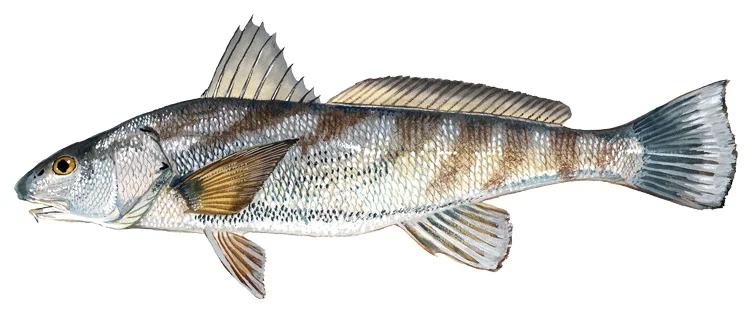
Elongate, silvery-gray or tan, belly white; 7 – 8 faint dark bars on sides. Margins of fins often dark; pelvic, anal, and caudal fins often yellowish. Mouth small and inferior; single short rigid barbell on chin.
Habitat & Range
Adults and juveniles occur over muddy or sand-mud bottoms in shallow coastal water and estuaries. Also common along beaches, near inlets and mouths of larger coastal sounds; juveniles sometimes in upper estuaries.
Life History
Reproductive Cycle: - Mature by age 1; approx. size at maturity: males – 5.3 inches, females – 7.5 inches.
- Move offshore to spawn April – September. Larger individuals may return to summer habitat after breeding.
- Larvae enter nearshore waters late spring and utilize estuaries and beaches as nursery grounds. Young fish move seaward as they grow.
Foraging Habits: - Use chin barbel to locate bottom prey in estuaries and in the surf. Feed primarily on marine worms, crabs and shrimp. Larvae feed on zooplankton.
Status, Trends & Threats
- Commonly called “whiting,” and the most abundant of three kingfish species in South Carolina.
- Tolerate greater salinity and temperature ranges than northern and gulf kingfish. Inhabit state waters year-round; taken inshore from piers and bridges, and in the surf. Inshore harvest peaks during late spring and early fall migrations. Overwinter in deeper water offshore.
- Conservation concerns: degradation and loss of estuarine and nearshore habitat; potential for significant recreational harvest; potential for significant mortality as by-catch in southeast U.S. shrimp trawl fishery.
Frequently Asked Questions
Size & Record
6 – 10 inches, 0.5 pounds South Carolina State Record: 2 pounds, 10 ounces (1968); maximum age: approx. 6 years (majority of fish rarely survive more than 3 years).