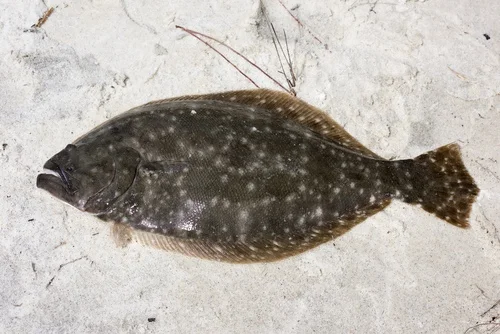
Dorsoventrally flattened body with both eyes on the left side. Pigmented side light to dark brown (controlled by chromatophores) with diffuse nonocellated dark spots and blotches; blind side of body is white or dusky.
Habitat & Range
Adults: Inhabit estuaries , rivers, and shallow coastal water including front beach ; most abundant in shallow, muddy bottom tidal creeks and at tidal creek mouths; also utilize flooded salt marshes at high tides and occasionally near estuarine inlets; overwinter offshore.
Juveniles: Reside in shallow, soft bottom tidal creeks at upper reaches of estuaries ; may occasionally reach freshwater; may utilize submerged vegetation either as cover or for foraging purposes.
Life History
Reproductive Cycle: - Both sexes mature at 2 – 3 years of age; approx. size at maturity: males: 11 – 13 inches, females: 14 – 16 inches.
- Adults migrate to unknown locations offshore during late fall; spawning occurs in these areas throughout the winter; return to inshore habitats during spring.
- Larvae undergo a 30 – 60-day pelagic phase then use ocean currents to enter estuaries during late winter and early spring. Metamorphosis is partially completed prior to settling inshore; once inside the estuary larvae finish metamorphosis and settle to the bottom in the flat juvenile body form. Juveniles remain in estuaries through winter and first migrate offshore just prior to spawning.
Foraging Habits: - Predatory, ambushing prey, using camouflage to blend into surrounding habitat; foraging occurs in tidal creeks and flooded salt marsh or at marsh edges.
- Adults: Feed primarily on fishes (striped mullet, spot, mummichog, white mullet, anchovy); also consume crustaceans, including grass shrimp, penaeid shrimp, and blue crabs.
- Juveniles: Prey species vary with size of flounder: smaller juveniles feed primarily on zooplankton, mysids, and grass shrimp; larger juveniles (subadults) feed on small fish. Larvae consume zooplankton.
Status, Trends & Threats
- Most abundant flounder species in South Carolina waters. Distribution is primarily temperature regulated; offshore migration of older fish coincides with decreasing fall water temperatures.
- Movement within estuaries is minimal and related to tidal stages, flounder move up estuary with rising tide and retreat as tides fall. Most fish return to the same estuaries in successive years, with some latitudinal movement to other estuaries.
- Tolerate wide salinity range; generally occupy lower salinities than other Paralichthid flounder species in South Carolina; larvae may enter fresh water and larval development appears best in low salinity.
- Conservation concerns: degradation and loss of tidal creek and estuary habitat; compromised water quality; potential for overfishing; lack of knowledge regarding spawning locations in South Carolina.
Frequently Asked Questions
Size & Record
12 – 14 inches, 1 – 2 pounds; South Carolina State Record: 17 pounds, 6 ounces (1974); maximum age: approx. males – 5 years, females – 7 or 8 years; females are generally larger and outlive males.