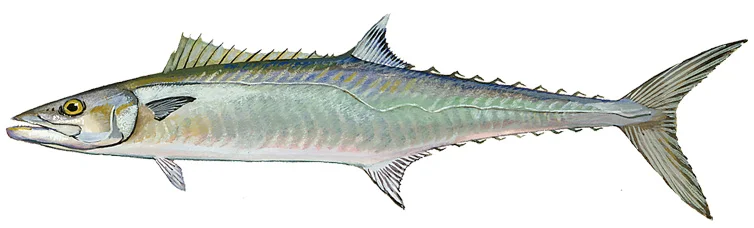
Back iridescent bluish-green; sides silver; first dorsal fin with light and uniform pigment and 14 – 16 spines; snout much shorter than rest of head; posterior maxilla (mouth) exposed and reaching posterior portion of eye; lateral line with abrupt downward curve at second dorsal fin.
Habitat & Range
King mackerel prefer warm, clear waters; all phases of development occur over continental shelf, including both nearshore and offshore habitats and live bottom .
Adults: Older fish inhabit high salinity, green ocean waters, near the surface or at moderate depths. May move inshore on higher tides and during summer. Often associated with outer reefs, wrecks, towers, and buoys.
Juveniles: Occur from mid-shelf to inshore waters and from the surface to moderate depths in water column. Individuals caught near fishing piers are typically older juveniles.
Life History
Reproductive Cycle: - Both sexes mature at 3 – 4 years of age; approx. size at maturity: males – 28 inches, females – 32 inches.
- Spawning occurs between Gulf Stream and high turbidity zone in nearshore waters. In South Carolina, spawning occurs April – September.
- Larvae remain in high salinity waters throughout development. Larvae may be present across continental shelf, but are often most abundant in middle to outer shelf waters.
Foraging Habits: - Adults and juveniles are prey on herring, anchovies, jacks, and menhaden. Juveniles also consume some squid and shrimp.
- Diet of larval king mackerel consists exclusively of fishes.
Status, Trends & Threats
- Distribution is governed by temperature and salinity. Annual migration from South Carolina waters to overwintering grounds in south Florida occurs during fall. Northward migration occurs during spring and early summer.
- Smaller fish move in schools, older fish occur individually or in small groups. Tendency to associate with hard structure such as fishing piers may increase fishing pressure.
- Conservation concerns: potential for overfishing (especially in south Florida overwintering grounds); migratory nature increases management difficulty.
Frequently Asked Questions
Size & Record
33 inches, 10 pounds; South Carolina State Record: 62 pounds (1976); maximum age: approx. 14 years