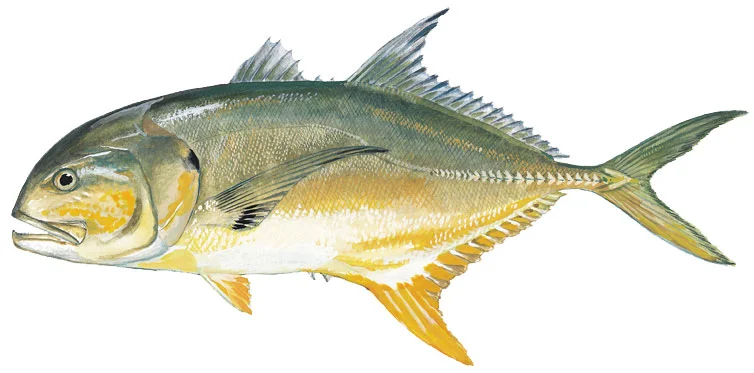
Body silver with dark blue-green along the back, and yellow along the belly. Fins yellowish, conspicuous dark spots visible on the operculum and at the base of the pectoral fins. Second dorsal and anal fins with first rays greatly elongated. Five dark bars often present on the body of juveniles, but disappear in adults. Chest is unscaled except for a small patch in front of the pelvic fins.
Habitat & Range
Primarily a schooling fish inhabiting deeper offshore waters as well as hard substrates and natural or artificial reefs. Juveniles and adults also enter estuaries and tidal creeks up to the freshwater line; juveniles may also utilize seagrass beds.
Life History
Reproductive Cycle: - Age at maturity is not known; males greater than 27 inches and females greater than 26.3 inches have been caught with “ripe” gonads.
- Spawning occurs between March and September in subtropical waters of the Florida Strait and the Caribbean Sea. Larvae are carried to South Carolina waters during spring and summer by the Gulf Stream.
- Larvae develop in offshore waters. Juveniles utilize estuaries during their first summer and return to offshore waters in the fall.
Foraging Habits: - All ages are diurnal predators; most hunt in schools, but larger fish may be solitary.
- Adults: feed primarily on small schooling fishes such as anchovies, Atlantic bumper, and pinfish; may also consume penaeid shrimp, portunid crabs, and squid.
- Juveniles: diet similar to adults; primarily piscivorous, but also occasionally feed on invertebrates.
Status, Trends & Threats
- Distribution is temperature regulated; inhabit South Carolina waters only during summer. Southward migration during fall coincides with decrease in water temperatures. Occasional mass mortality due to low temperature.
- Tolerate wide salinity ranges; adults most common in nearshore and offshore waters greater than 30 ppt, but may also enter estuaries; juveniles tolerate lower salinity waters including far upstream in tidal creeks.
- Annual abundance in South Carolina highly variable and dependent upon larval recruitment to state waters, survival during seasonal migrations, and health of spawning stocks in subtropical waters.
- Conservation concerns: degradation or loss of estuarine habitat; potential for high recreational harvest – although most fish are released immediately after capture, release is high; lack of information on biology in South Carolina waters.
Frequently Asked Questions
Size & Record
25 – 30 inches, 2 – 5 pounds; South Carolina State Record: 40 pounds, 1 ounce (1993); maximum age: has not been established