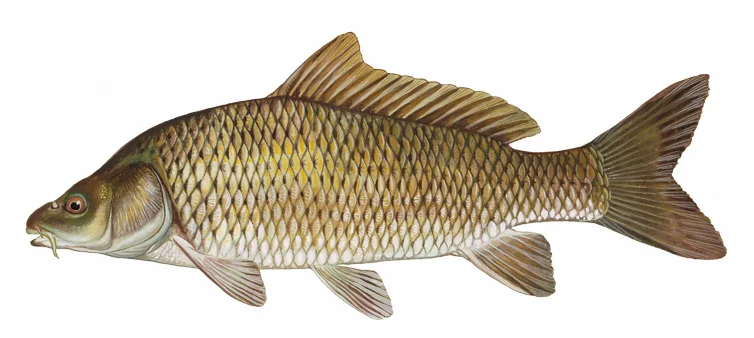
Common carp are native to Eurasia and were first introduced in to North American in 1831. They were reintroduced widely in the 1880’s by the federal government as a food source. Consequently, they now occur in nearly all 50 states. Their introduction has proven to be a serious mistake because of their destructive effect on habitat where they feed and spawn. Carp can also adapt better than most fish to pollution. This adaptability allows the common carp to outcompete other native species.
Range: Statewide
Commonly Mistaken Species: Some species of fish that are commonly mistaken for this species are:
Grass carp Difference Between Common Carp and the Stocked Triploid Grass Carp ( PDF ) (file size 3M)
Habitat & Range
Common carp inhabit either standing or sluggish warm water over soft mud bottoms where vegetation is found.
Life History
Spawning: - Spawning for the common carp occurs from April to June. Female carp produce on average 100,000 to 500,000 eggs that either attach to vegetation or sink to the muddy bottom. Spawning activities are quite vigorous, stirring up sediment and often causing a commotion that can be heard.
Diet: - Worms, insect larvae, crustaceans and mollusks.
Frequently Asked Questions
Size
3 feet 1 to 10 pounds
Lifespan
Approximately 20 years
State Record
: 58 pounds (2000)