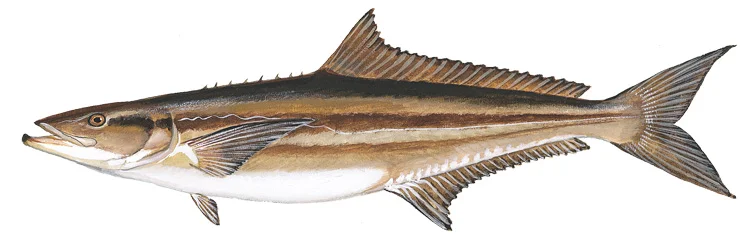
Elongated body with dark brown sides and back, 2 sharply defined silver bands on sides. Broad, depressed head, with large, terminal mouth. First dorsal fin consists of 7 – 9 short, isolated spines not connected by a membrane. Long second dorsal fin with 27 – 33 rays. Upper lobe of caudal fin longer than lower lobe.
Habitat & Range
Adults: Inhabit coastal and continental shelf waters, occasionally enter estuaries . Occur over a variety of live bottoms (sand, mud, rocky) and are often associated with reefs or wrecks, larger marine organisms (rays, sea turtles, sharks), and drifting or stationary objects (buoys, pier pilings, etc.).
Juveniles: Utilize inshore habitats such as estuaries , river mouths, bays, sounds, or inlets, as well as coastal and barrier island or beachfront waters.
Life History
Reproductive Cycle: - Adults mature by 2 – 3 years of age. Approx. size at maturity: males – 24 inches; females – 31 inches.
- In South Carolina, spawning occurs May – August, most likely in the mouths of bays and sounds. Some spawning also occurs in open ocean waters.
- Larvae require high salinity waters from the Gulf Stream to nearshore shelf waters. Larval development is rapid and juveniles quickly settle in nearshore habitats.
Foraging Habits: - Cobia are opportunistic bottom feeders. Adults and large juveniles share a similar diet. In older fish, blue crabs and portunid crabs constitute the major portion of the diet; shrimp (rock, mantis, penaeid) and fish, including elasmobranchs, are also consumed.
- Larvae and young juveniles consume mostly zooplankton.
Status, Trends & Threats
- Distribution is temperature dependent. An offshore and southward migration coincides with decreasing water temperatures in fall.
- Present in South Carolina nearshore waters April – October. Peak abundance occurs in late spring; thereafter, larger fish move offshore and are replaced in nearshore waters by younger individuals. Some probably overwinter in deeper water offshore of the state.
- North of St. Helena Sound, cobia inhabit primarily offshore waters. As a result, fishing pressure in South Carolina is mostly concentrated in Beaufort County.
- Conservation concerns: degradation of nearshore habitat and water quality; potential for overfishing; lack of knowledge of spawning sites and larval and juvenile habitats in South Carolina waters.
Frequently Asked Questions
Size & Record
30 inches, 15 pounds; South Carolina State Record: 92 pounds, 10 ounces (2009); maximum age: approx. 15 years