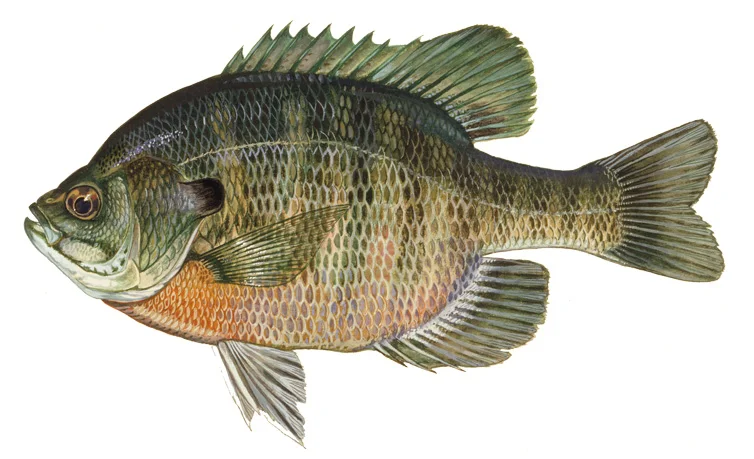
Just like largemouth bass, bluegills are one of the most common fishes stocked for angling and food. It has been stocked extensively by state and federal agencies into farm ponds, usually in combination with redear sunfish and largemouth bass. With proper farm management, bluegill can provide many years of successful fishing. Lack of proper management may result in crowded ponds with stunted bluegill, only growing 4 to 5 inches in length. Successful and multiple reproduction of bluegill is important to provide an adequate food source for developing young largemouth bass. Concentrations of large numbers of nesting or bedding bluegill produce an odor which is detectable by experienced anglers.
Range: Statewide including all rivers as well as small and large impoundments
Commonly Mistaken Species: Some species of fish that are commonly mistaken for this species: Green sunfish Redear sunfish
Habitat & Range
Bluegills are very tolerant of many habitat types including pools of creeks and rivers, swamps, oxbow lakes, ponds, vegetated shores of impoundments, man-made lakes, ponds and retention basins. They prefer sluggish or slow-moving water.
Life History
Spawning: - Bluegills are colonial nesters with 100 or more different bluegill nests in one area. This helps provide extra protection for the eggs and fry from predators.
- Bluegill become sexually mature at 1or 2 years of age and then construct nests in shallow water over sand or mud bottoms as water temperatures exceed 75°F, usually from May to August.
- Females can produce up to 80,000 eggs per year. A female may deposit eggs in several adjacent nests within a nesting colony.
- Highly unusual for sunfishes, male bluegill will sneak into nests of other males to deposit their sperm to produce more of their offspring versus another male.
- Males will guard their nests and aerate the eggs by fanning their fins until the eggs hatch, within 1-2 days. Males continue to guard the area as the young fry disperse.
Diet: - Bluegills are opportunistic carnivores feeding on a variety of prey types. They will feed on mature and immature insects, small invertebrates, crayfish, mollusks (mussels) and other fishes.
- They have small mouths; however, the larger the bluegill the larger the prey type they can consume. They mostly feed near the surface.
Frequently Asked Questions
Size
5-10 inches 3-8 ounces
Lifespan
: Approximately 11 years
State Record
: 3-pounds, 4-ounces (1973)