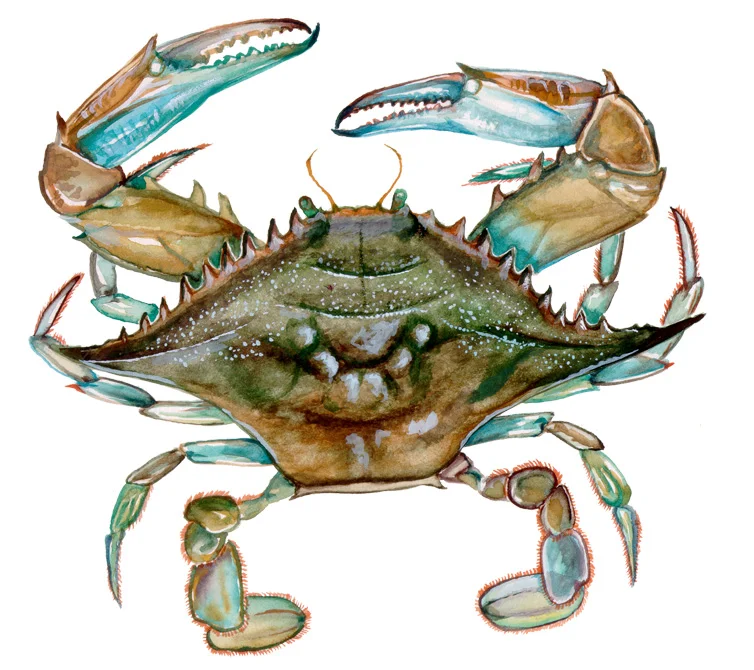
Smooth oblong carapace in variations of gray, blue, or brownish green. Four spines on the anterior edge of the carapace, 9 spines on the anterior lateral edge (posterior-most are the largest). Males: T-shaped abdomen, blue on legs and inner surface of chelipeds, blue fingers of claws. Females: triangular (immature) or circular (mature) abdomen, fingers of claws are orange with purple tips.
Habitat & Range
Occupy a range of estuarine habitats as well as coastal bays, sounds and nearshore waters; often in association with submerged vegetation or oyster reefs .
Adults: Males utilize soft bottom tidal creeks and middle to upper reaches of estuaries, generally moving further upstream than females. Females utilize similar but higher salinity habitats until moving to estuary mouths to spawn; thereafter, females remain near inlets or in coastal ocean waters.
Juveniles: Reside in shallow, soft bottom habitats in upper estuaries, tidal creeks, salt marshes , and rivers.
Life History
Reproductive Cycle: - Adults mature by 1 – 2 years of age; approx. size at maturity: males – 4 inches, females – 5 inches.
- Mating occurs in low salinity upper estuary waters following terminal molting of females. Mating occurs February – November. Females mate only once in life, store sperm internally, and spawn (April-August) multiple times over the next 1 – 2 years.
- Early larval development (zoeal stages) occurs in oceanic waters. Larvae use tidal currents to recruit to estuaries as megalopae (i.e. postlarvae) and move into upper estuaries as juveniles.
Foraging Habits: - All sizes of blue crab are opportunistic omnivores and forage along the bottom; overall diet is similar between adults and juveniles; preferred prey may change with size and locality.
- Adults: Feed primarily on bivalves, snails, shrimp, fishes, and decaying organic matter; also cannibalize other blue crabs.
- Juveniles: Consume small bivalves, detritus, and plant matter. Larvae feed on zooplankton.
Status, Trends & Threats
- Adults and juveniles are present in South Carolina estuaries year-round; overwintering typically occurs in estuaries, but crabs may seek deeper water, become sluggish, and bury in mud during cold; movement to deeper water can also occur with extremely warm water.
- Salinity significantly influences distribution of various life stages; juveniles and adult males seemingly prefer lower salinity waters than female crabs. Larval and megalopae development is best at salinities ≥ 20 ppt.
- Conservation concerns: degradation and loss of estuarine habitats; protection of coastal ocean habitat critical to larval development; viral and bacterial prevalence and mortality; potential for high commercial and recreational harvest; mortality associated with abandoned crab pots; gray crab disease (caused by the pathogenic amoeba Paramoeba perniciosa ).
Frequently Asked Questions
Size & Record
Average carapace width: males – 5 1/2inches, females – 6 inches; approx. maximum size: 10 inches; maximum age: approx. 3 years