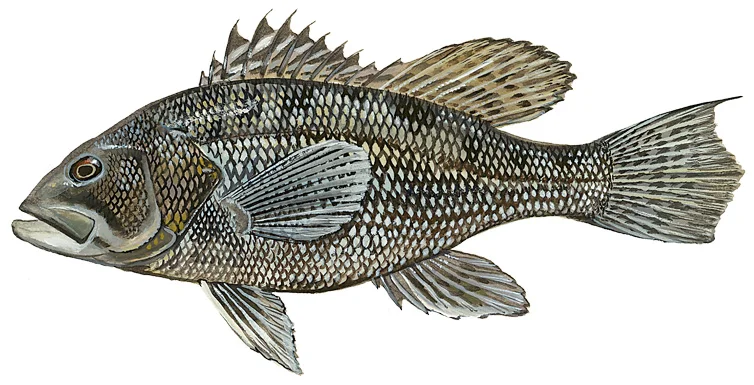
Body very dark. Preopercle finely serrated, lacking a strong spine or spiny lobe, opercle with three flat spines. Dorsal fin single, notched with 10 spines and 11 soft rays. Caudal fin round or trilobite, often with a single upper ray elongated in adults. Large males may possess a bluish hump anterior to the dorsal fin.
Habitat & Range
Adults: Temperate reef fishes; inhabit open-shelf and shelf-edge waters 10 – 120 m deep; typically around structured habitat, hard or rocky substrates, and live-bottom .
Juveniles: Occupy nearshore coastal habitats and high salinity, lower estuarine waters; often near oyster reefs , pier pilings, and over live-bottom .
Life History
Reproductive Cycle: - Protogynous hermaphrodites: most fish begin as females and later become males. Most fish transition by 2 – 4 years of age. Males are most frequent in fish greater than 4 years old. Approx. size at sexual transition: 8 – 13 inches.
- Females mature at 1 – 3 years of age. Approx. size at maturity: 7 inches. Spawning occurs in offshore waters March – May with minor spawning also occurring during September – November.
- Early larval development occurs offshore. Larvae quickly become bottom dwelling fish and move to nearshore waters and estuaries.
Foraging Habits: - Black sea bass are opportunistic bottom foragers during daylight.
- Adults and older juveniles consume bottom dwelling invertebrates, especially crabs, shrimp, clams, small fishes, and squid. They also graze on organisms attached to hard structure.
- Younger juveniles and larvae consume zooplankton, including amphipods and isopods, and small shrimp.
Status, Trends & Threats
- Inshore and coastal distribution is salinity regulated. Juveniles inhabit higher salinity nearshore and lower estuarine waters.
- Seasonal movement is temperature regulated. Individuals inhabit South Carolina waters year-round, older individuals occur over offshore reefs/structure; smaller fish move out of shallower coastal habitats to overwinter in deeper water before returning in spring.
- Conservation concerns: degradation or loss of nearshore and estuarine nursery habitats; intensive fishing pressure from recreational and commercial fisheries.
Frequently Asked Questions
Size & Record
12 inches, 1 pound; South Carolina State Record: 8 pounds 3 ounces (1995); maximum age: approx. 20 years