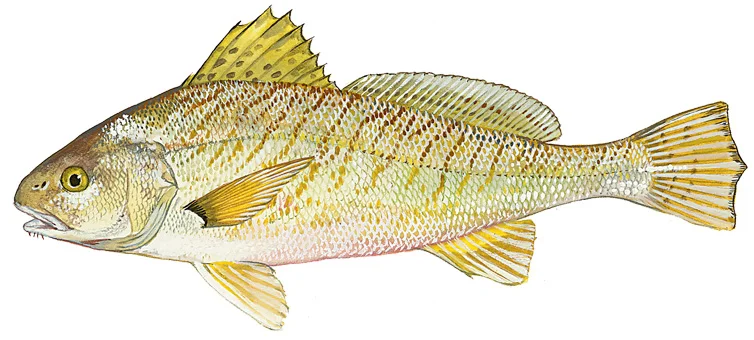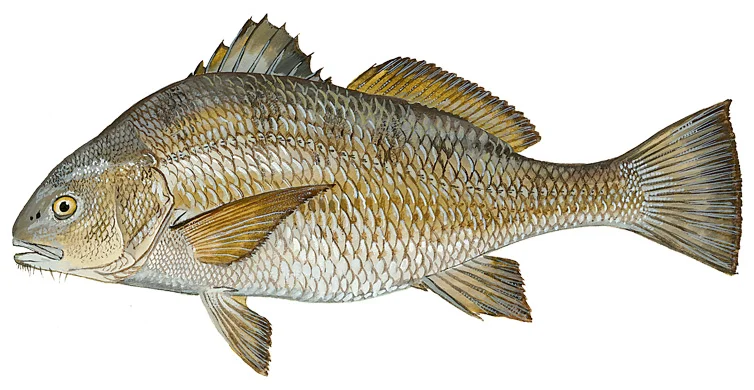
Deep-bodied, silvery-gray to dark gray with blackish fins. Young fish have 4 – 5 vertical black bars that disappear with age. Mouth inferior and horizontal, lower jaw with 10 – 13 pairs of barbels in multiple rows. Body scales large and comblike, lateral line extends to hind margin of tail fin.
Habitat & Range
Adults: Common over sandy and soft live bottoms in salt and brackish water including: estuaries , coastal rivers, shallow coastal bays, and along beaches. Spatial distribution closely tied to natural and artificial hard structures, including: reefs, rock piles, jetties, docks, pier pilings, and bridges.
Juveniles: Common over muddy bottoms in shallow tidal creeks and salt marsh . Subadults progress to deeper creeks, river mouths, and bays and into nearshore coastal waters.
Life History
Reproductive Cycle: - Mature by 4 – 6 years of age; approx. size at maturity: males – 23 inches, females – 25 inches.
- Spawning occurs during spring and early summer in high salinity inlets, estuaries, bays, sounds, and coastal rivers. Adults may form schools for migration to spawning grounds.
- Larvae use tidal currents to enter estuaries where they settle in shallow tidal creeks. Older juveniles leave deeper inshore waters during fall, migrate offshore to overwinter, and return inshore in the spring.
Foraging Habits: - Black drum are bottom feeders and use their sensitive chin barbels to aid in locating food. Heavy pharyngeal teeth are used to crush invertebrates.
- Adults: Feed primarily on mussels, oysters, crabs, shrimp and occasionally small fishes.
- Juveniles: Consume small crabs, amphipods, copepods, shrimp, marine worms, and small fishes. Diet of larger juveniles is similar to adults. Larvae consume primarily zooplankton.
Status, Trends & Threats
- Adults tolerate wide salinity ranges; distribution is therefore tied to temperature and availability of hard structures or oyster reef habitat. In South Carolina, black drum are most abundant in nearshore or coastal waters February – July; cold may induce movement to deeper bays, sounds or offshore waters to overwinter.
- No commercial fishery exists for black drum in South Carolina; however, recreational harvest is potentially high since this species occupies nearshore waters during most of the year.
- Conservation concerns: degradation or loss of estuarine nursery habitat; potential for significant recreational harvest; lack of biological and spawning location data for South Carolina black drum.
Frequently Asked Questions
Size & Record
14 inches, 2.2 pounds; South Carolina State Record: 89 pounds (1978); maximum age: approx. 60 years