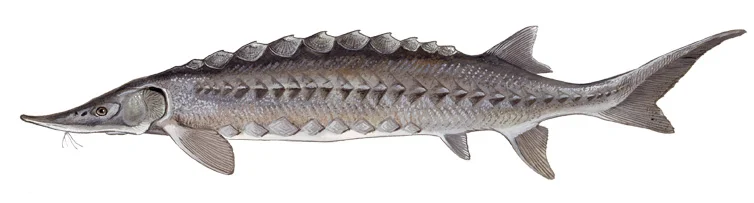
Atlantic sturgeons are the largest fish living in freshwater on the entire Atlantic coast. During the mid-1970s, half of the US landings of this species came from South Carolina, in particular in Winyah Bay. The fishery for this species in South Carolina was closed in 1985 and other Atlantic States. The Atlantic sturgeon is federally listed as an endangered species.
Range: All major river drainages, mostly in the river mainstems and on the coast.
Commonly Mistaken Species: One species of fish that is commonly mistaken for this species:
Shortnose sturgeon
Atlantic and Shortnose sturgeon comparison
Habitat & Range
Atlantic sturgeon are diadromous, spending its first few years of life in fresh or brackish water of large rivers and then migrating to the ocean to mature. In South Carolina, adult Atlantic sturgeons occur in most rivers and estuaries along the coast.
Life History
Spawning: - Spawning has been documented in both the fall and spring in South Carolina with spawning occurring in the Pee Dee, Edisto, Combahee, Savannah rivers and possibly the Waccamaw River.
- Dams impede natural spawning migrations on the Santee and Cooper Rivers but studies indicate that populations may reproduce below the dams.
Diet: - They are bottom feeders feeding on aquatic insects, amphipods, isopods, shrimp, mollusks and even some fishes that live in the substrate.
Frequently Asked Questions
Size
3 to 14 feet Up to 800 lbs
Lifespan
: Approximately 30 years
State Record
: Unknown