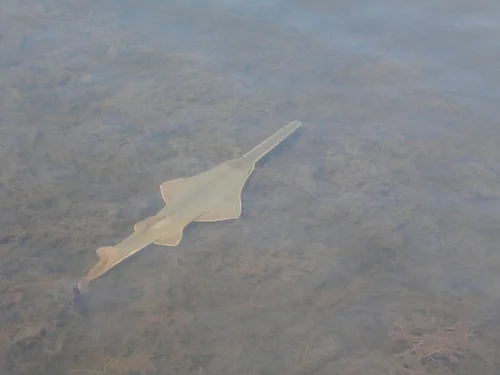
The smalltooth sawfish is a cartilaginous fish that belongs to the Subclass Elasmobranchii, which also includes all others rays and sharks. This dorsally tannish-brown fish can reach a total length of up to 18 feet (5.5 meters) including the saw (Bigelow and Schroeder 1953). The species’ common and scientific names are derived from its long, flattened, toothed rostrum (nose or beak structure) that extends outward from its flattened head. The rostrum resembles a saw because it has 21-30 unpaired saw teeth on each side. Rostral teeth that are lost will not grow back; however, chipped teeth will continue to grow as long as the base is intact (Slaughter and Springer 1968). The mouth teeth are small and flat like other rays. The smalltooth sawfish is a type of ray, in part because the gill slits are on the bottom of the body and the pectoral fins are attached to the head.
Habitat & Range
Small juvenile smalltooth sawfish use different habitats than large juveniles and adults. Small juveniles inhabit shallow coastal areas in estuaries, river mouths, and bays year-round (Poulakis et al. 2011). They have been recorded from a variety of habitat types including unvegetated mud and sand bottoms, especially along red mangrove shorelines, which are considered “critical habitat” (Norton et al. 2012). Also, small juveniles use creeks and canals that connect to the main stem of rivers (Poulakis et al. 2011, 2016). Small juveniles typically inhabit salinities between 18 and 30 parts per thousand (PPT) (the ocean is 35), sometimes far up rivers (Simpfendorfer et al. 2011; Poulakis et al. 2013).
Adults are typically found in open water habitats from the shallows to depths of several hundred feet (up to 122 meters) (Seitz and Poulakis 2002; Poulakis and Seitz 2004; Graham et al. 2021), but have been encountered near coral reefs and occur inshore during the spring when females give birth and mating is thought to occur. Of five species of sawfish found worldwide, the only species found in Florida waters is the smalltooth sawfish. Although the historical range of this species extended from the U.S. to Brazil, currently, smalltooth sawfish are only regularly found in south Florida and the western Bahamas (Brame et al. 2019).
Life History
The diet of the smalltooth sawfish consists of a variety of bony fish and stingrays (Poulakis et al. 2017; Hancock et al. 2019). The saw is used to slash at fish.
Females give birth in estuarine nursery areas primarily during April and May (Poulakis et al. 2011). Fertilization is internal and 7-14 embryos mature inside the mother with no placental connection (Brame et al. 2019). The female reproductive cycle is every other year and males mate every year. Smalltooth sawfish are born with fully calcified rostral teeth that are covered by a skin-like protective sheath (Poulakis et al. 2024), which prevents injuries to siblings and the mother. The sheath begins disappearing after birth and is gone after about four days. Males take seven years to mature; females mature after eight years (Kroetz et al. 2025).