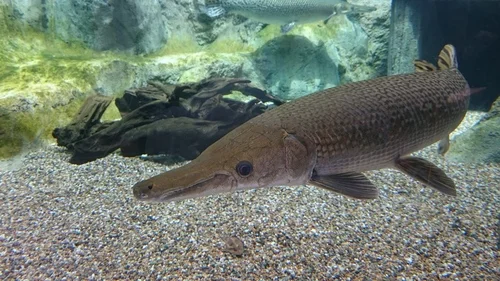
The alligator gar is the largest member of the Family Lepisosteidae, reaching 8 feet (2.44 m) in length and over 300 pounds (136 kg). Having long torpedo-shaped bodies, broad snouts, and hard, diamond-shaped (ganoid) scales, they are easily distinguished from other freshwater fish species. Their broad snouts resemble that of an alligator, giving this fish its name and is a unique feature when compared to other gar species. They have 2 rows of sharp teeth as well as the unique ganoid scales that act as heavy armor. Their relatively small fins are positioned further back on their body, towards their round tail (caudal) fin. This species ranges from brown to olive in color with counter shading featured on their underside. The contrasting light and dark colors help them camouflage when viewed from either below or above.
Habitat & Range
Alligator gar primarily live in freshwater. They prefer large, slow-moving rivers, lakes, swamps, and bays. This species of gar is the most tolerant to salt water, allowing them to spend time in marine habitats. In Florida, they are restricted to six rivers in the western Panhandle and the bays these rivers are connected to.
Life History
Alligator gars reproduce in late spring, but regional differences can occur between populations. Spawning involves an individual female joined by multiple males in shallow areas. The males compete to fertilize the eggs as the female releases them over submerged vegetation. The eggs are toxic to crayfish and small rodents, which may prevent predators that are attracted to the splashing that occurs during spawning. Juveniles grow at fast rates. This growth slows as they get older and sexual maturity is reached at around 10 years old. Fish are part of the diet throughout the entirety of the alligator gar’s life cycle. During their early life stages, young alligator gar also feed on larvae and insects, shifting to larger vertebrates like birds and small mammals as adults. Adult alligator gar have few natural predators, but American alligators are known to eat them.