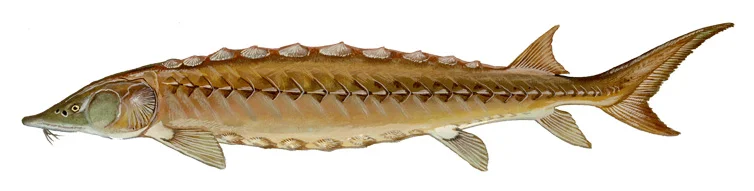
The shortnose sturgeon is one of seven species of sturgeons found in North America. Sturgeons are prehistoric species that date back to the time of dinosaurs. They are popular in the food industry as a source of caviar. Their physical features separate them from other kinds of fish, such as a spiral valve stomach and a cartilaginous skeleton (like sharks and rays), but they have scutes (hard, protective, large individual body plates) instead of denticles like sharks have or scales like other fish have. Shortnose sturgeon have barbels located on the underside of the snout, no teeth, rubbery lips, and a suctorial mouth for vacuuming food off the bottom. The sturgeon's coloring typically is dark brown along the upper (dorsal) side, shading to a creamy white-colored belly (Wakeford 2001). The shortnose sturgeon is one of the smallest sturgeons with a body length of three to four feet (.9-1.2 meters) and a weight of up to eight pounds (3.6 kilograms).
Habitat & Range
Shortnose sturgeon are classified as anadromous, living in the estuarine reaches of most Atlantic seaboard rivers and ascending to flowing freshwater to spawn. They tend to congregate in the main river channels and only use smaller tributaries to a lesser extent. While shortnose sturgeons only occasionally frequent marine habitats, they can tolerate full seawater, and do migrate between rivers. The shortnose sturgeon can be found from New Brunswick Canada, to the St. Johns River in Florida (National Marine Fisheries Service 1998).
Life History
Sturgeons are benthic feeders consuming organisms on, in, or near the bottom of a water body. Preferred prey includes worms, crustaceans, insect larvae, and molluscs (National Marine Fisheries Service 1998).
Spawning times differ geographically due to the fact that shortnose sturgeon require specific water temperatures to spawn. Shortnose sturgeon migrate from estuarine waters to fresh water to spawn. Spawning begins when the water reaches temperatures of 44.6-50°F (7-10°C) (Friedland and Kynard 2004). Females can lay from 27,000 to 208,000 eggs per spawning act. Sturgeon eggs have a sticky surface, which enables them to stick on objects on or near the bottom of the water body. Eggs hatch 13 days after spawning at 44.6-50°F (7-10°C). The fry (young fish) are very poor swimmers and will drift with the current down river. Sexual maturity is reached at different times in their geographical range. Males reach sexual maturity by age three in Georgia, age five from South Carolina north to the New England states, and age 11 in New Brunswick. Females reach sexual maturity by age six in Georgia, age seven from South Carolina north to the New England states, and age 13 in New Brunswick. Males will first spawn around two years after reaching sexual maturity, while females will first spawn around five years after reaching sexual maturity. Males can spawn every year, while females usually spawn every three years (National Marine Fisheries Service 1998).