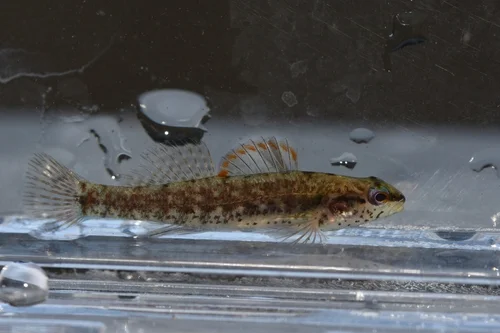
The Okaloosa darter is a small darter that reaches a body length of only two inches (5.1 centimeters). This darter species has a green-yellow to red-brown coloration with five to eight brown spots along the lateral surface of its body, and a well established spot above the base of its pectoral fin. Male Okaloosa darters develop an orange band along the edges of its first dorsal fin (Florida Natural Areas Inventory 2001). As an obligate bottom dweller, they have no swim bladder, which enables a fish to control its buoyancy.
Habitat & Range
The Okaloosa darter inhabits small streams that are fed by ground water seepage from the surrounding sandhills (U.S. Fish & Wildlife Service 1998). The majority of Okaloosa darter habitat is located within Eglin Air Force Base’s (Eglin AFB) boundaries, but they can also be found in adjoining portions of Okaloosa and Walton counties in Boggy and Rocky bayou of the Choctawhatchee Bay drainage (Burkhead and Williams 1992).
Life History
The diet of the Okaloosa darter primarily consists of mayfly nymphs, caddisfly larvae, and midge larvae (Ogilvie 1980).
Okaloosa darters breed between the months of March and October, with most breeding activities occurring in April and a peak breeding period in October. In one Okaloosa darter study, a mean average of 79 ova (eggs), of which 29 were mature, were found among 201 females sampled. Eggs attach to vegetation once they are released. Female Okaloosa darters reach sexual maturity when a standard length of 1.2 inches (3.1 centimeters) is reached (Ogilvie 1980).