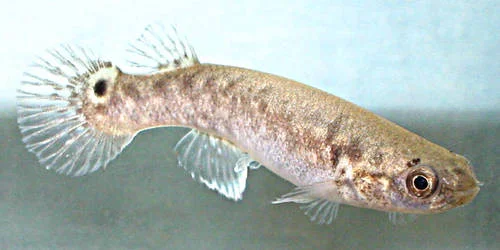
Mangrove rivulus are the only member of the rivulus family that occurs in North America (Taylor and Snelson 1992). This species can reach a body length of 2.4 inches (6.1 centimeters). Mangrove rivulus are olive-colored with a flat back body, rounded tail fin, and small black dots located throughout the body surface (sometimes) (National Oceanic and Atmospheric Association 2009).
Habitat & Range
The mangrove rivulus inhabits mangrove forests from southeastern Brazil through the Antilles and Central America to Florida (Taylor 1999). In Florida, this species is found on the Atlantic coast from the Keys to Volusia County and from the Keys to Tampa Bay on the Gulf Coast (Taylor 1999, Briggs and Brown 1986, S. Taylor pers. comm. 2012). They are an amphibious/fossorial species (they are capable of living on land and water, burrowers on land). Most of their time is spent on land where they can be found hidden in rotten wet logs or under moist leaf litter (Taylor et al. 2008).
Life History
The diet of the mangrove rivulus primarily consists of worms, copepods (small crustaceans), mosquito larvae, and their own eggs when held captive (National Oceanic and Atmospheric Association).
Mangrove rivulus are self-fertilizing hermaphrodites (have both male and female reproductive organs), which makes them the only known vertebrate to practice this style of reproduction. However, a small non-hermaphroditic population has been discovered in Belize. Eggs hatch two to four weeks after being laid (National Oceanic and Atmospheric Association 2009).