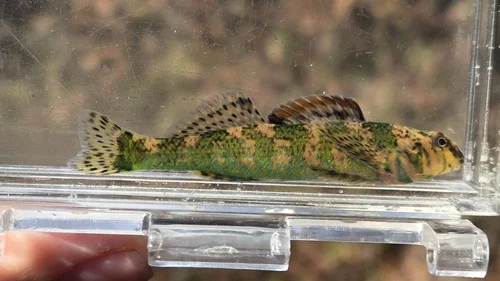
The harlequin darter is a smaller member of the darter Family Percidae that can reach a standard length of 2.5 inches (6.4 centimeters). This species is greenish, with six or seven brown saddles, and seven to 11 dark green or brown spots. Harlequin darters also have a green and black dorsal (back) side, a yellow belly with dark markings, and a clear first dorsal fin with a red boundary (Boschung and Mayden 2004, Florida Natural Areas Inventory 2001).
Habitat & Range
Harlequin darters inhabit snags and debris build ups in rivers and creeks (Florida Natural Areas Inventory 2001). They can be found from Illinois, Indiana, and Kentucky, south to Florida, and west to Texas (Boschung and Mayden 2004, Etnier and Starnes 1993, Page 1983). Harlequin darters only occur in the Escambia River watershed in Florida.
Life History
Little is known about the reproduction of the harlequin darter; however, spawning capable adults have been found in February and March. Females reach sexual maturity at one year (Gilbert and Yerger 1992, Steinberg et al. 2000, Bass et al. 2004, Kuhajda and Warren 1989). Females lead the search for nesting sites and will pick the site as the male follows her lead. Snags (a partially or completely dead standing tree) are used as primary nesting habitats. When released, eggs attach to detritus (decomposed organic matter) components in deep waters.