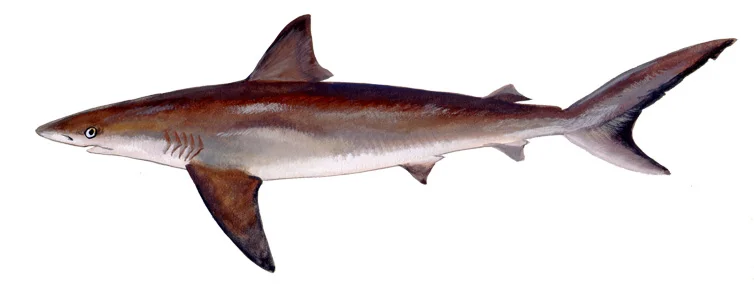
- Back is bronze-gray to blue-gray, fading to a white belly
- Snout moderately rounded, shorter than or equal to mouth width
- Second dorsal fin free tip less than twice as long as fin height
- First dorsal fin is sloping with its origin over the pectoral fin free tip
- Interdorsal ridge present
Similar Species: Caribbean Reef shark, C. perezii (bluntly rounded snout); Sandbar shark, C. plumbeus (first dorsal fin starts in front of pectoral fin insertion); silky shark, C. falciformis (first dorsal fin starts behind pectoral fin free tip; longer second dorsal fin free tip)
Habitat & Range
A cosmopolitan species inhabiting continental nearshore areas and offshore waters. Adults are known to migrate great distances and avoid estuaries with low salinities. Juveniles congregate in shallow bays and estuaries.
Life History
Mating occurs in the spring and after approximately 16 months of gestation, females give birth to live young in shallow bays and coastal lagoons. Broods contain 6-14 pups. Size at birth about 3 feet.
Frequently Asked Questions
Size
Among the slowest growing of shark species. Maximum size is up to 12.5 feet. Matures at approximately 20 years of age (about 8.5 feet) and is estimated to live 45+ years.