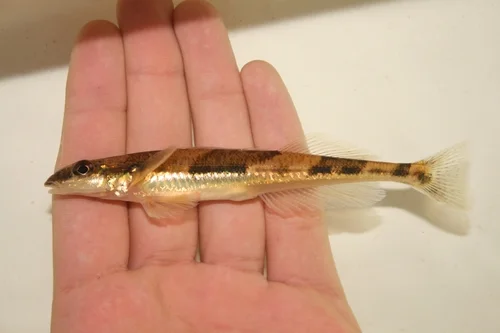
The crystal darter is one of the larger members of the Family Percidae (Gilbert 1992). This species can reach a body length of six inches (15.2 centimeters). Crystal darters are a light brown fish that have a side-to-side compressed head, large eyes, and four dark saddle marks (the first saddle originating in front of the pectoral fin) on their upper part (Florida Natural Areas Inventory 2001).
Habitat & Range
Crystal darters inhabit rivers with modest current, sandy riffles, and a sand/gravel bottom of medium to large size streams (Florida Natural Areas Inventory 2001). They can be found within the Mississippi River basin from Wisconsin and Minnesota east to Ohio, west to Oklahoma, and south to Louisiana and Florida (Boschung and Mayden 2004, Page 1983). In Florida, crystal darters occur in the Escambia River.
Life History
Crystal darters are invertivores – they feed on a variety of invertebrates.
Spawning presumably begins in meandering side channels of main waterwaya when water temperatures reach 53.6-59°F (12-15°C). During copulation (mating), females will bury themselves slightly in the substrate (habitat floor). Females can copulate with more than one male at a time. The spawning season usually lasts one week. Fertilized eggs are strongly adhesive and attach to sand and gravel when released by the female. The average egg mass for crystal darters is 106-576 eggs (Boschung and Mayden 2004). Sexual maturity is reached at the age of one year (George et al. 1996).