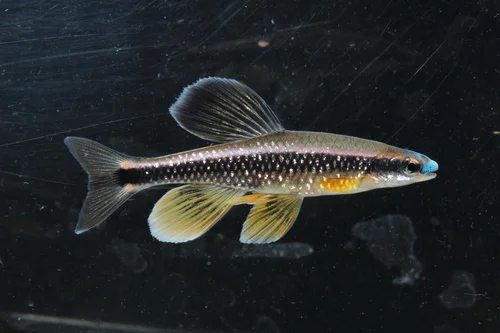
The bluenose shiner is a smaller member of the Family Cyprinidae that can reach a body length of only 1.9 inches (4.8 centimeters). This species is an olive-colored ray-finned fish that has dark-colored dorsal (back) fins, and yellow pelvic and anal fins that are banded in black. Two distinct features of the bluenose shiner include a blue nose, a dark lateral stripe that runs from the snout to the tail, and males that have well developed (in size and color) dorsal, pelvic and anal fins.The origin of the species common name comes from the blue nose tha t male adults have (Gilbert 1992, Florida Natural Areas Inventory 2001).
Habitat & Range
Bluenose shiners inhabit backwaters and river swamps to spring-run streams and are often associated with areas of aquatic vegetation and deep pools (Florida Natural Areas Inventory 2001, Gilbert 1992, Bass et. al. 2004). In Florida, there are two disjunct distributions, the St. Johns River basin and the western panhandle with no known occurrences between the St. Johns and the Apalachicola rivers (Gilbert, 1992). The first specimens were collected from the St. Johns River, near Welaka, in 1897 by William C. Kendall (Bass and Hoehn, 2010).
Life History
The diet of the bluenose shiner consists of insects and rotifers (microscopic aquatic species). (Osprey Data International, Inc. 2001).
Breeding begins in April and will increase until September when breeding capabilities begin to decrease. To attract females during courting, two males will circle each other, positioning their body into a bow shape while displaying each of their fins at one the female. Spawning takes place over sunfish nests. Spawning actions were studied in Mississippi, and it was determined that females produce 55 to 190 eggs (Osprey Data International, Inc 2001, Bass & Hoehn 2010, Johnston and Knight 1999).