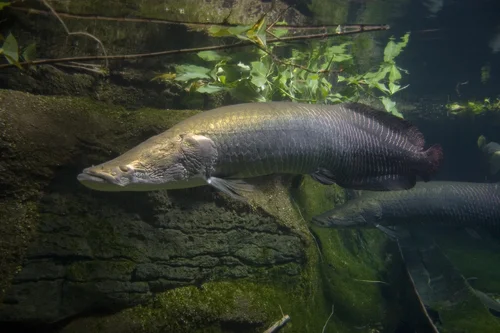
The arapaima, Arapaima gigas (Arapaimidae), is among the largest known freshwater fish species with sizes up to 14 feet and 440 pounds. They have a streamlined, oval shape with a large, flattened head. The body is covered by very large scales that are generally gray to gray green in color but many scales towards the tail have red markings.
Arapaima are obligate air breathers, meaning they need to surface to breathe every 10-20 minutes. They usually make a large surface disturbance when they breathe and frequently make a loud noise when they capture prey at the surface. Arapaima are capable of surviving in stagnant waterbodies with low dissolved oxygen and a wide range of aquatic habitats.
In their native range, arapaima occur in the large rivers surrounded by tropical forest. Within these areas, they typically are found in floodplain lakes and slow-moving waters. Rising water levels trigger spawning in these areas in the wild but under captive conditions they can spawn in ponds with stable water levels and high amounts of food. Arapaima can spawn at 4-5 years of age and 45 inches in length for males and 57 inches for females. A female can lay 10,000 to 20,000 eggs in a nest dug in sandy sediments and males will protect the young for up to three months.
Arapaima grow rapidly and can reach 3 feet and 20 pounds in their first year and five feet and 90 pounds by their fourth year.
Arapaima are sensitive to cold water temperatures and die if it drops below 61 o F. This would limit their potential Florida range to the southeast region of the state.
Habitat & Range
Although there have been several reports of adult arapaima reported from the wild in southwest Florida, there is no indication that they are reproducing in Florida.
Life History
Arapaima will prey on native species of freshwater fish and due to their size, could consume all but the largest individual fish. Their diet could include freshwater gamefish including largemouth bass, butterfly peacock and common snook. Their ability to breathe air could allow them to occupy a wide variety of aquatic habitats in south Florida.