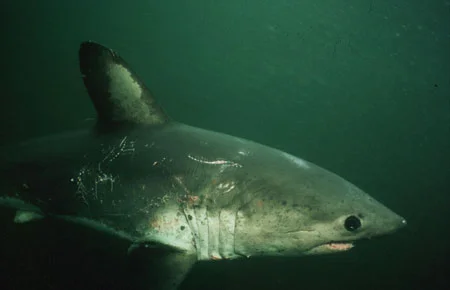
The skin is dusky gray above and paler below with white markings. A strong swimmer, it has a wide tail that has a double keel (a second, short ridge running along the upper part of the lower lobe of the tail). A double keel is unusual among sharks; the only other double-keeled tail is on the closely related porbeagle shark. Salmon sharks can grow to over 10 feet long, but the average is usually in the 6.5-8 ft range. Maximum recorded weights of salmon sharks are in excess of 660 pounds. Males mature at 5 years of age and females at 8–10 years. Salmon sharks have long gill slits and possess large teeth.
Diet: Salmon sharks feed on sea otters, birds, salmon, squid, sablefish, herring, walleye pollock, and a variety of other fish
Habitat & Range
The salmon shark is widely distributed in coastal and oceanic environments of the subarctic and temperate North Pacific Ocean. Their preferred temperature range is 2.5 to 24 degrees Celsius. They range across the North Pacific from the Bering Sea and the Sea of Okhotsk to the Sea of Japan in the western Pacific, and from the Gulf of Alaska to southern Baja California, Mexico, in the eastern Pacific. This species is most common in continental offshore waters, from the surface down to a depth of at least 500 feet, but it has been known to come inshore - sometimes just beyond the breaker zone.
Range: The salmon shark is widely distributed in coastal and oceanic environments of the subarctic and temperate North Pacific Ocean.
Life History
Growth and Reproduction
After spending the summer in the northern part of their range, the salmon shark migrates south to breed. In the western North Pacific they migrate to Japanese waters whereas in the eastern North Pacific, the salmon shark breeds off the coast of Oregon and California. Males mature at 5 years of age and females at 8-10 years. Salmon sharks breed in late summer to early autumn. The internal developmental period in salmon sharks last 9 months. Developing embryos will consume unfertilized eggs in the womb. The female give birth to live young. Once the sharks are born, they are completely independent, and they have to fend for themselves
Feeding Ecology As an apex predator, the salmon shark feeds on salmon, squid, sablefish, herring, walleye pollock, and a variety of other fish. They have been seen taking other prey including sea otters and marine birds. In 1998, Alaskan salmon sharks consumed twelve to twenty-five percent of the total annual run of Pacific salmon in Prince William Sound. Migration Salmon sharks are highly migratory, with segregation by size and sex, and with larger sharks ranging more northerly than young. Migration for the salmon shark is ultimately dependent on the concentration of the available prey species. Adult salmon sharks migrate alone or in loose groups of 30 to 40 individuals, following schools of Pacific salmon — including Sockeye ( Oncorhynchus nerka ), Pink ( Oncorhynchus gorbusha ), Chum ( Oncorhynchus keta ), and Coho ( Oncorhynchus kisutch ) — as they swim along the great arcs of current flowing off the coasts of northern Japan and the Kamchatka peninsula, the Aleutian Island chain, Alaska and British Columbia. There is an annual north-south movement of salmon sharks in both the eastern and western Pacific. Many salmon sharks feed in the coastal waters of the Gulf of Alaska, in particular Prince William Sound, home to Pacific salmon spawning grounds. Some of these sharks rapidly migrate southeast towards the west coast of Canada and the US; however, some remain in Prince William Sound and the Gulf of Alaska during winter months despite the colder temperatures.
Frequently Asked Questions
Size
Maximum weight is over 660 pounds; Maximum length is over 10 feet, but the average is 6-8
Lifespan
Maximum age is 25 years
Reproduction
Mating occurs in late summer to autumn. Females give live birth in the spring to 2-5 pups.
Did You Know?
Salmon sharks are capable of speeds up to 50mph.