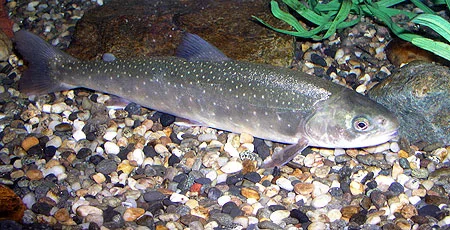
Char are generally distinguished from other salmonid fishes by having light spots on a dark background and by the lack of teeth on the shaft of the vomer (upper palate of the mouth). Arctic char are highly variable in color depending on environmental conditions within their lake of residence and time of year, but are generally brown to greenish-brown on their upper body and lighter on their lower body. They have sparse pink to red spots on their back and sides (15-20 below their lateral line) and typically, the leading edge of their lower fins are white. In spawning adults, especially males, the lower body and the lower fins are orange to red, with fins having a prominent white leading edge. Spawning colors are more exaggerated in males than in females.
In Alaska, Arctic char are often confused with a closely-related species, Salvelinus malma (Dolly Varden), since Dolly Varden have similar coloration and inhabit the same locations as Arctic char. In many cases, definitively distinguishing Arctic char from a Dolly Varden requires close examination of several body structures. Generally speaking however, Arctic char tend to have fewer and larger spots, a more deeply-forked tail, and a narrower caudal peduncle (the area before the tail fin) than Dolly Varden. Spawning Arctic char are usually gold, orange, yellow or rose and only infrequently red, while spawning Dolly Varden are usually red or pink on the lower abdomen with bright red spots. Spawning male Arctic char also have a much smaller kype (hooked lower jaw) than spawning male Dolly Varden.
Diet: Zooplankton, insects, other fish (including younger char)
Habitat & Range
Arctic char range across the northern polar regions and have been introduced into many European and North American Lakes.
Arctic char are found in lakes in the Brooks Range, the Kigluaik Mountains, the Kuskokwim Mountains, the Alaska Peninsula, Kenai Peninsula, Kodiak Island, and in a small area of Interior Alaska near Denali Park. Map
Range: Arctic/subarctic lakes from the Brooks Range to the Kenai Peninsula (Alaska). Lakes and rivers throughout the arctic and sub-arctic region, circumpolar.
Life History
Growth and Reproduction
Little is known about the life history of Arctic char in Alaska lakes. However, in other areas, char often exist in two different forms in the same lake. These forms are usually described as "dwarf' and "normal." The forms show differences in habitat and food selection, resulting in different growth rates, size at maturity, and average size. Growth is slow for Arctic char in Alaska's cold, often nutrient-poor lakes. Some arctic char have been known to live for over 20 years. Maximum size may vary greatly, depending on the productivity of the particular lake and the presence of other fish species. Fish over 10 pounds are not uncommon in some Alaska lakes, while other lakes may not produce fish over 2 pounds even though fish may reach great age. The largest Arctic char in Alaska probably occur in some of Bristol Bay's large lakes, where good fishing can be had from late May through early July when these fish congregate to feed on salmon smolts as they move toward the sea.
Spawning takes place in lakes between the fall months of August and October. Most char are ready to spawn between six to nine years and individuals usually spawn only every other year. Eggs are fertilized and deposited over jumbles of substrate or shoals of gravel. Spawning sites are also chosen based on water depth; thick ice can freeze to the bottom in shallower portions of lakes. In some lakes, pre-spawning char congregate near inlet streams or waterways connecting lakes, but they move back into the lake to spawn. Prior to spawning the female selects a location within the male's territory and begins to dig the spawning nest or redd. The male courts the female by circling around her. He then moves alongside her and quivers. The mating pair eject eggs and milt into the pit area and the fertilized eggs are deposited into the gravel. The fertilized eggs will hatch after 2 months, usually before the spring. Young arctic char begin to feed after emerging from the gravel.
Feeding Ecology
Arctic char feed on a variety of different food items from zooplankton and insects to other fish (including smaller char) depending upon the specific water body, their age and relative size, as well as time of year.
Migration
In Alaska, all known populations of Arctic char appear to spend their entire lives in lakes and do not migrate. Anadromous populations of Arctic char have not been observed in Alaska, although anadromous forms of the species do exist in on the Chukchi Peninsula and Kamchatka in far east Russia.
Frequently Asked Questions
Size
Highly variable depending upon lake environment, up to 38 inches and 15 lbs.
Reproduction
Spawn every 1-2 yrs, eggs laid in redds in broken substrates or gravel shoals
Did You Know?
The famous Swedish naturalist, Carlolus Linnaeus was the first to describe arctic char from an alpine lake in northern Swedish Lapland in 1758. He named the fishSalvelinus alpinus, or “alpine char”.