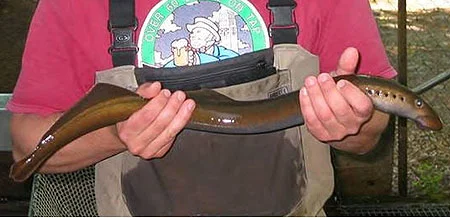
The Pacific lamprey is an eel-like fish up to 30 inches in total length. Pacific lampreys are distinguished from other Alaska lampreys by three large teeth on the supraoral bar and three sharp points on each of the central lateral tooth plates.
Adult Pacific lampreys are blue-black to greenish on the dorsal side and silver to white on the ventral side. Metamorphosis of Pacific lamprey from larval to juvenile life stage occurs gradually over time as juvenile lamprey develop eyes, teeth, and the ability to swim freely. During spawning, adult Pacific lamprey can appear to be reddish-brown in color.
Diet: Larvae are filter feeders of primarily detritus (but also occasionally diatoms and algae). Juveniles feed by attaching parasitically to various species of fish such as walleye pollock, Pacific cod, Pacific halibut, Pacific salmon and some sharks. They also feed off marine mammals such as sperm whales and humpback whales. Once back in freshwater to migrate upstream and spawn, adults do not feed.
Habitat & Range
In Alaska, Pacific lampreys are found from southeast Alaska north to the Bering Sea and Bristol Bay area drainages where currently the farthest north documentation of this species using freshwater in western Alaska is the Kuskokwim River. In southcentral Alaska,the Copper River and the Kenai Peninsula are well known watersheds or regions with Pacific lamprey populations. The Chilkat River is home to Pacific lamprey in southeast.
Range: The current map of the Pacific lamprey distribution in Alaska is based off an individual captured in the ocean off the coast of Nome, suggesting our understanding and representation of this species’ freshwater range here is misleading and should be shown with the Kuskokwim River being the northernmost documented freshwater habitat for the species. These maps are used by textbooks and other references, leading to some confusion regarding their freshwater habitats.
Life History
Growth and Reproduction
Pacific lampreys are anadromous which means it spends part of its life in the ocean and part of its life in fresh water. Anadromous Pacific lampreys may spend months moving to the cool, clear headwaters of streams to make their nests. Both males and females participate in nest building in stream riffles by removing small rocks with their mouths and fanning smaller particles with their tails. Males and females intertwine while simultaneously depositing sperm and eggs into the nest. Depending on her size, a single female can release up to 100,000 eggs. The adults die soon after spawning. The eggs hatch in freshwater in 2 to 4 weeks depending on the water temperature. Larval forms of lampreys are born without eyes and lack sucking mouthparts. Larval Pacific lampreys generally remain at this stage for three to eight years before metamorphosing into juveniles, which includes the development of a sucking mouth, eyes, and teeth. However, some Pacific lamprey populations may transform from larvae into juveniles in as little as 2 years or as many as 15 years.
Feeding Ecology
Larvae burrow into the silt or mud of shallow pools and eddies of clear streams and feed by filtering primarily detritus from the water. Juvenile Pacific lampreys parasitize other organisms such as fish, sharks, and whales using their sucking mouthparts to attach themselves to the host's body. They then use their teeth to cut through the scales and skin to get to the host's blood and body fluid. Recent research also suggests juvenile Pacific lamprey may have an alternative feeding strategy where they predate upon fishes as well. Once returned to freshwater, adults migrating upstream do not feed.
Migration
Parasitic juvenile Pacific lampreys migrate to the sea after metamorphosing from larvae and tend to spend about 18 months in the ocean before returning to freshwater to eventually spawn. Pacific lampreys have two different spawning migration strategies: so-called "ocean-maturing" fish migrate upstream and spawn (and die) in the same summer whereas "freshwater-maturing" individuals migrate into streams in the summer and fall before overwintering to spawn the following spring. Lampreys tend to migrate upstream in large groups and once upstream migration commences, lampreys do not feed.
Frequently Asked Questions
Size
The Pacific lamprey is the largest lamprey species in Alaska (second largest in the world), measuring up to 30 inches in length.
Reproduction
Some Pacific lampreys are thought to overwinter and remain in freshwater environment for up to one year before spawning while others migrate, spawn, and die in the same summer, much like Pacific salmon.
Did You Know?
Adult Pacific lamprey can be distinguished from other species of lamprey by the presence of three large teeth and posterior teeth on the oral disc.