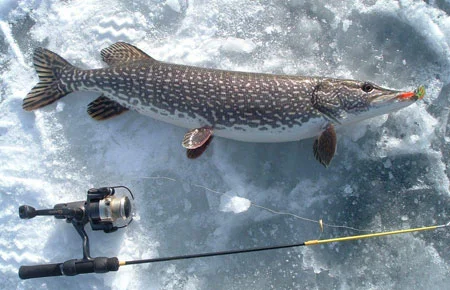
Northern pike have an elongated body and head, a broad, flat snout shaped somewhat like a duck bill. The jaws, roof of the mouth, tongue, and gillrakers are armed with many sharp teeth which are constantly replaced. A single soft-rayed dorsal (back) fin is located far back on the body.
Northern pike can be variable in color: a fish from a clear stream or lake will usually be light green, while a pike from a dark slough or river will be considerably darker. Males and females are similar in appearance but females live longer and attain greater size.
Fish up to 9 kilograms (~20 pounds) are common in some Alaskan rivers and lakes, though Northern pike can grow much larger. The state sport fishing record is a 17-kilogram (~38 pound) fish caught on the Innoko River, a tributary of the Yukon River.
Diet: Invertebrates, fishes, small mammals and waterfowl
Habitat & Range
Northern pike range from the Alaska’s Interior to the Arctic coast, from the Canadian border to the Seward Peninsula, and southwest to the Bristol Bay drainages. There is a small, isolated population near Yakutat. During recent years, illegally-stocked northern pike have established themselves in streams of the Susitna River drainage south of the Alaska Range as well as on the Kenai Peninsula.
Life History
Reproduction and Movements
Northern pike spawn in the spring of the year soon after the ice goes out. An 11-kilogram (~25 pound) female may contain up to 500,000 eggs which she deposits in the grassy margins of a lake shore, slow-moving stream, or slough. The eggs drop to the bottom where they stick to grass, rocks, or other debris. Because of the cold temperature of Alaskan waters, incubation may take 30 days.
Because ice-covered, shallow lakes become depleted of oxygen, most Northern pike overwinter in the deep, slow waters of large rivers. Spring migration from overwintering areas to spawning grounds and then to summer feeding areas are generally short distances. Movement during the summer is localized between warm, shallow feeding areas. In Interior Alaska, a 308 millimeter (12-inch) pike may be two to three years old. A 635 millimeter (25-inch), 2.5 kilogram (~5 pounds) pike may be six to eight years old. Fish 7 kilograms (~15 pounds) or more, may be 10 to 17 years of age.
Feeding Ecology
Young northern pike feed on small crustaceans and insects. By the time they reach 50 millimeters (2 inches) in length they may be eating smaller fish. Adult northern pike eat other fishes (mostly whitefishes but also suckers, burbot, smaller northern pike and juvenile salmon). Large adults can eat voles, shrews, red squirrels, and small waterfowl. A bald eagle chick, was found in the stomach of one large female.
Frequently Asked Questions
Size
Length to 4 feet, weight to 40 lbs.
Reproduction
Sexual maturity at 2-3 years, females can carry over 100,000 eggs
Did You Know?
Northern pike are found throughout the circumpolar north.