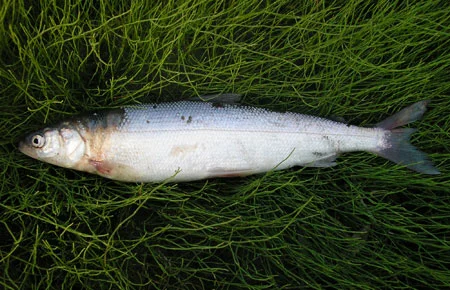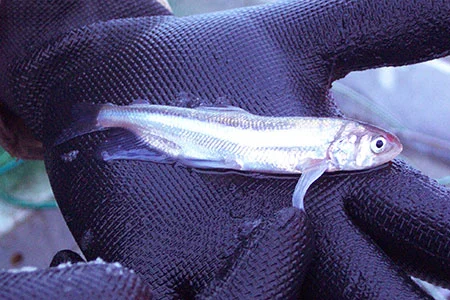
The longfin smelt is a small fish up to 6 inches in total length. Longfin smelts are distinguished from other Alaska smelts by a large eye and longer pectoral fins. The terminal mouth is equipped with moderately developed canine-like teeth and a protruding jaw.
Longfin smelt are generally pale olive brown dorsally and silvery white in color in salt water. Spawning male longfin smelt are generally darker than females with profuse stippling on the males’ back and along scale margins. Enlargement and stiffening of portions of the pectoral, pelvic, anal, and dorsal fins during spawning also serve to distinguish males from females.
Diet: Juvenile longfin smelt feed on crustaceans and insect larvae in freshwater.
Habitat & Range
In Alaska, longfin smelt are seasonally abundant in several drainages from Southeast Alaska, north to Prince William Sound and Cook Inlet and westward to Shelikof Strait in the Gulf of Alaska.
Range: Coastal marine waters from Southeast Alaska north to Prince William Sound.
Life History
Growth and Reproduction
Longfin smelt are anadromous which means it spends part of its life in the ocean and part of its life in fresh water. Longfin smelt spawn in freshwater streams. As the spawning season approaches, longfin smelt gather in large schools off the mouths of their spawning streams and rivers. Longfin smelt do not strictly “home” to a particular stream like salmon, but appear to use streams in the general area where they were spawned that have the best habitat conditions.
Longfin smelt spawning rivers are typically slow moving waterways since these fish are weak swimmers that cannot travel through long stretches of high water velocity. Spawning sites are in the lower elevations of the river or stream, but in some rivers with long flat deltas spawning sites may be many miles upstream. Eggs are "broadcast" over sandy gravel bottoms, once fertilized a sticky substance allows them to attach to sand particles. Their adhesive eggs, about 24,000 per female, attach to sand-gravel substrates, rocks, or aquatic plants. The eggs hatch in freshwater in 21 to 40 days, depending on the water temperature. After emerging from the eggs, young longfin smelt migrate downstream to salt water to grow to maturity in the sea. After two to three years at sea, they return as adults to spawn. After spawning, the majority of longfin smelt die.
Feeding Ecology
River currents carry newly hatched young to the sea where they feed mainly on copepod larvae and other plankton or insect larvae. As juveniles and adults, they feed mainly on small crustaceans, especially copepods, cumaceans, and euphausiids.
Migration
Since stream water temperature can affect the timing of the spawning migration, the numbers of spawning longfin smelt returning to a particular stream can vary greatly from year to year depending on stream water conditions and overall ocean survival. In Southeast Alaska, the main spawning migration can occur as early as April, while in Southcentral Alaska, longfin smelt have been observed returning to the Kenai River in late November through early December. Some streams can have two separate but overlapping migrations.
Frequently Asked Questions
Size
The longfin smelt is a small fish up to 6 inches in total length.
Reproduction
Female longfin smelt can produce up to 24,000 eggs and most longfin smelt die after spawning.
Did You Know?
The longfin smelt’s longer pectoral fins distinguish it from other species of smelt