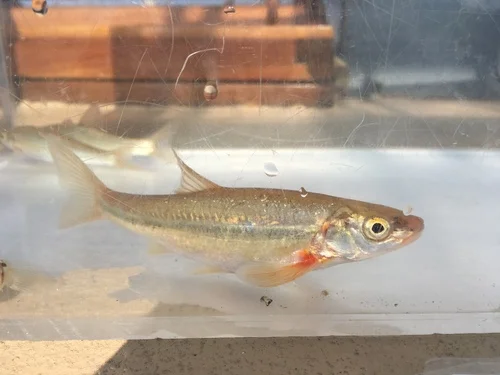
The lake chub (Couesius plumbeus) belongs to the largest freshwater fish family, the minnows (Cyprinidae), and is found only in North America. Its distribution is mostly throughout the northern part of the United States and into Canada. The lake chub is the only member of the minnow family that is found in Alaska. It is found throughout the Yukon River upstream of Nulato and in its tributaries, which include the Koyukuk, Tanana, and Porcupine drainages.
The lake chub has an elongate, slender body with a rounded snout. Adult lake chubs average from 5 to 10 cm long (2 to 4 inches). It has a fairly small mouth with the upper jaw protruding past the lower jaw. It lacks normal teeth, but has well developed pharyngeal teeth (teeth in the pharynx area, which is the beginning of the digestive tract) that are used by pressing food against a hard pad of cartilage. The fins are spineless and the tail is moderately forked with rounded lobes. The lake chub has a relatively large eye and a complete lateral line. The upper body is brown to green with a silvery abdomen. There is a distinct dark band along the sides, and sometimes there are dark specks on the sides and abdomen. Although not documented in Alaska, in other parts of its range orange patches on the side of the head and the base of the pectoral fins are present during the spawning season. Fine tubercles (small bumps) develop on the head, on the back up to the dorsal fin, and on the pectoral fins in breeding adults, but are more pronounced in males. One distinguishing feature of the lake chub is a barbel (a small, fleshy projection) located at the corners of the mouth. It is unknown whether the barbel has any function. The lake chub belongs to a group of fish (Cypriniformes, which also include the longnose sucker) that have a unique feature called the Weberian apparatus. The Weberian apparatus is made up of four to five modified vertebrae in the head that connect the ear to the swim bladder, which aids in sensing sound and pressure changes. Life History: The spawning period of the lake chub occurs between spring and early summer. Lake chubs move to shallow water of rivers and streams that have rocky or gravelly bottoms. Unlike salmon, no redds, or nests, are constructed for the eggs. Instead, the yellowish eggs fall into crevices in-between the gravel. Neither males nor females guard the eggs after fertilization. The eggs hatch about 10 days after fertilization. It is thought that the lake chub is sexually mature at age 3 or 4 and that it lives to an average age of 5 years old. Not much else is known of the life cycle. Habitat: The lake chub is found in all types of freshwater bodies (lakes and streams), but in Alaska it has been found more often in silty waters. It tends to prefer shallow water, although it will move to deeper water during hot weather. The lake chub is usually abundant wherever it is found. Food Habits: Young lake chubs feed primarily on zooplankton. Older lake chubs feed on terrestrial and aquatic insects, but also feed on algae, occasionally small fishes, and have been known to scavenge on decaying fish. The lake chub is an excellent food source for larger fish and some birds. Text: Kelly Mansfield Illustration: Kelly Mansfield 2004