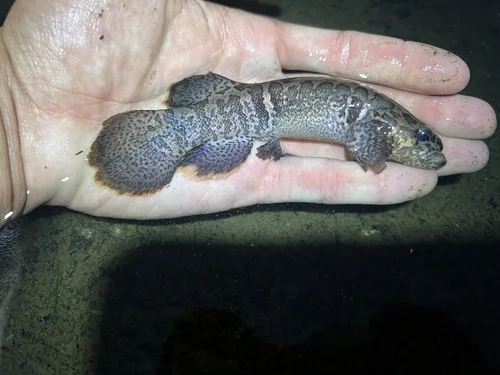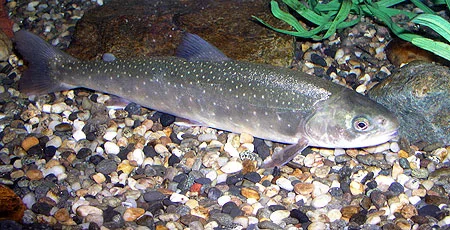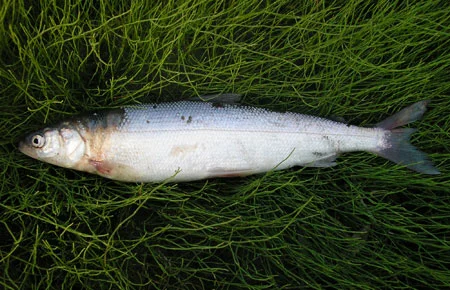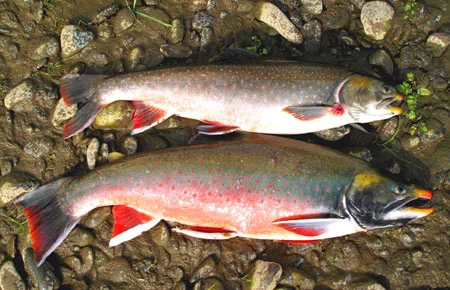
Though similar to, and often confused with, trout, Dolly Varden are actually a char ( Salvelinus sp). To tell a char from a trout, look at their spots—char have light spots (white or yellow to red) on a dark body, while trout have dark spots (brown to black) on a light body.
There are two forms of Dolly Varden in Alaska, which differ in number of vertebrae (62–65 for southern form and 66–70 for northern form) and in number of chromosomes (82 for southern form and 78 for northern form). In addition, northern form Dolly Varden can attain a much larger size (up to 27 pounds) than southern-form fish. The southern form ranges from Southeast Alaska throughout the Gulf of Alaska to the south side of the Alaska Peninsula and the Aleutian and Kodiak islands. The northern form ranges from the north side of the Alaska Peninsula northward to the Mackenzie River in Canada, and in the Susitna drainage in Southcentral Alaska. Both freshwater-resident and sea-run populations occur in both the northern and southern forms. Freshwater-resident Dolly Varden are often dwarfed (maturing at 3–6 inches), and are most-commonly found in small headwater streams without easy access to the ocean, or in land-locked lakes and ponds. Dolly Varden may also choose to remain in fresh water if they have access to a large, productive lake or river, in which they may grow to a similar size as sea-run Dolly Varden.
Diet: Insects, crustaceans, various fish species and eggs, and rodents.
Habitat & Range
The Dolly Varden is one of the most widely-distributed salmonids in Alaska. It occurs throughout the coastal areas of the state from Southeast Alaska across the Gulf of Alaska and the Bering Sea into the Beaufort Sea to the Mackenzie River in northern Canada. It also occurs in streams in Interior Alaska and the Brooks Range. Elsewhere, their range stretches along the Pacific coast of North America from Washington State to the Arctic coast of Canada, and along the Pacific coast of Russia south to Japan and Korea.
Freshwater habitats of Dolly Varden range from the smallest headwater stream (often less than 3 feet wide) to large deep lakes. Saltwater habitats range from brackish estuaries to fully-marine shoreline environments, and occasionally the open ocean. Dolly Varden spend winters in lakes (southern form) or rivers (northern form). Entire populations of freshwater-resident Dolly Varden may spend their entire life cycle within a single stream, and during the winter, the entire population may reside at a single springs.
Range: Statewide, especially in coastal areas, but also in streams of Interior Alaska and the Brooks Range.
Life History
Growth and Reproduction
Dolly Varden grow slowly in Alaska, maturing in 5–6 years at a length of 12–16 inches for the southern form, and 5–9 years at a length of 16–24 inches for the northern form. Dwarf, freshwater-resident forms mature earlier (age 2–4) and at a much smaller length (3–6 inches). Southern form Dolly Varden rarely live longer than 8 years, reaching sizes of up to 28 inches and 10 pounds. Northern form Dolly Varden live up to 16 years and reach sizes of over 30 inches and 20 or more pounds.
Unlike pacific salmon, Dolly Varden are capable of spawning multiple times during their lives, but they rarely survive to spawn more than 3 times. Depending on food availability, adults, particularly in the northern form, may skip a year or two between spawning events.
Dolly Varden spawn in the fall, between September and November, over gravel beds in small headwater streams or occasionally in larger rivers. The female, depending on her size, will deposit 600–6,000 eggs (2,500–10,000 in the northern form) in nests (redds), which she digs in the streambed gravel with her tail while turned on her side. As the female deposits eggs, one or more males simultaneously fertilize them.
The fertilized eggs (embryos) remain in the gravel for 4–5 months, depending on water temperature, prior to hatching. Hatchlings (alevin) remain in the gravel for an additional month or two, while absorbing nutrients from the yolk sack and continuing their development. Juveniles (fry) usually emerge from the gravel in April–May (southern form) or June (northern form) and disperse into slowly-flowing areas along stream margins.
In May or June of their 2nd–4th year in freshwater, some young Dolly Varden (now called smolts) prepare to enter saltwater. To accomplish this transition, they change many aspects of their bodies, including color (lose parr marks and become silvery), shape, physiology, and behavior. They spend the summer feeding at sea and growing rapidly, then return to freshwater to spawn and spend the winter.
Feeding Ecology
Dolly Varden are carnivorous, feeding opportunistically on a variety of prey. Prey species and feeding techniques vary greatly between regions, habitat types, and seasons, depending on food availability. Juveniles feed primarily on the stream bottom in slow-flowing areas near the banks. Their diet often consists mostly of winged insects and the larvae of mayflies and midges. As they grow, Dolly Varden redistribute to deeper pools and eddies where they eat crustaceans, salmon eggs, and small fish, in addition to insects.
In the spring, sea-run Dolly Varden continue feeding while migrating to salt water, during which time they also eat outmigrating salmon fry where available. In the ocean, Dolly Varden range from near-shore habitats to the open ocean and feed on amphipods and small fish such as juvenile salmon and sandlance. Sea-run Dolly Varden are also known to follow salmon into rivers in order to feed on their highly-nutritious eggs.
Dolly Varden have been much maligned as a predator of salmon. From 1921 to 1941, there was a bounty on Dolly Varden in Alaska. It was terminated when analysis of the 20,000 tails submitted for payment in 1939 revealed that more than half were from coho salmon, and of the remainder, more were from rainbow trout than were from Dolly Varden.
Although Dolly Varden do eat salmon eggs and salmon fry, they have not been found to be significant predators in areas where their feeding habits have been studied. They primarily eat drifting salmon eggs that would not have hatched anyway. They are more of a scavenger than a predator. In fact, they perform a beneficial hygienic function, eating dead or fungus-infected eggs that could infect the entire redd.
In cases where they eat salmon fry, Dolly Varden primarily feed on pink salmon. Their ability to capture these is directly related to fry abundance. Thus, more fry are eaten when large numbers are available, and the overall effect on the salmon population is less significant. When other fish such as Arctic char, cutthroat trout or young coho salmon are present, Dolly Varden have always been shown to be the least effective predator.
Migration
Dolly Varden migration patterns are highly variable. Most southern-form Dolly Varden spend winters in lakes, while the northern form usually overwinter in rivers or springs. While at sea, Dolly Varden generally stay near shore, but may travel long distances along the coast, frequently ascending rivers to feed or to find a suitable place (lake or river) to spend the winter. The movement of a Dolly Varden between North America and Russia (over 1000 miles) is the greatest distance documented.
After feeding at sea during the summer, southern-form Dolly Varden whose home stream has an attached lake usually return to that same lake each winter. However, southern-form fish originating from a stream without a connected lake must find a lake in which to over-winter.
Northern-form Dolly Varden in Northwestern Alaska exhibit two different life-history types and are commonly referred to as summer and fall spawners. These two types differ greatly in the time they spend in freshwater before and after spawning. Summer spawners remain in freshwater about 20 months, while fall spawners remain about nine months.
Frequently Asked Questions
Size
Over 30 inches and up to 27 pounds
Reproduction
Annually (especially southern form), may skip spawning some years (especially northern form).
Did You Know?
A dwarf form (maturing at about 3–6 inches long) of stream-resident Dolly Varden is common in steep headwater streams statewide. The adults retain parr marks (which normally disappear on sea-run Dolly Varden by their first seaward migration).