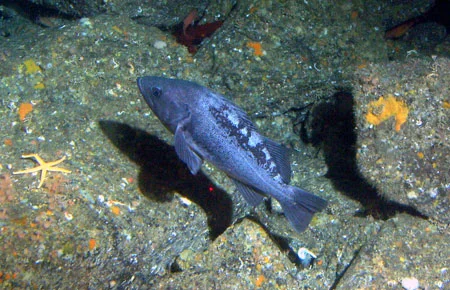
Adult black rockfish ( Sebastes melanops ) have a mottled gray-black body often with dark stripes from the eye to the gill plate. These fish are characterized by having a bass-shaped body, a large mouth, and spinous dorsal fin. The spines are venomous and may cause pain or infection; however, are not extremely toxic. Black rockfish may be distinguished from similar species, such as dark ( S. ciliatus ) and dusky ( S. variabilis ) rockfish, by the white belly and lack of pores or knob on the lower jaw. Adults may reach a maximum weight of 5 kg (11 lbs) and maximum length of 69 cm (27.6 in) with females reaching larger sizes than males. Newly settled black rockfish may be orange to dark brown in coloration, and older juveniles are mottled gray and black with a black spot on the posterior portion of the spinous dorsal fin.
Diet: Zooplankton, crab larvae, and fish such as herring and sand lance
Habitat & Range
Black rockfish range from Amchitka Island in the Aleutian Islands to southern California. They are also rarely observed around the Pribilof Islands.
Black rockfish occur in the waters above the continental shelf at the surface to depths of 366 m, but usually are found in water shallower than 150 m. Generally, when black rockfish are observed at the surface they are in feeding aggregations. Black rockfish are found in rugged, rocky habitat, often above pinnacles and/or in high current locations. Black rockfish are considered a pelagic rockfish species and are generally found in large schools in the water column; however, they are also observed to rest on the bottom. They are observed to school with other species such as yellowtail, widow, or dusky rockfish.
Range: Aleutian Islands to southern California and rare occurrences around Pribilof Islands
Life History
Growth and Reproduction
In Alaska, black rockfish become sexually mature at 6 to 8 years of age (38–42 cm). Black rockfish produce between 125,000 to 1,200,000 eggs per season. After mating, females will store sperm for several months until fertilization. Larvae are released alive from January to May along the Pacific coast. Black rockfish live to about 50 years.
Feeding Ecology
Black rockfish are an opportunistic predatory fish that typically feed in the water column on zooplankton, Dungeness crab larvae ( Cancer magister/ syn. Metacarcinus magister ), and fish species, such as herring ( Clupea harengus ), sand lance ( Ammodytes hexapterus ), and Puget Sound rockfish ( Sebastes. empheaus ). However, they may also feed on benthic species such as crustaceans and octopi.
Predators of young black rockfish include sablefish ( Anoplopoma fimbria ), Pacific halibut ( Hippoglossus stenolepis ), other fish species, and pigeon guillemot ( Cepphus columba ).
Migration
Black rockfish are more mobile than many other rockfish species. However, acoustic tagging studies performed in Oregon indicate they have a small home range of about 0.55 square km. Black rockfish may take trips outside their home range during the reproductive season or to take advantage of food available seasonally. Tagging studies performed in Alaska indicate an average distance of 4 km travelled from release to recovery location. In addition, acoustic tagging studies indicate that black rockfish perform vertical migrations, often with sunrise or sunset.
Frequently Asked Questions
Size
Maximum weight of 5 kg (11 lbs) and maximum length of 69 cm (27.6 in)
Reproduction
Black rockfish give birth to live young after internal fertilization
Did You Know?
Rockfish have venomous spines, though their venom is relatively mild and seldom causes more than minor pain or swelling.